

What Is Dropshipping
Anyone looking for simple and riskless ways to start an online business has probably heard about dropshipping. People want more from life: more ways to make a living and more opportunities for their loved ones. Working a regular 9 to 5 job isn’t the goal anymore: now everyone is seeking something that can provide a steady income and free them from the usual daily routine. These kinds of opportunities are possible with dropshipping.
So, what does dropshipping mean?
Simply put, dropshipping allows you to sell products without the need to handle inventory or shipping yourself. You simply resend the order to a supplier who takes care of fulfillment!

What is dropshipping?
Dropshipping in simple terms is a business model where you sell products online without holding any inventory. Instead of keeping stock, a third-party supplier takes care of the shipping directly to your customer. When someone places an order, you purchase the item from the supplier, who then handles everything from packaging to delivery.
The main advantage of dropshipping is that there’s no need to invest in inventory upfront. You only pay for the product once you’ve made a sale, making it a low-risk way to start an online business without the worries of storage or large initial costs.
How does dropshipping work?
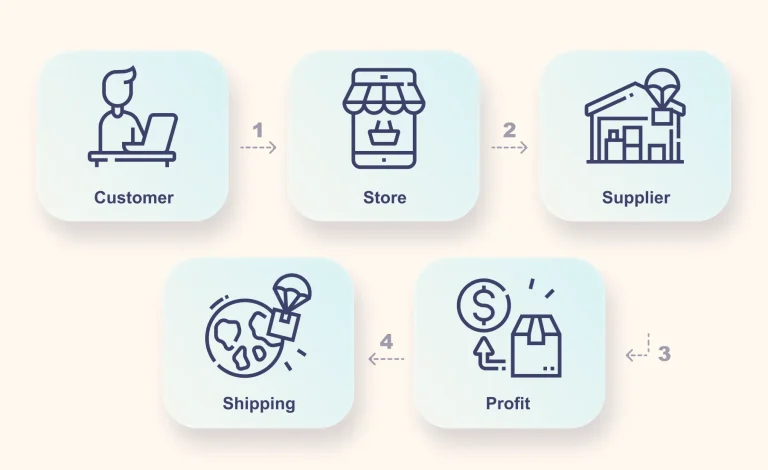
This simple business model can be adopted by anyone. Here’s the general idea of how dropshipping works:
1️⃣ Select a niche for your dropshipping business.
2️⃣ Develop a website for your online store or acquire a ready-made one.
3️⃣ Find a dropshipping supplier to partner with and select products that match your niche.
4️⃣ Upload products with optimized descriptions and media to your store catalog, set the price for every item (use the pricing formula for precision).
5️⃣ When customers order something from your online store, purchase the item from the dropshipping supplier you’ve chosen (note that this process can be automated).
6️⃣ The packaging and delivery process is the responsibility of the dropshipping supplier.
7️⃣ Your profit is the difference between the price of the product on the dropshipping supplier’s store and the price you set on your online store.
This process makes it easier to run an online store without the hassle of managing inventory or handling shipping yourself.
What does dropshipping mean for newcomers to ecommerce?
Dropshipping is a business model with limited downsides, making it an ideal choice for newcomers, regardless of education, background, etc. It’s easily accessible to everyone because it doesn’t require a significant upfront investment or a need to manage inventory. For someone just starting out, dropshipping offers a low-risk opportunity to create your own dropshipping business and learn the ropes of ecommerce.
The beauty of this model lies in its simplicity – it allows you to focus on growing your online store while a third-party supplier handles the product inventory and shipping. In essence, you can dive into the dropshipping business without worrying about the complexities that come with traditional retail.
Not only does it provide a way for newcomers to get familiar with ecommerce business practices, but it also opens up an accessible path to entrepreneurship. This is especially beneficial for those looking to quickly get accustomed to the ins and outs of running a business online. With the right tools and mindset, anyone can leverage dropshipping as a stepping stone into the larger world of ecommerce.

The key benefits of starting a dropshipping business
Dropshipping has revolutionized the way entrepreneurs approach e-commerce. By removing the traditional barriers to entry, it offers a unique set of advantages that make it an attractive model for both beginners and seasoned business owners.
1. Minimal upfront capital required
The biggest advantage of dropshipping is that you don’t need to invest thousands of dollars in inventory upfront. In a traditional retail model, businesses have to purchase stock before they even make a sale. With dropshipping, you only buy the product once a customer has already paid you, significantly reducing your financial risk.
2. Low overhead costs
Since you don’t have to deal with purchasing inventory or managing a warehouse, your overhead expenses are remarkably low. Many successful dropshipping stores are operated as home-based businesses, requiring little more than a laptop and a few recurring software subscriptions to run.
3. Location independence
A dropshipping business can be managed from anywhere with an internet connection. As long as you can communicate with suppliers and customers easily, you can run your store from a home office, a coffee shop, or while traveling the world.
4. Wide selection of products
Because you don’t have to pre-purchase the items you sell, you can offer a massive variety of trending products to your customers. If a supplier stocks a new item, you can list it on your website almost instantly at no additional cost.
5. Easy to scale
In a traditional business, if you receive three times as much business, you usually need to do three times as much work (and hire more staff). With dropshipping, the work of processing additional orders is largely borne by the suppliers. This allows you to scale your business rapidly with much less growing pains than a traditional retail setup.
6. Flexibility to test and pivot
If a particular niche or product isn’t performing well, you aren’t stuck with boxes of unsold inventory. You can simply remove the product from your store and try something else. This flexibility allows you to follow market trends in real-time and find the most profitable products through trial and error without significant loss.
Navigating the challenges: Drawbacks of dropshipping business
While the advantages of dropshipping make it one of the most accessible paths to entrepreneurship, like any business model, it comes with a few unique challenges. However, for the proactive entrepreneur, these are less like “roadblocks” and more like manageable hurdles that pale in comparison to the massive upside of the model.
1. Slimmer profit margins in competitive niches
Because it is so easy to get started, some popular niches can become crowded, which may lead to price competition. However, this is easily navigated by focusing on high-quality marketing, building a strong brand identity, and selecting unique “problem-solving” products. When you provide a premium customer experience, you can command higher prices that more than compensate for the low overhead costs.
2. Less control over the supply chain
Since you aren’t physically handling the products, you rely on your partners for quality control and shipping speeds. While an occasional shipping delay can occur, this is a small trade-off for not having to manage a warehouse yourself. By vetting your suppliers and maintaining open lines of communication, you can build a reliable fulfillment network that functions like a well-oiled machine.
3. Shipping complexity with multiple suppliers
If a customer orders three different items that come from three different suppliers, you may incur separate shipping charges. While this requires some initial strategic planning regarding your shipping rates, it is a minor logistical puzzle compared to the immense cost and burden of storing, packing, and mailing those items yourself.
Ultimately, these challenges are simply the “cost of entry” for a business that offers unparalleled freedom and low risk. Compared to the heavy debt and overhead of traditional retail, these few drawbacks are a small price to pay for the ability to build a global brand from your laptop.
How to start a dropshipping business: A step-by-step guide
Starting a dropshipping business is one of the fastest ways to enter the world of ecommerce, but success requires a strategic approach. Follow this proven roadmap to move from an idea to your first sale.
Step 1: Choose your niche and target audience
The “shotgun” approach rarely works in dropshipping. To stand out, you need to specialize.
- Identify your passion or interest: It’s easier to market products you understand.
- Conduct market research: Use tools like Google Trends or Pinterest Trends to see what’s gaining momentum.
- Solve a problem: Look for products that address a specific pain point for a defined group of people (e.g., ergonomic home office gear for remote workers).
Step 2: Perform competitive analysis
Before committing to a product, see who else is in the arena.
- Check the giants: Look at Amazon and Etsy to see high-volume sellers and read customer reviews to find gaps in their service.
- Analyze social media: Search for your product on TikTok and Instagram. If you see high engagement on ads for similar products, it’s a sign of a healthy market.
Step 3: Find and vet reliable suppliers
Your supplier is your most important business partner. Their performance directly impacts your brand’s reputation.
- Platforms: Explore directories like AliExpress, or Salehoo to connect with manufacturers.
- Order samples: Never sell a product you haven’t held in your hands. Check for quality, packaging, and shipping speed.
- Communication: Message potential suppliers to see how quickly they respond. Clear communication is vital when issues arise.
Step 4: Build your ecommerce store
You don’t need to be a developer to create a professional storefront.
- Choose a platform: Shopify is the industry standard for dropshipping due to its app ecosystem, while AliDropship is an ecosystem itself that offers turnkey solutions for beginners.
- Focus on UX: Ensure your site is mobile-responsive, as over 50% of ecommerce traffic happens on phones.
- Write compelling copy: Don’t just copy-paste the manufacturer’s description. Write original content that focuses on the benefits to the customer.
Step 5: Master the art of marketing
A beautiful store is useless if nobody sees it. Your goal is to drive high-quality traffic.
- Short-form video: Platforms like TikTok and Instagram Reels are currently the most cost-effective ways to get “viral” reach for dropshipping products.
- Influencer marketing: Partner with “micro-influencers” in your niche to build immediate trust with a targeted audience.
- Paid ads: Once you find a winning product, use Facebook or Google Ads to scale your reach.
Step 6: Optimize and scale
Once the orders start rolling in, your job shifts to optimization.
- Analyze data: Which products have the highest return rate? Which ads are underperforming?
- Automate: Use apps to automate order fulfillment so you can focus on brand building.
- Expand: Once one niche is profitable, consider adding complementary products to increase your Average Order Value (AOV).
By following these steps, you transform dropshipping from a “side hustle” into a scalable, professional brand.
How to choose the right dropshipping suppliers
In the dropshipping model, your supplier is more than just a vendor—they are your fulfillment department, your quality control team, and your logistics manager. Because they handle the product and shipping, your brand’s reputation is entirely in their hands. Here is how to find and vet the best partners for your business.
1. Key criteria for a top-tier supplier
Before you look at specific names, you must know what “good” looks like. Evaluate every potential partner against these four pillars:
- Manufacturing quality: Low prices are tempting, but poor quality leads to returns and bad reviews. Always order samples to test the product’s durability and appearance.
- Shipping efficiency: In the age of Amazon Prime, customers expect speed. Look for suppliers with local warehouses (e.g., US or EU based) or those who use tracked, expedited shipping methods.
- Customer support: When a package goes missing, you need an answer immediately. Test a supplier by asking technical questions before signing up; if they take more than 24 hours to respond, move on.
- Technological integration: The best suppliers offer data feeds that sync with your store to update inventory levels in real-time, preventing you from selling out-of-stock items.
2. Red flags to avoid
Be wary of companies that exhibit the following:
- Monthly membership fees: Most legitimate wholesale suppliers do not charge a monthly fee just for the privilege of doing business with them. If they do, they might be a “middleman” directory rather than a true supplier.
- Lack of tracking information: If a supplier cannot provide a tracking number for every order, they are not equipped for modern e-commerce.
- Generic packaging: Ensure they don’t include their own marketing materials or invoices inside the box, which confuses your customers.
3. Prominent dropshipping suppliers
Depending on your niche and technical needs, these are the most reliable players in the market today:
AliExpress & AliDropship
AliExpress is the “giant” of dropshipping, offering millions of products at factory prices. AliDropship is a powerful automated solution designed specifically for those using WordPress or WooCommerce. It allows you to import products directly from AliExpress and automates the entire order fulfillment process.
- Best for: Entrepreneurs who want a turnkey solution and opportunity to start their business immediately.
Spocket
Spocket specializes in original suppliers from the US and EU. This allows for significantly faster shipping times (usually 3-5 days) compared to overseas options.
- Best for: High-quality brands focusing on the Western market and faster delivery.
Zendrop
Zendrop was built specifically by dropshippers to solve common sourcing issues. They offer “Thank You” cards, custom branding, and a much more reliable support system than traditional marketplaces.
- Best for: Scaling a “winning” product into a legitimate, branded business.
CJDropshipping
CJDropshipping offers a unique hybrid model. They have their own warehouses globally and can source specific products for you upon request. They also provide “Print on Demand” and professional product photography services.
- Best for: Experienced sellers who want a “one-stop shop” for global sourcing and custom fulfillment.
Printful / Printify
If you are in the “Print on Demand” niche (custom t-shirts, mugs, posters), these are the gold standard. They handle the manufacturing and shipping only when an order is placed.
- Best for: Creative entrepreneurs, artists, and designers.
4. The “Golden Rule” of Vetting
Never rely on a single supplier for your entire business. Always have a “Backup Supplier” identified for your best-selling items. If your primary partner runs into supply chain issues or shipping delays, you can pivot immediately without having to pause your store.
5 Common Dropshipping Mistakes to Avoid
Even with the best suppliers, many stores fail due to avoidable errors in strategy. Keep these in mind as you launch:
- Chasing “saturated” niches: Beginners often flock to trendy items (like fidget spinners or generic phone cases) that are already flooded with competition. Aim for niches with high “passionate” engagement but lower direct competition.
- Relying on a single supplier: If your only supplier goes out of stock or gets banned, your business stops. Tools like AliDropship allow you to find alternatives on AliExpress; always have a “Plan B” vendor for your top three sellers.
- Ignoring the “customer experience”: Dropshipping is often viewed as a hands-off business, but customer service is your responsibility. Failing to provide tracking numbers or slow response times to emails will lead to payment disputes and store closures.
- Underestimating shipping times: Be transparent. If a product takes 15 days to arrive, state it clearly. Trying to hide long shipping times leads to angry customers and chargebacks.
- Competing only on price: There will always be someone willing to sell for $0.10 less. Instead of a “race to the bottom,” compete on better branding, superior product descriptions, and curated collections.

What is AliDropship?
AliDropship is a user-friendly platform that provides you with turnkey ecommerce solutions, making dropshipping smooth and hassle-free – from sourcing products to fulfilling orders. It takes care of technical stuff and fulfillment, so you can focus on sales, marketing, and growing your business without stress. ✨
Why choose AliDropship as your dropshipping partner?
AliDropship is packed with features designed to make your dropshipping journey easier and more efficient. Here’s what makes it stand out:
⚙️ Powerful automation
Automate essential tasks like product importing, order processing, and inventory tracking. Save time and focus on scaling your business without getting stuck in manual work.
🛍️ High-profit “winning” product database
The ecosystem provides access to a curated database of thousands of products that have been manually vetted for high profit potential and shipping reliability. You aren’t just guessing what might sell; you are leveraging data-backed insights from stores already succeeding in the ecosystem.
🔄 Seamless AliExpress integration
Effortlessly connect with AliExpress suppliers and access a huge variety of high-quality products. Real-time updates ensure accurate pricing, stock levels, and product details – eliminating the need for manual inventory management.
🎨 Turnkey solutions
The platform offers turnkey solutions for your business: pre-built store, pre-selected products catalogue, tried and tested marketing campaigns, whatever you might need for your business setting up and growth.
🤝 Comprehensive support
Whether you’re just starting with dropshipping or already an experienced seller, AliDropship offers tutorials, guides, and a dedicated support team to help you every step of the way.
🎯 Free trial
AliDropship provides you with an access to its ecosystem for free giving you a turnkey dropshipping store ready to sell from day 1. You won’t have to spend half of your free trial period on figuring out how to set up your store (unlike with other platforms), your store is already pre-built and comes entirely for free even after trial ends (if you subscribe to AliDropship after trial ends, hosting, domain and SSL included).
🌎 Global reach
Sell to customers worldwide with support for multiple languages and currencies. Expanding into international markets has never been easier.
📢 Built-in marketing tools
Increase your store’s visibility with SEO optimization, email integration, and social media tools designed to drive traffic and boost sales.
📚 Community & educational resources
Join a thriving community and access valuable resources like blogs, forums, and webinars to stay ahead with trending products and smart marketing strategies.
AliDropship makes launching and managing your dropshipping business simple with powerful automation, customization, and marketing tools. Whether you’re selling locally or globally, this platform gives you the flexibility and reliability to grow your online store. Start today and bring your business idea to life! 🚀
Are you ready to become an owner
of a profitable online business?
Free Dropshipping Guide