

DeepSeek AI
If you feel like the AI world changes every single week, you aren’t wrong. However, every few years, a “disruptor” arrives that changes the rules for everyone. For ecommerce store owners, DeepSeek is that disruptor.
We will break down what this technology is, why it is costing tech giants their sleep, and – most importantly – how you can use it to sell more products while spending less on software.
The new frontier of open-source AI
What is DeepSeek?
DeepSeek is an artificial intelligence research company based in Hangzhou, China. While companies like OpenAI (creators of ChatGPT) and Google keep their most powerful “recipes” secret, DeepSeek AI has taken a different path. They focus on open-source (or “open weights”) models.
In simple terms: DeepSeek gives the world the “blueprints” for high-level AI. This allows developers and business owners to run powerful AI on their own terms without being locked into expensive monthly subscriptions.
The paradigm shift
Until recently, the common belief was that you needed billions of dollars and tens of thousands of expensive computer chips to build a smart AI. DeepSeek proved this wrong. By using smarter math and more efficient training methods, they created models that match or beat GPT-4o while using a fraction of the energy and money.
Why this matters for ecommerce
If you run an online store, you know that margins are everything. You are likely already paying for tools to write product descriptions, handle customer chats, and manage your SEO.
The problem: These tools get expensive as you scale.
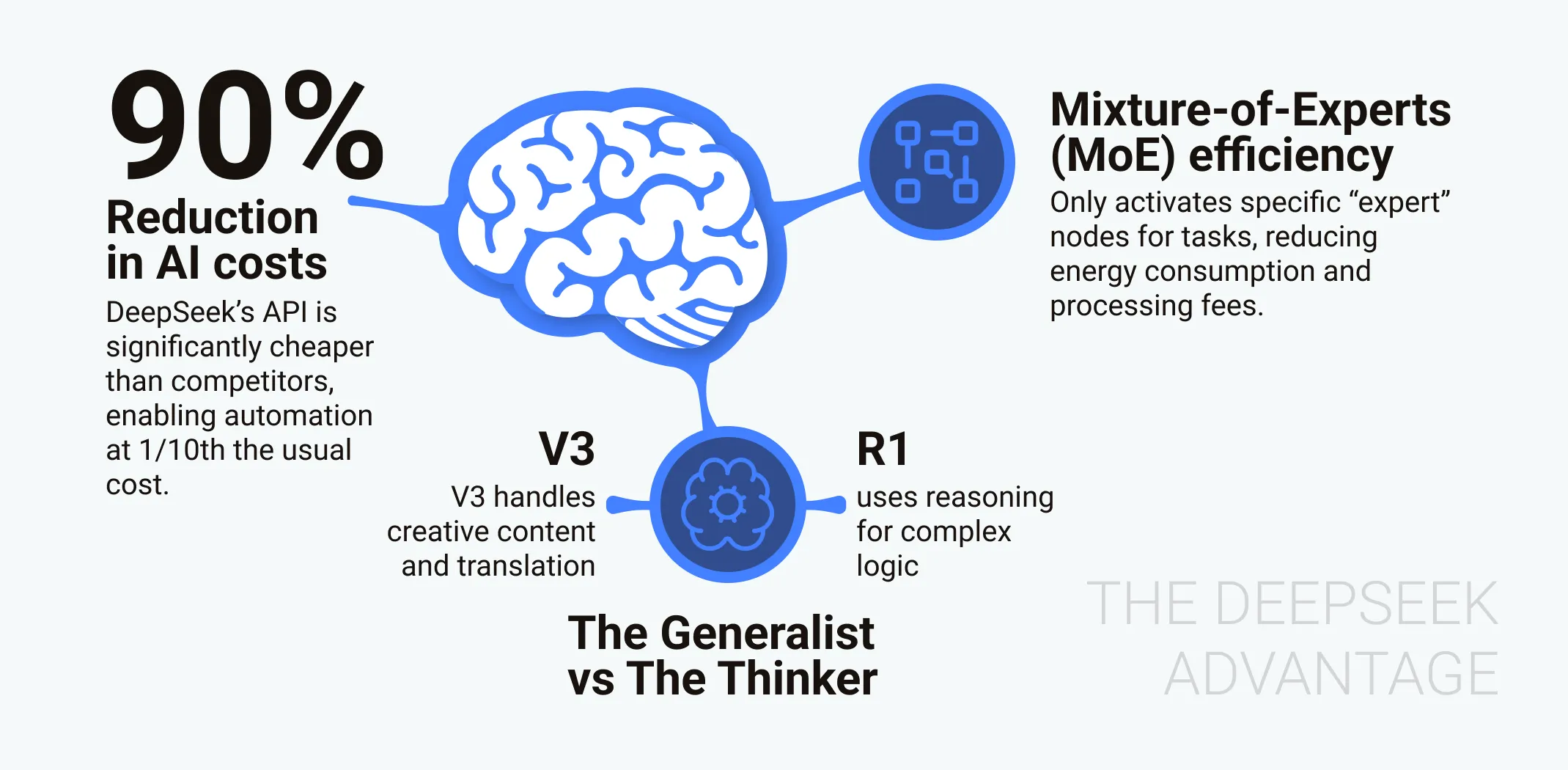
The DeepSeek solution: Because DeepSeek is so much cheaper to run, it allows you to automate your entire store – from supply chain logic to Instagram captions – at about 1/10th the cost of previous AI models.

The technical core: Why DeepSeek is different
You don’t need to be a computer scientist to use DeepSeek, but understanding these two concepts will help you choose the right tool for your store.
Mixture-of-Experts (MoE) explained
Imagine you have a massive warehouse with 600 workers. In a traditional AI model, every time a customer asks a question, all 600 workers wake up and start working. This is slow and expensive.
DeepSeek AI uses a “Mixture-of-Experts” (MoE) architecture. When a task comes in, the system only wakes up the two or three experts who are best suited for that specific task.
The result: You get a brilliant answer, but you only pay for the energy of a few workers. This is why DeepSeek’s API (the “plug” that connects AI to your website) is significantly cheaper than its competitors.
DeepSeek-V3 vs DeepSeek-R1
DeepSeek offers different “flavors” of AI. For a store owner, you will mostly interact with these two:
- DeepSeek-V3 (The Generalist):
Best for: Writing blog posts, translating product listings into 10 languages, and creating social media schedules.
Vibe: Quick, creative, and very easy to talk to.
- DeepSeek-R1 (The Thinker):
Best for: Complex math, coding a new feature for your website, or solving a shipping logic puzzle.
Vibe: It “thinks” before it speaks. You will actually see it “reasoning” through a problem step-by-step.
Comparison: DeepSeek vs the giants
While the “giants” offer incredible polished ecosystems, DeepSeek provides the raw power and flexibility that allows smaller shops to compete with Amazon-level automation.

DeepSeek for ecommerce: Strategic applications
Now, let’s get practical. How does this actually make you money?
Hyper-personalized product recommendations
Most stores use basic logic for recommendations (e.g., if they buy a lamp, show them a lightbulb). DeepSeek can handle Deep Logic.
Example: DeepSeek can analyze a customer’s past five purchases, look at the current fashion trends in their specific city, and suggest an outfit that feels curated by a personal stylist.
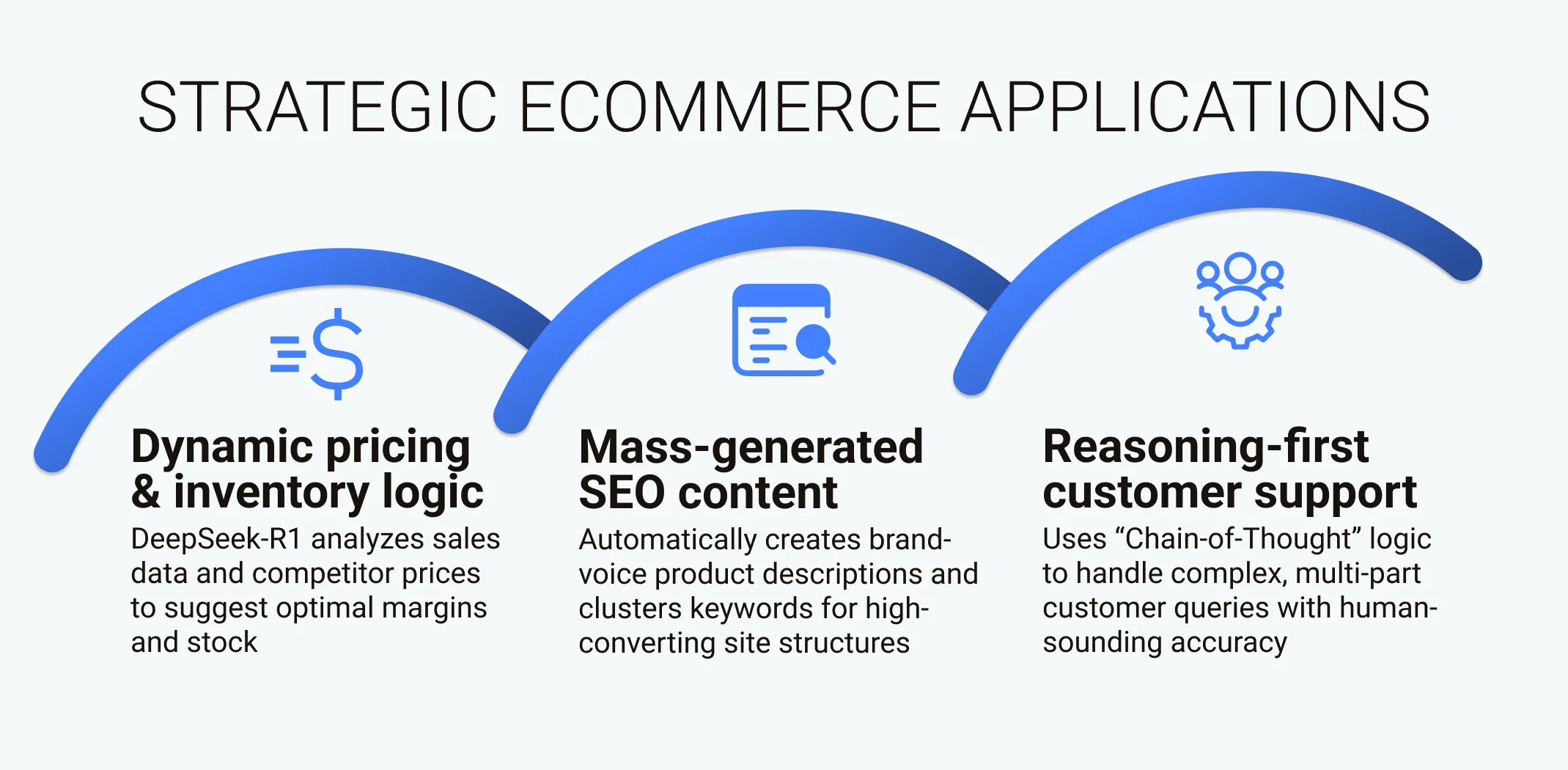
Dynamic pricing & competitive intelligence
Prices on Amazon change every few minutes. Most independent store owners can’t keep up. You can use DeepSeek to:
- Scan your competitors’ websites daily;
- Analyze your own stock levels;
- Automatically suggest a price that is competitive but still protects your profit margins.
Intelligent inventory forecasting
Overstocking kills cash flow; understocking kills sales. DeepSeek-R1 can look at your last three years of sales data and compare it against upcoming holidays or economic trends. It doesn’t just give you a number; it explains why it thinks you should order 20% more stock in March.
Masterclass: AI-driven content & SEO for online stores
In the world of ecommerce, content is king, but speed is the king’s advisor. If you have 500 new products arriving for the summer season, writing unique, SEO-friendly descriptions for all of them manually is impossible.
By understanding the specific intent behind Google search queries rather than simply writing text, DeepSeek acts as a sophisticated bridge between your products and your customers’ needs.
Mass-generating high-converting product descriptions
Standard AI often sounds robotic or uses too many flowery adjectives (like “game-changing” or “unparalleled”). DeepSeek-V3 can be tuned to follow your specific brand voice.
- The strategy: Instead of asking it to write a description, give it a technical spec sheet.
- The prompt secret: Tell DeepSeek: “Focus on the problem this product solves. Use a professional but friendly tone. Keep sentences under 20 words for mobile readability.”
Automated SEO blogging at scale
Google’s algorithms prioritize helpful content. DeepSeek-R1 is perfect for this because it can “reason” through a topic.
- Keyword clustering: Feed DeepSeek a list of 100 messy keywords from your research tool. Ask it to “Cluster these into topic silos for a pet supply store.” It will group “dog leashes,” “harnesses,” and “training collars” together, helping you build a site structure that Google loves.
- Internal linking: DeepSeek can analyze your existing blog posts and suggest exactly where to add links to your new products, ensuring that “link juice” flows through your whole store.
Multilingual expansion: The global store hack
If you want to sell in Germany, France, or Japan, basic translation (like Google Translate) often misses the cultural “vibe.” DeepSeek was trained on a massive, diverse global dataset. It understands local idioms and shopping habits, allowing you to “localize” your store – not just translate it – for a fraction of the cost of a translation agency.
Customer experience (CX) revolution
Customer service is usually a cost center (it costs you money). DeepSeek turns it into a loyalty center.
Reasoning-first chatbots
Most chatbots get confused if a customer asks a two-part question, like: “My order is late, and I also want to know if the blue XL shirt will be back in stock soon.”
DeepSeek-R1’s advantage: Because it uses Chain-of-Thought reasoning, it breaks the question down:
- First, it checks the tracking number (Logic);
- Second, it checks the inventory database for the blue shirt (Data);
- Third, it combines these into one helpful, human-sounding reply.
Sentiment analysis for reviews
Don’t just read your reviews – analyze them. You can export 1,000 customer reviews and ask DeepSeek: “What are the top 3 reasons people return this product?” > Example insight: DeepSeek might notice that 15% of customers say the “Large” size fits more like a “Medium.” You can then update your size guide immediately, saving you thousands in future return shipping costs.
Implementation guide: Integrating DeepSeek into your tech stack
You don’t need to be a coder to start using DeepSeek today. Here are the three most common ways to plug it in.
The API shortcut (the engine swap)
If you already use an AI tool that asks for an OpenAI API key, you can often use DeepSeek instead. Because DeepSeek uses the same API structure as OpenAI, you can simply replace the key and update the API URL.
Why do this? Your tool will function exactly the same way – but your monthly costs could be up to 90% lower.
No-code workflows (the automator)
Tools like Zapier or Make.com act as the glue between your store (WooCommerce/Shopify) and DeepSeek.
- Trigger: A new product is added to your store;
- Action: Send the product title to DeepSeek;
- Action: DeepSeek writes an SEO meta-description and a caption for Instagram;
- Result: The text is automatically saved back into your store as a draft.
Self-hosting: The private vault option
For larger stores worried about data privacy, DeepSeek’s open-source nature is a godsend. You can run DeepSeek on your own server. This means your customer data, sales figures, and “secret sauce” strategies never leave your building.
Cost-benefit analysis: The bottom line for sellers
In ecommerce, every cent counts. The biggest reason store owners are switching to DeepSeek is the dramatic reduction in overhead.
The 90% discount reality
When you use AI for your store, you typically pay for “tokens” (units of text). If you use OpenAI’s GPT-4o, you might pay a premium for its brand name and infrastructure. DeepSeek’s architecture and infrastructure allow it to offer similar capabilities at significantly lower per‑token prices than many Western providers.
Note: Prices are based on early 2026 market averages. DeepSeek is consistently 10x to 20x cheaper than Western equivalents.
ROI projection: The AI employee
If you use DeepSeek to automate your customer support and product descriptions, a budget of just $10–$20 a month can process as much work as a full-time junior copywriter. This allows you to reinvest those savings into your ad spend or product development.
Risks, ethics, and geopolitics
While the technology is brilliant, business owners must be aware of the “fine print.”
- Data sovereignty: By default, DeepSeek’s cloud API processes data on servers that may be located in China. For stores in the EU or US, this raises questions about GDPR and CCPA compliance.
Solution: If you handle sensitive customer data, consider using Local Hosting or a provider that offers “Regional Data Residency.”
- The “hallucination” factor: Like all AI, DeepSeek can sometimes be “too confident” and make up facts (e.g., claiming a product is waterproof when it isn’t).
Best practice: Never let AI publish directly to your live store without a quick human sanity check.
- Geopolitical stability: Because DeepSeek is a Chinese company, it is subject to trade regulations and “Tech Wars.”
Strategy: Don’t build your entire business on just one AI. Use a multi-model approach so you can switch to another provider if access changes.
Future outlook
We are moving away from chatbots and toward AI Agents.
- DeepSeek Janus-Pro (multimodal): DeepSeek is evolving to understand images as well as text. Soon, you’ll be able to upload a photo of a new product, and DeepSeek will automatically identify the material, style, and color, then draft the listing and create a social media video script.
- Total store audits: With long-context windows, you can feed DeepSeek your entire 50-page Terms of Service or a year’s worth of sales spreadsheets. It can then tell you exactly where you are losing money or where your legal language is weak.
Conclusion: Starting your DeepSeek journey
DeepSeek AI represents the democratization of intelligence. You no longer need a Silicon Valley budget to have world-class automation in your ecommerce store.
How to start today:
- Low risk: Use the DeepSeek web chat to draft your next 5 email newsletters;
- Medium risk: Use an API key to automate your product meta-descriptions;
- Advanced: Integrate DeepSeek-R1 into your inventory management system to predict next month’s sales.
The winners in the next era of ecommerce won’t just be the ones with the best products, but the ones who use AI to work faster and cheaper than the competition.
Are you ready to become an owner
of a profitable online business?
Free Dropshipping Guide