

ChatGPT
What is ChatGPT?
ChatGPT is a type of artificial intelligence that can hold conversations with people, answer questions, and even generate creative text like stories or essays. Unlike older computer programs that follow strict rules, ChatGPT can understand natural language, which means it can process the way humans speak and write. This makes it one of the most advanced AI chatbots available today.
People use ChatGPT for many things, from helping with homework to generating content for businesses, writing code, and even exploring creative ideas.
The rise of ChatGPT is part of a larger movement in technology where machines are not just tools but collaborators. For example, writers may use it to brainstorm ideas, programmers to check code, and teachers to explain complex concepts in simple ways.
While it can seem like magic, ChatGPT is based on complex mathematics and huge amounts of text data. Its goal is to predict the next word in a sentence, which surprisingly allows it to produce coherent paragraphs, answer questions, or mimic a conversation convincingly.

However, ChatGPT is not perfect. It sometimes provides answers that are incorrect or misleading. It does not “think” like humans but relies on patterns in language data it has seen during training.
Despite these limitations, ChatGPT has grown rapidly in popularity. It saves time, offers new perspectives, and helps with writing and language-based tasks. Its impact goes beyond technology enthusiasts, as everyday users are discovering new ways it changes how they work, learn, and communicate online.
This article explores ChatGPT in detail, including its development, underlying technology, key features, applications, challenges, competitors, and the future of AI chatbots.
History and development
OpenAI and the origins of ChatGPT
The story of ChatGPT begins with OpenAI, an artificial intelligence research organization founded in 2015. OpenAI’s goal was to create AI systems that could benefit humanity while being safe and widely accessible. The development of ChatGPT builds on years of research into language models – computer programs designed to understand and generate text.
The birth of GPT-1
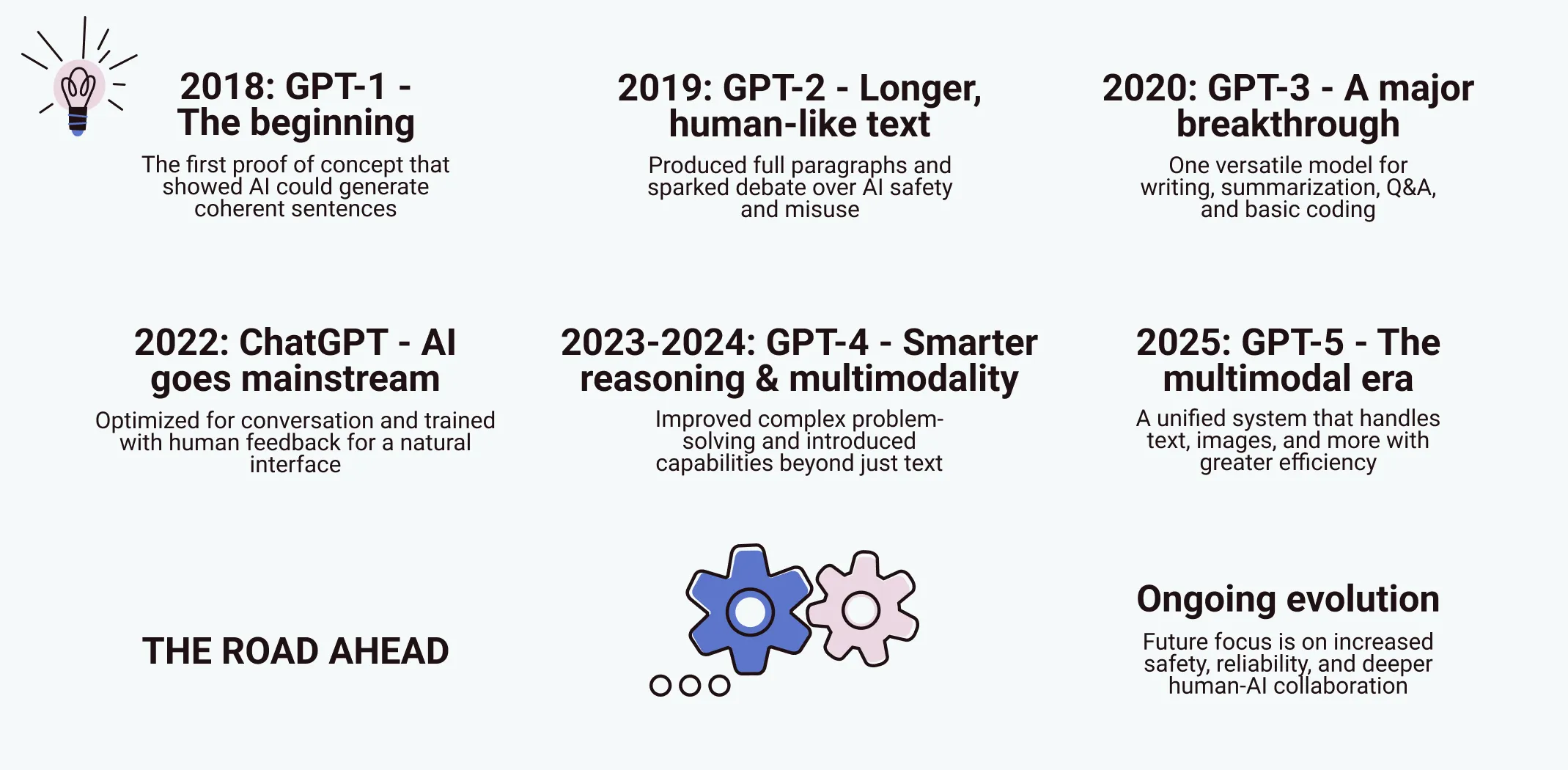
The first major step in this journey was the creation of GPT, which stands for Generative Pre-trained Transformer. The first version, GPT-1, was introduced in 2018. It was relatively small by today’s standards but demonstrated that machines could generate coherent text after being trained on large amounts of written material.
GPT-2 and growing capabilities
GPT-2 followed in 2019, with significantly more parameters (the settings a model adjusts as it learns) and the ability to produce longer and more coherent passages. GPT-2 showed the world that AI could generate text that sometimes seemed human-like, raising both excitement and concern about potential misuse, such as generating fake news.
GPT-3: A major breakthrough
A major breakthrough came with GPT-3 in 2020. With 175 billion parameters, GPT-3 showed that a single large language model could perform a wide variety of tasks – answering questions, writing essays, summarizing text, and generating basic computer code – without task-specific training. This general-purpose capability laid the foundation for ChatGPT.

The emergence of ChatGPT
ChatGPT itself emerged as a fine-tuned application of these GPT models, optimized specifically for conversation. By using reinforcement learning from human feedback (RLHF), OpenAI improved the model’s ability to follow instructions, remain coherent over multiple turns, and provide helpful, context-aware responses.
When ChatGPT was released to the public, it quickly gained millions of users, drawing attention from educators, businesses, and policymakers alike.
GPT-4 and expanded capabilities
The release of GPT-4 marked another significant stage in ChatGPT’s development. GPT-4 improved reasoning, accuracy, and contextual understanding compared with earlier models, and introduced stronger performance in complex tasks such as advanced writing, coding, and problem-solving. This expansion positioned ChatGPT as a more powerful tool for professional, educational, and creative use.
GPT-5 and the shift to multimodal AI
In 2025, OpenAI introduced GPT-5, representing a new generation of large language models. GPT-5 is a multimodal system that combines reasoning and non-reasoning capabilities within a unified architecture.
It replaced several earlier models and became the primary engine behind newer versions of ChatGPT, offering improvements in efficiency, reasoning depth, and task versatility. The release of GPT-5 highlighted OpenAI’s shift toward more integrated and scalable AI systems capable of handling a broader range of real-world applications.
Ongoing evolution and societal impact
Overall, the evolution of ChatGPT – from early text-prediction models to advanced multimodal systems – reflects rapid progress in artificial intelligence research. Each generation has improved fluency, accuracy, and usability, while ongoing challenges such as bias, factual reliability, and ethical deployment continue to shape future development.
The history of ChatGPT is not only a technical story but also a reflection of society’s growing interaction with AI systems that can communicate in increasingly human-like ways.
Technology behind ChatGPT
GPT architecture
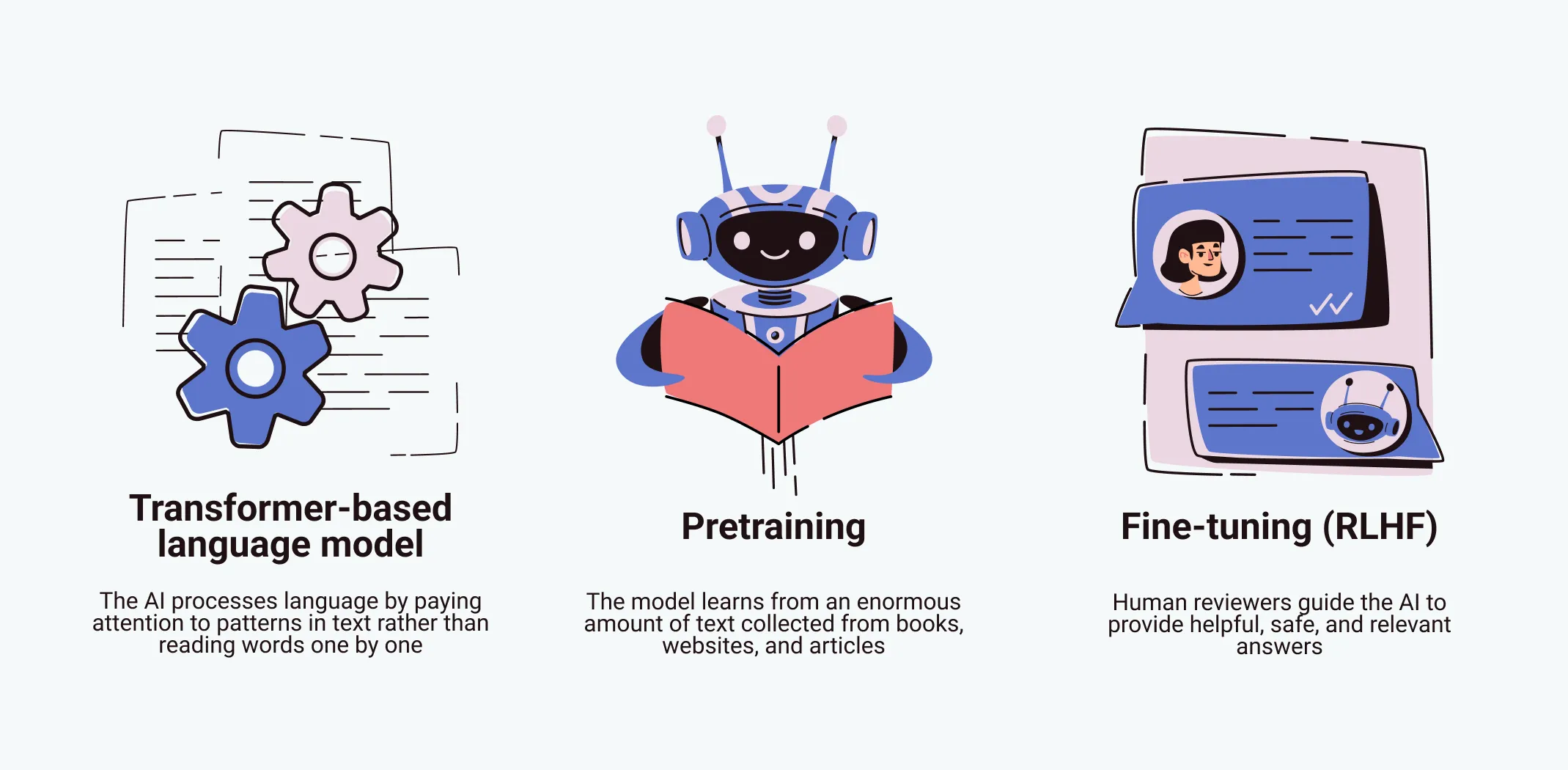
At its core, ChatGPT is built on a type of artificial intelligence called a language model, specifically the GPT (Generative Pre-trained Transformer) architecture. The word “transformer” might sound technical, but it refers to a way that the AI processes language by paying attention to patterns in text rather than reading words one by one.
Imagine reading a sentence and being able to remember every word you’ve seen while predicting the next word. That’s roughly what a transformer does, using complex math to weigh the importance of each word in a context.
Pretraining
The process begins with pretraining, where the model learns from an enormous amount of text collected from books, websites, and articles. During this stage, ChatGPT does not have opinions or understanding – it simply observes patterns. For example, if the text often says “the sky is blue,” it learns that “blue” is a likely continuation after “the sky is.”
Through millions of such examples, the model develops a statistical understanding of language. Pretraining gives ChatGPT the raw ability to generate text that sounds fluent and human-like.
Fine-tuning
After pretraining comes fine-tuning, a stage designed to make the AI more practical for real conversations. Here, humans provide guidance by rating or correcting AI outputs. This method, called reinforcement learning from human feedback (RLHF), teaches the model to prioritize helpful, safe, and relevant answers.
For instance, if a user asks, “Can you explain photosynthesis?” the AI learns to produce an informative and accurate response rather than an unrelated story. This is why ChatGPT feels more like a conversation partner than a random text generator.
Capabilities and limitations
ChatGPT’s abilities extend beyond simple text generation. It can understand context, meaning it remembers what was said earlier in a conversation and can provide coherent responses over multiple exchanges.
For example, if a user asks about climate change, and later asks, “What about its economic impact?” the AI can connect these topics and respond in a relevant way. This multi-turn conversation capability is a key factor that makes ChatGPT feel human-like.
However, there are limitations. ChatGPT does not “know” facts in the same way a person does – it predicts words based on patterns. This can lead to hallucinations, where the AI generates information that sounds plausible but is incorrect.
It also has biases, inherited from the data it was trained on, meaning some answers may unintentionally reflect stereotypes or skewed perspectives. Context is another limitation; extremely long conversations can overwhelm the model, causing it to forget details from earlier in the discussion.
Despite these issues, the technology behind ChatGPT is revolutionary. By combining statistical language patterns with human-guided fine-tuning, it achieves a level of interaction that was previously impossible with traditional rule-based chatbots.
It’s not perfect, but it demonstrates how AI can process and generate natural language on a scale that opens new possibilities in education, business, creativity, and daily life. Understanding this technology helps users appreciate both the potential and the responsibility that comes with interacting with AI.
Features and functionalities
Conversational flexibility
ChatGPT is more than just a chatbot that answers questions – it offers a wide range of features that make it useful for individuals, businesses, and creative work. Its main strength lies in its ability to understand natural language and generate responses that feel human-like.
Unlike older software that required strict commands, ChatGPT can handle flexible requests, such as “Explain quantum physics like I’m 12” or “Write a short story about a cat who travels the world.” This flexibility allows users to interact in a conversational style rather than following rigid instructions.
Text completion and summarization
One of the key functionalities of ChatGPT is text completion and summarization. For example, if a user starts writing an essay, ChatGPT can suggest the next sentences or even complete paragraphs. Similarly, it can take long texts and summarize them in simple terms.
Imagine receiving a detailed research paper on climate change. ChatGPT can condense it into a clear summary without losing essential details, saving time and helping people understand complex topics quickly. This feature is particularly valuable for students, journalists, and professionals who need to process large amounts of information efficiently.
Creative writing
Another significant feature is creative writing. ChatGPT can write stories, poems, scripts, and even marketing copy. Businesses use it to generate product descriptions or social media posts, while writers use it as a brainstorming tool.
For example, a marketer might ask, “Create three catchy taglines for a new coffee brand,” and ChatGPT can provide multiple creative options instantly. Even though the AI doesn’t have personal experience or emotions, it mimics human creativity by combining patterns in language it has learned from its training data.
Programming assistance
Programming assistance is also a notable functionality. ChatGPT can help generate, debug, and explain code in various programming languages. For instance, a beginner learning Python can ask, “How do I sort a list in Python?” and ChatGPT will provide code examples along with explanations.
It can also debug errors by analyzing the code and suggesting corrections. This makes it a valuable tool for both students and professional developers who want quick guidance or alternative approaches.
Multilingual support
Additionally, ChatGPT supports multilingual communication, meaning it can understand and respond in multiple languages. This is useful for translation, language learning, or communicating across borders. For example, a user can write in Spanish, and ChatGPT can respond in Spanish or translate it to English.
Overall, ChatGPT’s features offer practical ways to streamline tasks, explore ideas, and communicate more effectively. Its versatility allows users to approach problems and projects in new ways, making it a valuable assistant for both everyday activities and more complex challenges.
Use cases and applications
ChatGPT is used in a wide variety of areas, from personal tasks to professional projects. Its flexibility and conversational abilities make it useful for almost anyone who works with text, language, or information. While its functions may seem straightforward, the implications are often deeper, changing how people approach tasks like writing, learning, customer service, or creativity.
Personal use
For personal use, ChatGPT can be a learning companion or productivity assistant. Students often use it to understand complex subjects or brainstorm ideas for essays. For example, a student struggling with history homework can ask ChatGPT, “Explain the causes of World War I in simple terms,” and receive a clear, structured answer.
It can also act as a daily planner, generating schedules, reminders, or even motivational prompts. Beyond academics, some use ChatGPT for entertainment, like generating stories, jokes, or role-playing games, highlighting its flexibility in casual scenarios.
Business applications
In business, ChatGPT has significant applications. Companies use it for customer support, creating chatbots that can answer common questions without human agents. For instance, an ecommerce website can integrate ChatGPT to handle inquiries about shipping or product availability.
It’s also used in content creation, generating blog posts, social media updates, and marketing materials. A small business owner can ask, “Write a promotional email for our new product,” and get multiple draft options instantly.
Education and research
Education and research benefit greatly from ChatGPT. Teachers can use it to explain topics in simple language, create exercises, or generate examples for lessons. Researchers can summarize academic papers or explore alternative ways to phrase concepts.
For example, a graduate student analyzing economic trends might ask ChatGPT to “Summarize this research paper and identify the key arguments,” saving hours of manual reading.
Creative industries
In creative industries, ChatGPT has opened new possibilities. Writers use it to brainstorm plot ideas, poets to explore new styles, and musicians to generate lyrics. Even film or game developers can experiment with dialogue or character development using AI prompts.
For instance, a game designer could ask ChatGPT to create dialogue for a fantasy character, receiving multiple variations that can inspire final content. Some argue that this may reduce the human element of creativity, but others see it as a collaborative tool, expanding imagination rather than replacing it.
Emerging applications
Finally, emerging applications include integration into software tools, virtual assistants, and healthcare. Developers are experimenting with AI-powered apps that guide users through tasks, provide mental health check-ins, or help doctors summarize patient records.
While these applications are promising, they raise ethical and safety concerns. For example, using ChatGPT for medical advice requires careful oversight because the AI can generate plausible but incorrect information.
Overall, ChatGPT’s applications demonstrate its versatility. It is not just a tool for answering questions; it’s a partner in learning, working, creating, and exploring new ideas. Its wide range of use cases is what has made it so widely adopted, but its limitations and risks remind us that human judgment remains essential.
Ethical considerations and challenges
While ChatGPT offers incredible capabilities, it also raises important ethical questions and practical challenges. These issues are not just theoretical – they affect how people use the technology every day and how society adapts to AI that can mimic human conversation. Understanding these concerns helps users interact responsibly and helps organizations deploy AI safely.
Bias and misinformation
Bias and misinformation are closely linked ethical concerns with ChatGPT. As mentioned earlier, the AI can reflect patterns from its training data, which may unintentionally include stereotypes related to gender, race, or culture. At the same time, it can produce information that appears plausible but is factually incorrect.
Both biased and inaccurate outputs can influence decisions, reinforce misconceptions, or shape public perception if users accept them uncritically. This makes human oversight essential: users must verify content, think critically about AI-generated responses, and remain especially cautious in sensitive contexts such as education, journalism, or professional decision-making.
Privacy and data security
Privacy and data security are also important ethical issues. ChatGPT interacts with users by processing the text they provide, but it does not “remember” conversations permanently in the public version. Still, concerns exist about how user inputs are stored or used for training and improvement.
Individuals sharing personal, confidential, or sensitive information must be aware of these risks. For businesses, handling user data responsibly is critical to avoid breaches or misuse.
Regulation and responsible deployment
Finally, regulation and responsible deployment are central challenges. Governments, organizations, and developers are debating how to ensure AI is safe, fair, and transparent because real incidents have already shown the risks of under‑regulated systems.
For example, lawsuits alleging that AI chatbots contributed to harmful outcomes have drawn public and legal scrutiny, and fabricated emergency reports generated with AI have diverted police resources, raising safety concerns. In crises, AI‑generated misinformation has spread false narratives before fact‑checking can keep pace, undermining public trust.
Some propose rules for AI transparency, requiring clear labeling of AI‑generated content or guidelines for high‑stakes fields like healthcare and finance. The balance is delicate: overly strict regulations could slow innovation, while too little oversight risks misuse, harm, and further public distrust.
In summary, the ethical and practical challenges of ChatGPT are as important as its technical capabilities. Bias, misinformation, privacy, dependency, and regulation all shape how society can use AI responsibly.
Understanding these issues is essential for individuals, businesses, and policymakers to make informed decisions about when and how to rely on conversational AI. The technology is powerful, but its responsible use requires awareness, oversight, and critical thinking.
ChatGPT vs competitors
ChatGPT is not the only conversational AI available today. Several other companies and research organizations have developed chatbots or AI assistants that aim to replicate human-like conversation. Comparing ChatGPT with its competitors helps understand its strengths, limitations, and unique position in the market.
Google Gemini
One of ChatGPT’s main competitors is Google Gemini, Google’s advanced AI chatbot and assistant built on its DeepMind large language models. Like ChatGPT, Gemini is designed to respond naturally to questions and prompts, but it differs in how it accesses and uses information.
Gemini is tightly integrated with Google’s ecosystem, including Search and Workspace apps like Gmail, Docs, and Sheets, which lets it pull in real‑time data and contextual support for tasks such as drafting emails or summarizing current events.
In contrast, ChatGPT’s free public versions rely primarily on its training data and do not inherently access live web search. Because of this, Gemini can be more current and connected to real‑world information, while ChatGPT is often praised for the depth and natural flow of its conversational capabilities, creative content generation, and the flexibility of its plugin and custom GPT ecosystem.
Perplexity AI
Another notable competitor is Perplexity AI, which takes a different approach by combining conversational AI with search-engine functionality. Perplexity is designed to answer questions using real-time web data and provides citations and source links alongside its responses. This makes it especially valuable for research, fact-checking, and information discovery, where transparency and verification are important.
While ChatGPT excels in long-form dialogue, brainstorming, and creative generation, Perplexity focuses on concise, evidence-backed answers. Its responses tend to be less conversational, but its emphasis on sourcing appeals to users who prioritize accuracy and traceability over open-ended interaction.
DeepSeek
A newer and increasingly discussed competitor is DeepSeek, a generative AI chatbot developed by a Chinese company that gained rapid popularity upon its 2025 launch. DeepSeek’s models are designed to be more resource‑efficient and cost‑effective compared with larger Western models, and its app quickly became one of the most downloaded chatbot applications, challenging established providers.
Unlike ChatGPT, which offers multimodal support, DeepSeek currently focuses primarily on text‑based responses and efficient reasoning, targeting developers and technical users with simplified deployment and lower costs.
While DeepSeek shows strength in logical problem solving and structured analytical tasks, it generally lacks the extensive ecosystem, broad integrations, and polished conversational style that ChatGPT has developed through years of iteration.
Microsoft Copilot
Another competitor is Microsoft Copilot, which is integrated into Microsoft Office tools like Word and Excel. Copilot focuses on assisting with productivity tasks, such as drafting documents, creating spreadsheets, and automating repetitive processes.
While ChatGPT can perform similar tasks, Copilot benefits from direct integration with software and can manipulate documents or spreadsheets in real time. This makes Copilot a strong choice for business users who want seamless workflow automation, whereas ChatGPT shines when tasks require flexible conversation, brainstorming, or general‑purpose writing.
Anthropic Claude
Anthropic Claude is also an emerging competitor, designed with safety and alignment as core principles. Claude aims to minimize harmful outputs and bias, focusing on responsible AI use. ChatGPT, while continually improving safety measures, sometimes produces unintended or overly verbose responses because it prioritizes conversational flexibility and creativity.
In highly sensitive scenarios – such as medical advice or ethical questions – Claude may provide more conservative output, while ChatGPT delivers detailed responses that can be useful but require human judgment to verify.
Despite these competitors, ChatGPT has several unique advantages. Its versatility is unmatched: it handles casual conversations, creative writing, technical problem‑solving, multimodal inputs, and multilingual support within a single platform.
It is also widely adopted and continuously updated, fostering a large community of users, developers, and enthusiasts who contribute feedback and applications. On the other hand, limitations remain, such as occasional inaccuracies, sensitivity to poorly phrased prompts, and reliance on training cutoffs for knowledge.
Comparison of major AI chatbots
The following table provides a brief overview of how ChatGPT compares with other prominent AI systems, focusing specifically on the types of tasks each is best suited for. This comparison offers a practical reference point, complementing the detailed explanations above and helping readers quickly identify which tool aligns most closely with their needs.
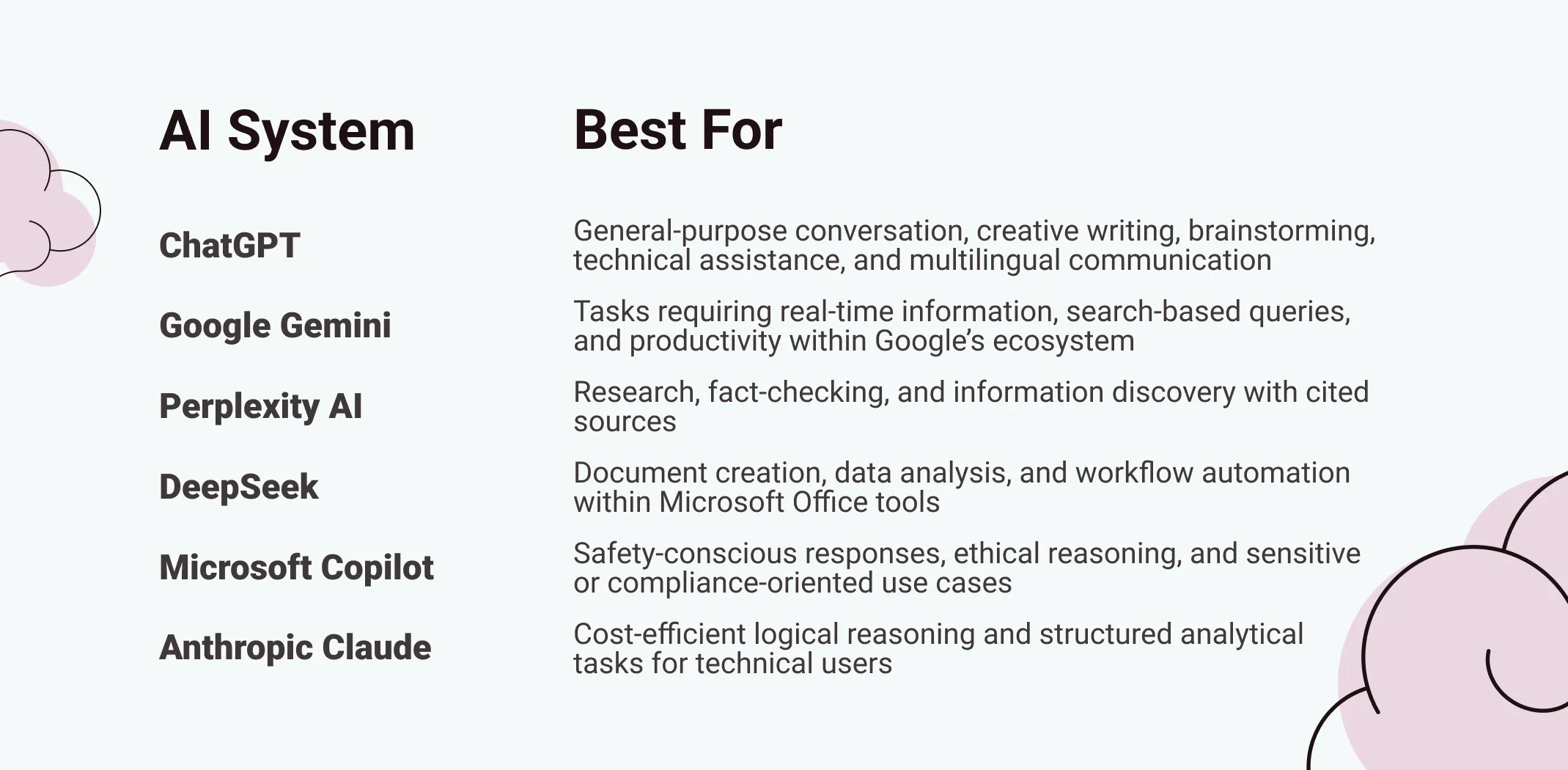
In conclusion, ChatGPT’s competitors offer specialized advantages – such as up‑to‑date information access, direct productivity integration, safety‑focused outputs, or cost‑effective reasoning models. However, ChatGPT’s strength lies in its balance between creativity, conversational depth, ecosystem breadth, and broad usability.
Choosing between ChatGPT and other AI chatbots depends on a user’s specific needs – whether they prioritize real‑time data, workflow integration, structured technical reasoning, or natural, flexible conversation. Understanding these differences helps users select the right AI tool while being aware of both potential and limitations.
Future of ChatGPT and AI chatbots
The future of ChatGPT and AI chatbots is both exciting and complex. As technology evolves, AI is expected to become more capable, more integrated into daily life, and more influential across different industries. However, this growth also brings challenges in ethics, regulation, and societal adaptation. Understanding these trends helps anticipate how AI may reshape the way people work, learn, and communicate.
Improved conversational abilities
One major direction is the improvement of conversational abilities. Future versions of ChatGPT, such as GPT-5 and beyond, are likely to remember longer conversation histories and provide more contextually accurate responses. Currently, ChatGPT has limitations in tracking very long or complex conversations.
Enhancing memory and understanding will allow users to have more seamless interactions, almost like speaking with a human who remembers details from earlier discussions. For instance, in educational settings, a student could discuss a multi-part project over several sessions, with the AI maintaining continuity without losing prior context.
Integration with external tools
Another important development is integration with external tools and real-time information. Today, ChatGPT can perform some integration via plugins, but future versions may access live data streams, databases, or other applications more efficiently. Imagine a business professional asking ChatGPT to analyze current stock market trends or generate reports based on live financial data.
Personalization
Personalization is also expected to expand. Future chatbots may adapt to individual user preferences, learning writing styles, communication habits, and areas of interest. For example, a writer could have a personalized AI that mirrors their tone and creative approach, offering suggestions tailored to their style.
Societal impact
At the societal level, AI like ChatGPT has the potential to transform work, education, and creativity by automating routine tasks such as writing, customer support, and data analysis. This automation can free humans to focus on higher-order thinking, innovation, and complex problem-solving.
At the same time, it brings challenges, including potential job displacement, over-reliance on AI, and the growing need for digital literacy to critically evaluate AI-generated content. The key will be balancing innovation with responsibility, guided by ethical standards and regulatory frameworks that ensure AI is used safely, inclusively, and transparently.
Human-AI collaboration
Looking ahead, collaboration between humans and AI is likely to deepen. ChatGPT is not intended to replace human effort but to complement it – accelerating tasks, providing creative input, and serving as a co-creator, tutor, or advisor in ways that expand human potential.
The future of AI will depend on ongoing dialogue among developers, users, and policymakers to manage risks while maximizing benefits, ensuring these technologies empower rather than diminish human capabilities.
Ultimately, the trajectory of ChatGPT and similar AI systems promises smarter, more integrated, and personalized tools that enhance learning, creativity, and productivity. Its impact will extend beyond technology, shaping how humans acquire knowledge, solve problems, and collaborate with intelligent machines.
By embracing AI thoughtfully and responsibly, society has the opportunity to harness unprecedented possibilities while safeguarding ethical and social values – a future where humans and AI thrive together.
Are you ready to become an owner
of a profitable online business?
Free Dropshipping Guide