What Is The Cheapest Home Business To Start Today?

Starting a business from home sounds expensive until you actually look at the numbers. The truth is, some of the most profitable online businesses today cost less to launch than a monthly gym membership. If you have been putting off starting something because you assumed you needed thousands of dollars upfront, this article is going to change how you see that.
Quick Answer: The cheapest businesses to start from home in 2026 include dropshipping, freelancing, print-on-demand, and digital product sales – most requiring under $100 to launch. Dropshipping is often the strongest all-around option because it combines low startup costs with real scalability and no inventory risk.
Below, we break down the most accessible low-cost home businesses, what they actually cost to start, how much you can realistically earn, and which one fits your situation best.

What is a low-cost home business?
A low-cost home business is any business model you can launch and operate from home without significant capital investment – typically under $200 to get started. These businesses usually rely on your time, skills, or an existing platform rather than physical inventory, office space, or expensive equipment.
In 2026, the barrier to entry for home-based businesses is lower than ever. Cloud-based tools, global supplier networks, and digital marketplaces mean that almost anyone with a laptop and an internet connection can start generating income within weeks rather than years. The key difference between a hobby and a real business, though, is choosing a model that can actually scale beyond a few hundred dollars a month.
Why this works in 2026: The global e-commerce market continues to grow, and consumer comfort with buying online – from small independent stores – is at an all-time high. That creates a genuine opening for new home-based sellers who start lean and grow smart.
How much can you realistically earn?
Earnings vary a lot depending on how much time you put in, which model you choose, and how quickly you learn the fundamentals. Here is a realistic breakdown of the most popular low-cost home business options.
These figures represent realistic ranges for people treating the business seriously, not as a casual hobby. Most models take 60–90 days to generate consistent income, and full-time results typically require full-time effort – or at minimum a structured part-time commitment of 15–20 hours per week.
One note on ceiling figures: The upper end of each range assumes you have already found a profitable niche, built an audience or traffic source, and are operating consistently. New starters should plan for the lower range in the first three months and grow from there.
The cheapest businesses to start from home in 2026
Here is a close look at each low-cost business model – what it costs, how it works, and what you need to get started.
E-commerce and product-based businesses
Dropshipping
Dropshipping is one of the most popular cheapest businesses to start from home because it requires zero inventory. You set up an online store, list products from a supplier, and when a customer places an order, the supplier ships directly to them. You never touch the product.
Startup costs are genuinely low. A basic dropshipping store can be launched for under $50 using platforms like AliDropship, and you can get a fully built store for free through certain offers. Your main ongoing cost is marketing – either paid ads or time invested in organic content.
- No inventory or warehousing costs
- Work from anywhere with a laptop
- Scalable – add products and niches over time
- Automatable once the system is set up
Earning potential: $500–$5,000+ per month with consistent effort over 60–90 days.
Print-on-demand
Print-on-demand (POD) works similarly to dropshipping. You create designs – t-shirts, mugs, phone cases, posters – and list them on a marketplace or your own store. When someone buys, the POD supplier prints and ships the item for you.
Platforms like Printful, Printify, and Redbubble have no upfront fees. You only pay production costs when an order comes in. Design tools like Canva make it accessible even if you have no graphic design background.
Earning potential: $100–$1,500 per month depending on niche focus and design output volume.
Reselling (online arbitrage)
Online arbitrage means buying discounted or undervalued products – from clearance sales, thrift stores, or wholesale suppliers – and reselling them at a profit on eBay, Amazon, Facebook Marketplace, or Mercari. It requires some starting capital (typically $50–$150 for your first batch of items), but it is one of the fastest ways to see your first sale.
The downside is that it does not scale easily without significant time investment in sourcing, listing, and shipping. Most successful resellers treat it as a part-time income stream rather than a primary business.
Earning potential: $100–$1,000 per month with consistent sourcing and active listing management.
Service-based home businesses
Freelancing
Freelancing is one of the cheapest home-based business ideas available because the startup cost is essentially zero. If you have a marketable skill – writing, graphic design, web development, video editing, social media management, bookkeeping – you can offer it on Upwork, Fiverr, or Toptal, or pitch clients directly.
The main investment is time: building a portfolio, writing proposals, and delivering quality work that earns repeat clients and referrals. Many freelancers reach $1,000–$2,000 per month within their first 90 days if they are consistent about outreach.
- Zero startup cost (free accounts on most platforms)
- Fast path to first payment – often within the first week
- Broad skill categories – writing, design, tech, consulting
- Can be done alongside a full-time job initially
Earning potential: $300–$3,000 per month depending on skill set, niche, and client acquisition effort.
Virtual assistant services
Businesses and entrepreneurs increasingly outsource administrative tasks – inbox management, scheduling, data entry, customer support, social media posting – to virtual assistants (VAs). You do not need specialized skills to start, which makes this one of the most accessible low investment business ideas available in 2026.
Platforms like Belay, Time Etc, and Fancy Hands list VA opportunities. Alternatively, you can pitch small business owners or content creators directly through LinkedIn or cold email. Rates typically range from $15–$35 per hour for general VA work, rising to $50+ for specialized roles.
Earning potential: $400–$2,000 per month for part-time hours, with room to grow into an agency model over time.
Online tutoring and coaching
If you have subject knowledge – academic subjects, language skills, music, fitness, career development – online tutoring is a genuinely low-cost home business with strong demand. Platforms like Wyzant, Preply, and Superprof connect tutors with students globally, while Zoom or Google Meet let you run sessions independently with zero platform fees.
Coaching is slightly different – it focuses on outcomes (career transitions, fitness goals, business growth) rather than subject knowledge – but the startup model is the same: a free video call platform, a PayPal or Stripe account, and a way to get in front of potential clients.
Earning potential: $500–$2,500 per month depending on your niche, rates, and client volume.
Content and digital businesses
Affiliate marketing
Affiliate marketing means promoting other companies’ products and earning a commission on each sale you drive. It is genuinely one of the cheapest business ideas to start from home – a free blog, a YouTube channel, or a TikTok account is all you technically need to begin.
The catch is that affiliate marketing takes time to generate meaningful traffic. Most new affiliate marketers do not see significant commissions until month three or four, and building a reliable $1,000+ monthly income stream typically takes six months to a year of consistent content production.
Programs like Amazon Associates, ShareASale, and individual brand affiliate programs are free to join. High-ticket affiliate niches (software, finance, health) offer commissions of $50–$300+ per sale.
Earning potential: $50–$2,000 per month, heavily dependent on traffic volume and niche selection.
Selling digital products
Digital products – ebooks, templates, presets, online courses, spreadsheets, Notion dashboards – are created once and sold indefinitely with no production or shipping cost. This makes them one of the highest-margin home business ideas available.
Platforms like Gumroad, Etsy (digital downloads), and Teachable charge no upfront fees. You create the product, list it, and promote it. The main cost is your time during creation and your marketing effort afterward.
Why this works in 2026: Remote work, the creator economy, and demand for practical tools (productivity templates, design assets, business guides) continue to grow. Digital product buyers are not slowing down.
Earning potential: $200–$4,000 per month once you have a product and an audience driving consistent traffic to it.
Startup cost comparison: which model is truly the cheapest?
Not all “low-cost” businesses start at the same price. Here is an honest breakdown of what each model actually costs to launch from scratch.
Dropshipping and print-on-demand stand out here because they combine near-zero startup costs with genuine scalability. Freelancing technically costs nothing, but your income is always capped by the hours you can work. Reselling requires real upfront capital relative to the others and does not scale well without more capital injection.
Tips for keeping your home business startup costs low
Start with free tools wherever possible
Before paying for anything, exhaust the free tier. Canva Free covers most design needs. Google Workspace handles documents, spreadsheets, and email. Mailchimp’s free plan supports up to 500 contacts. Most e-commerce platforms and freelance marketplaces offer free accounts with no monthly fees until you are generating revenue.
Avoid buying courses before you need them
One of the most common mistakes new home business owners make is spending hundreds of dollars on online courses before they have validated their business idea. Free resources – YouTube, Reddit communities like r/dropship and r/Entrepreneur, and official platform documentation – cover 90% of what you need to know in the early stages.
Pick one model and commit to it for 90 days
Spreading your effort across multiple business models in the early stages is one of the fastest ways to burn out and see zero results. Pick the model that fits your situation best, commit to it for a minimum of 90 days, and measure results before making any changes.
Reinvest early profits rather than spending them
When your first sales or client payments come in, resist the temptation to treat them as personal income right away. Reinvesting the first $200–$500 into paid ads, better tools, or outsourcing low-value tasks will compound your growth significantly faster than spending it.
Use automation from day one
Whether you are dropshipping or freelancing, automating repetitive tasks – order fulfillment, invoice generation, follow-up emails – frees up the time you need to focus on growth. Tools like Zapier, AliDropship’s built-in automation, and free CRM platforms make this accessible even with a zero budget.
Pro Tip: Set a hard monthly budget cap for your business tools and ads during the first 90 days. Starting with a $30–$50/month ceiling forces you to prioritize what actually moves the needle.
Legal and ethical considerations for home-based businesses
Running a legitimate business – even a small one from your kitchen table – means understanding a few non-negotiables.
Register your business and understand your tax obligations
In most countries, once you start earning income from a home business, you are legally required to declare it. In the US, income above $400 from self-employment is taxable. Most sole proprietors can register a business for under $50, and free tools like Wave handle basic bookkeeping.
Important: Operating without registering or declaring income is a legal risk, not a grey area. Start clean from day one.
What to avoid absolutely
Fake reviews, misleading product descriptions, and artificially inflated “before” prices are not just ethically wrong – they violate platform terms and can result in account bans and legal liability. Review manipulation on Amazon, Trustpilot, or Google is increasingly prosecuted in the US and EU.
Similarly, using copyrighted images, designs, or content without a license – common in print-on-demand – can result in DMCA takedowns and store closures.
What to do instead
Build your reputation on genuine product quality, honest descriptions, and real customer service. Respond to reviews – positive and negative. Use licensed image sources like Unsplash, Pexels, or the royalty-free assets your platform provides. These practices are not just ethical – they are the foundation of a sustainable business.
Key principle: The cheapest home business is one that does not cost you your account, your reputation, or a legal fine down the road.
How to choose the right home business for your situation
There is no single best answer here – the right cheapest business to start from home depends on your skills, your available time, and your income goals. Here is a practical guide by reader profile.
Complete beginner with no specific skills
Start with dropshipping or print-on-demand. Both require no prior experience, no inventory, and minimal startup capital. Dropshipping in particular gives you a real online business framework from day one – store, products, orders – without any of the complexity of manufacturing or sourcing yourself. Focus on one niche, learn the basics of product research, and run your first $20–$30 ad test within the first two weeks.
Intermediate – you have a skill and some spare time
Freelancing is your fastest route to income. Use the first 30 days to land two or three paying clients, then use that income to fund a parallel business model (like a dropshipping store) that can scale beyond your available hours.
Advanced – aiming for full-time income replacement
If your goal is $3,000–$5,000+/month within 12 months, dropshipping combined with digital product sales gives you the strongest combination of scalability and margin. Build the store first (lowest barrier to entry), generate cash flow, then layer in a complementary digital product that serves the same niche audience.
Side income – you just want an extra $300–$500/month
Virtual assistant work or online tutoring will get you there fastest with the least setup time. Both can be started this week with zero investment, and both have enough steady demand to hit that income target within 30–45 days of consistent outreach.
AliDropship: Your complete all-in-one solution for starting dropshipping in 2026
If you want the simplest possible way to start dropshipping – especially if you’re brand new – AliDropship remains one of the most beginner-friendly tools available in 2026. It brings together store creation, product imports, automation, and marketing into a single streamlined system designed to help you launch quickly and grow confidently.
Free turnkey store 🛍️
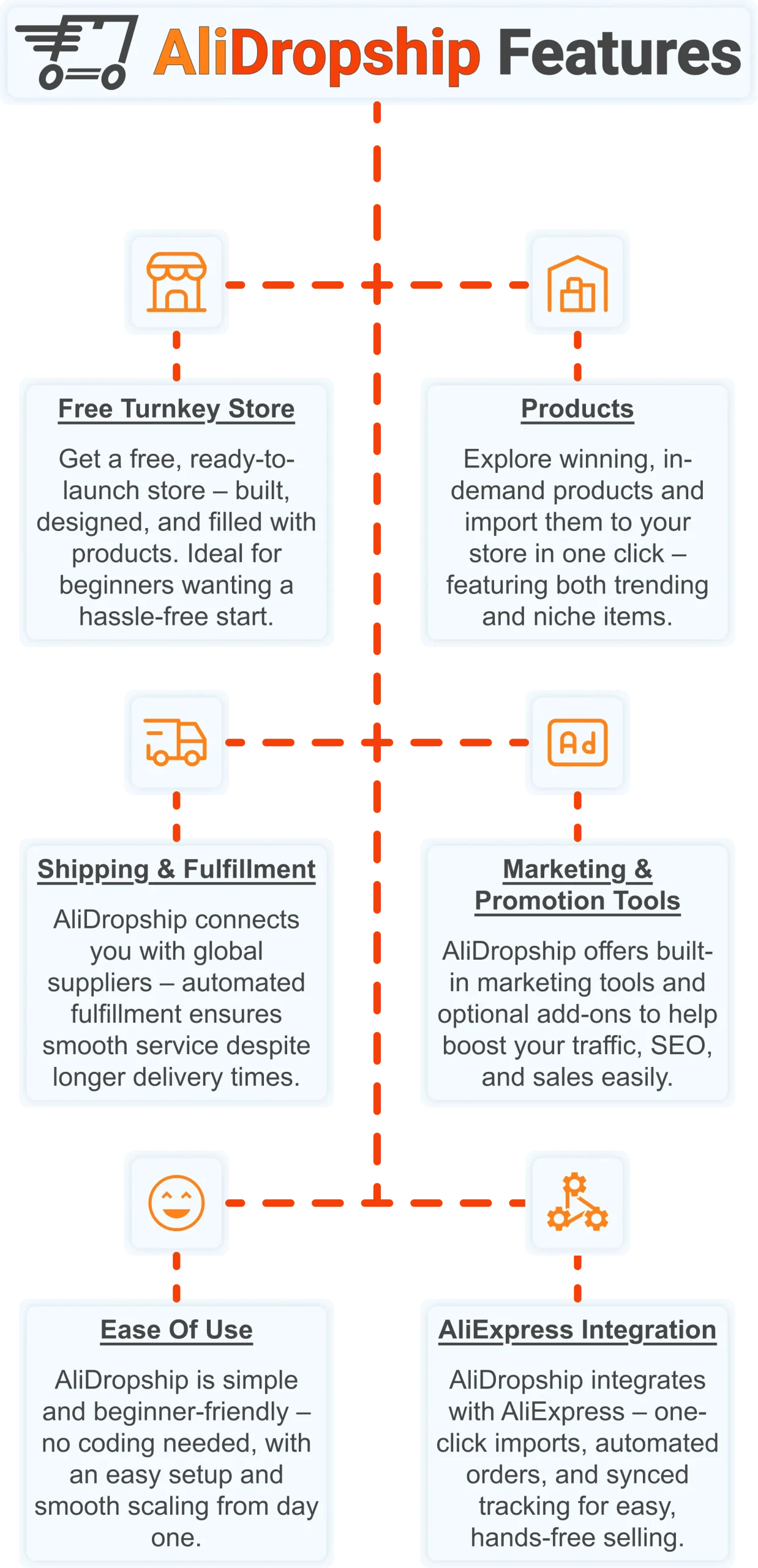
Get a free turnkey store – built, designed, and filled with products. Ideal for beginners wanting a hassle-free start, the store comes fully optimized to attract customers right away, saving you time on setup. Plus, it includes professional design elements to give your business a polished, trustworthy look from day one. This ready-made foundation makes it easy to move seamlessly into product selection.
Products 📦
Once your store is set up, you can explore winning, in-demand products and import them in one click – featuring both trending and niche items. This wide selection lets you cater to diverse customer interests and test what works best. Regular updates ensure you always have fresh products, keeping your store competitive and relevant. With great products in place, smooth shipping becomes the next essential step.
Shipping & fulfillment 🚚
AliDropship connects you with global suppliers, and automated fulfillment ensures seamless order processing despite international delivery times. Customers receive real-time tracking updates, which builds confidence and trust in your store. Once shipping is handled reliably, you can focus on promoting your store and attracting traffic.
Marketing & promotion tools 📣
To maximize sales, AliDropship offers built-in marketing tools and optional add-ons that help boost traffic, SEO, and conversions. From email campaigns and discounts to social media integration, these tools empower you to reach and retain customers without needing prior marketing experience. With promotion strategies in place, managing your business becomes simpler and more efficient.
Ease of use 👌
AliDropship is beginner-friendly – no coding needed, with an intuitive dashboard that guides you through every step. Easy setup and smooth scaling let you expand your store without stress. As your business grows, adding new features, products, and marketing campaigns remains hassle-free, giving you more time to focus on sales.
AliExpress integration 🛒
Finally, AliDropship integrates seamlessly with AliExpress, enabling one-click imports, automated orders, and synced tracking. Your inventory stays up-to-date with the latest products and prices, while automated order processing frees you from manual tasks. Combined with the turnkey setup, reliable shipping, and built-in marketing tools, this integration ensures your dropshipping business is fully equipped for growth and success.
Dropshipping is the cheapest business to start from home that actually scales – and AliDropship gives you everything you need to launch without the guesswork. Get your free turnkey store today and start building real income from home.
What is the cheapest business to start from home?
Can I start a home business with no money?
How long does it take to make money from a home business?
Is dropshipping still worth starting in 2026?
What home business makes the most money with low startup costs?