Canva AI: What It Is And How To Use It In 2026

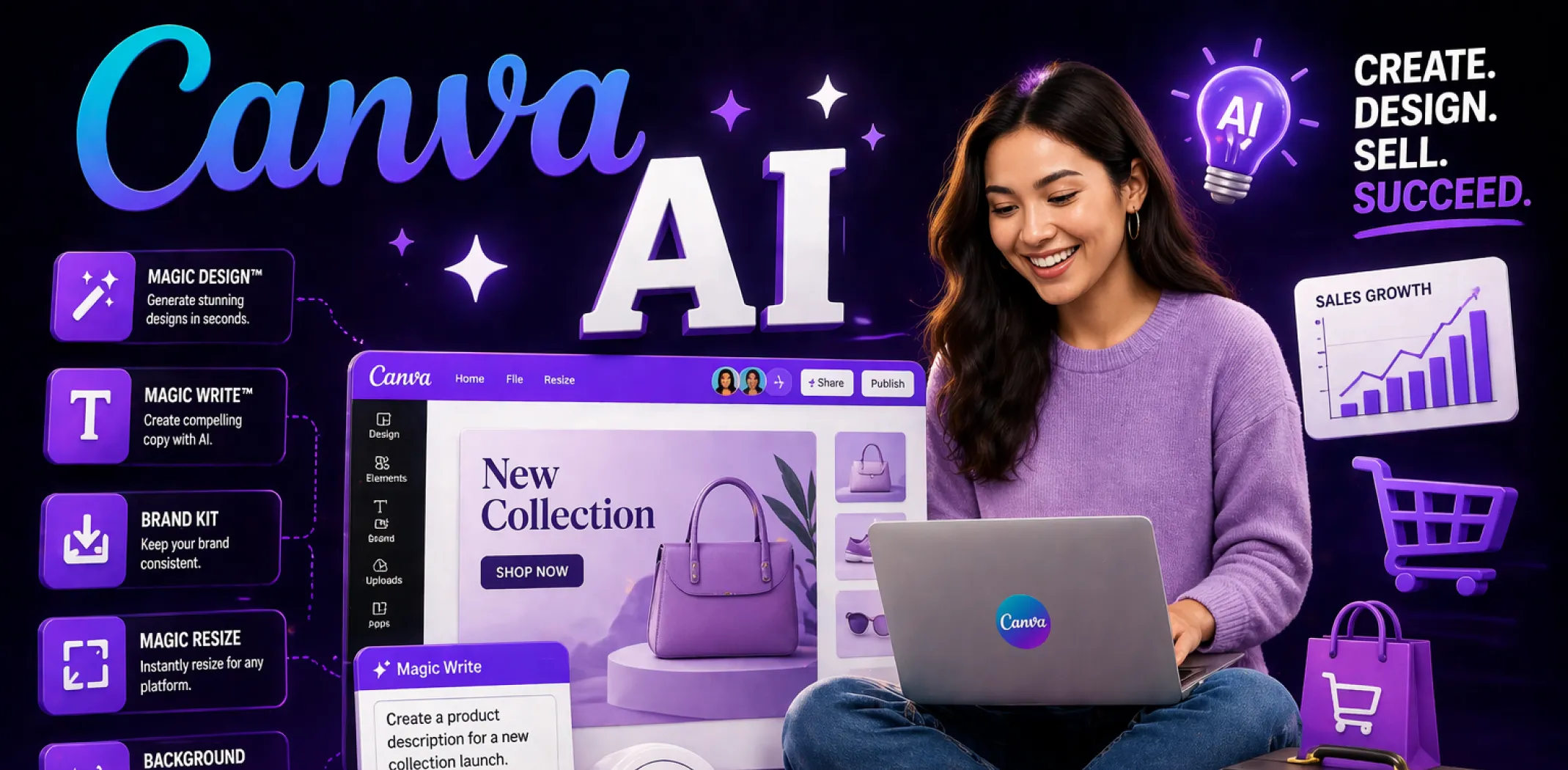
Canva AI has quietly become one of the most useful tools available to online sellers, content creators, and small business owners in 2026. Whether you want to design product images in seconds, write marketing copy, or build a full brand identity without hiring a designer, Canva’s AI-powered features make it genuinely accessible – even if you have zero design experience.
But how much can you actually do with it, and is it worth building into your ecommerce workflow? This guide breaks down every major Canva AI tool, how each one works in practice, and how to use them together to run a leaner, more profitable online business.
Quick Answer: Canva AI is a suite of artificial intelligence tools built into the Canva design platform. In 2026, it includes an AI image generator, a text-to-design feature, an AI writing assistant, background remover, Magic Resize, and more – all usable from a browser with no design skills required.
Before diving into the individual tools, it helps to understand why Canva AI has become so widely used among ecommerce sellers specifically – and what it can realistically replace in your workflow.
What is Canva AI?
Canva AI refers to the collection of artificial intelligence features embedded directly inside the Canva platform. Rather than being a standalone product, it sits within the same editor you already use to make social posts, presentations, and marketing materials. You do not need to switch tools or learn a new interface.
At its core, Canva AI is designed to reduce the time and skill required to produce professional-looking visual content. It handles tasks that used to require Photoshop skills, a copywriter, or a dedicated graphic designer – things like removing a background, generating a product photo from a text prompt, resizing a design for ten different platforms at once, or drafting ad copy that matches your brand voice.
For ecommerce sellers in particular, this matters a lot. Product listings, ad creatives, email headers, social content – you need a constant supply of visuals and copy, and producing them manually is one of the biggest time drains in the business. Canva AI compresses that workload significantly.
The platform operates on a freemium model. Many AI features are available on the free plan, while more advanced tools like Magic Studio’s full suite, the AI image generator at high resolution, and Brand Kit features require a Canva Pro subscription, which costs around $15/month for a single user.
GET YOUR AI INFLUENCER + STORE
How much can you realistically earn using Canva AI?
This question depends entirely on how you use it. Canva AI is not a direct income source – it is a production tool that reduces costs and speeds up output, which translates to better margins and more consistent content output for your business. That said, here is what different types of users typically see in terms of financial impact.
The table above reflects realistic ranges for users who are consistently active rather than occasional users. Freelancers who use Canva AI to deliver faster client work typically charge the same rates while dramatically cutting production time. Ecommerce sellers benefit most through cost savings – replacing the need for a designer on retainer, a photo editor, or a copywriting tool.
One note on these figures: Canva AI is a multiplier, not a standalone income stream. The higher end of these ranges requires consistent effort, a volume of clients or products, and at minimum 60–90 days to build momentum. Do not approach it expecting fast passive income on its own.
The real opportunity – especially for ecommerce – is using Canva AI as part of a broader business system that includes a real online store, automated fulfillment, and a product catalogue you did not have to build from scratch.
START FREE WITH AN AI INFLUENCER
Every major Canva AI feature (and how to use each one)
Canva has released a large number of AI-powered tools over the past two years. Below is a breakdown of every significant one, organised by use case, along with honest notes on what each does well and where it falls short for ecommerce sellers.
Visual creation and image tools
Magic Media (AI image generator)
Magic Media is Canva’s text-to-image generator. You type a description – for example, “minimalist flat lay of skincare products on marble, natural light” – and Canva generates four image options within about 15–20 seconds. You can refine the style, aspect ratio, and mood using drop-down selectors before generating.
For ecommerce sellers, this is most useful for creating lifestyle-style product imagery when you do not have the budget for a professional photoshoot. You can generate background scenes that match your brand aesthetic and drop your actual product photos on top using the background remover (covered below).
Earning potential: Saves $150–$600 per photoshoot project when used to build product imagery from scratch.
Important: Magic Media at full resolution (up to 2048px) requires Canva Pro. Free plan users get lower resolution outputs with a daily generation limit.
Background Remover
This is one of the most practically useful Canva AI tools for ecommerce. Upload any product photo, click “Background Remover,” and Canva isolates the subject from its background in one click. The result is a clean, transparent-background PNG that you can drop onto any custom scene, colour, or template.
The tool handles clean product shots very well – flat lays, packaged goods, apparel on mannequins. It struggles slightly with fine hair or complex edges, but for the majority of ecommerce product images, the output is clean enough to use directly in listings and ad creatives.
Why this works in 2026: Marketplaces like Amazon and Etsy require white-background or clean-background product images. Getting these professionally can cost $5–$25 per image. Background Remover makes it a 10-second task.
Magic Expand
Magic Expand lets you extend an image beyond its original edges using AI. If you have a product photo that is cropped too tightly for a banner ad or email header, you can drag the canvas edges outward and Canva will generate new background content that blends with the original image.
This is particularly useful when you have a strong product image that was shot in portrait orientation but you need a landscape version for a Facebook ad or website hero section. Rather than reshooting, you use Magic Expand to create the wider composition.
Magic Edit
Magic Edit allows you to paint over a specific area of an image and replace it with something new using a text prompt. Select a region, describe what should go there, and Canva generates a replacement that fits the surrounding context.
For ecommerce, this is useful for swapping product colours, changing a background element in a lifestyle photo, or adding a prop to an existing scene. The quality varies – complex objects are harder to blend convincingly – but for simple substitutions like changing a background colour, a surface texture, or a garment shade, it works reliably.
Design workflow and productivity tools
Magic Design
Magic Design generates a complete design from a single prompt or an uploaded image. Type “Instagram post for a summer skincare sale” and Canva presents a set of fully laid-out templates tailored to that brief – fonts selected, colour palette applied, placeholder copy included.
It is worth being clear about what this does and does not do. Magic Design gives you a strong starting point, not a finished asset. You will still spend 5–10 minutes adjusting colours to match your brand, swapping in your actual product images, and editing the copy. But it replaces the blank-canvas problem that slows a lot of non-designers down.
Why this works in 2026: Consistent, on-brand visual content is one of the most time-consuming parts of running an ecommerce business. Magic Design reduces a 45-minute layout task to roughly 10 minutes for most ad formats.
Magic Resize
Magic Resize takes any completed design and resizes it for a different format – automatically repositioning elements to fit the new dimensions. One Facebook ad becomes an Instagram Story, a Pinterest pin, a Twitter header, and a Google Display ad in about 30 seconds.
For ecommerce sellers running multi-channel campaigns, this is one of the highest-leverage features in the platform. You create one core ad creative, then generate a full suite of platform-specific variants without rebuilding layouts from scratch.
Important note: Magic Resize is a Canva Pro feature. On the free plan, you can manually resize by creating a new design and copying elements across, but the one-click automation is Pro-only.
Magic Switch (Translate and Reformat)
Magic Switch converts a design from one format to another – for example, turning a presentation into a document, or a social post into an email header – and also offers instant translation into over 100 languages. For sellers targeting international markets or managing storefronts in multiple regions, the translation feature alone saves a meaningful amount of time.
Writing and copy tools
Magic Write
Magic Write is Canva’s built-in AI writing assistant. You can use it to draft product descriptions, ad headlines, email subject lines, social captions, and promotional copy directly inside your design without switching to a separate tool like ChatGPT or Jasper.
The quality is solid for short-form commercial copy. Give it a clear brief – product name, one or two key benefits, the tone you want – and it produces usable output in seconds. You will still want to edit for brand voice, but the first draft is strong enough to build on.
For ecommerce sellers who manage a large catalogue, Magic Write is particularly useful for generating product description variants at scale. Rather than writing 50 unique descriptions manually, you can use it to generate drafts and refine them in batches.
Earning potential: Replaces $50–$200/month in copywriting tools or freelance copy costs for a standard ecommerce operation.
Magic Grab (Text-to-editable-element)
Magic Grab detects text and objects within an uploaded image and makes them independently selectable and editable. If you have an older product banner where the text is baked into the image, Magic Grab can extract it as an editable layer so you can update the copy without rebuilding the design from scratch.
This is a niche but genuinely useful feature for sellers who inherit legacy creative assets from a supplier or previous brand iteration.
How to use Canva AI for ecommerce – a practical workflow
Knowing what each tool does is one thing. Knowing how to chain them together into an actual ecommerce workflow is what most guides miss. Here is a repeatable system you can use for product launches, seasonal campaigns, or ongoing content production.
Step 1: Build your brand foundation
Start by setting up your Brand Kit inside Canva Pro. Upload your logo, set your brand colours and fonts, and add your brand voice to Magic Write. This takes about 20 minutes to set up once and saves significant time on every project after that – every design you generate from a template or Magic Design prompt will pull from your brand assets automatically.
Step 2: Create your core product images
For each product in your catalogue, follow this sequence: upload your supplier’s product image, run Background Remover to get a clean cut-out, then use Magic Media to generate a lifestyle background that matches your brand aesthetic. Composite the two in Canva’s editor. For a 20-product store, this process takes roughly 2–3 hours in total – a fraction of what a professional photo edit would cost.
Step 3: Build your ad creative suite
Take your best product image and use Magic Design to generate an ad template around it. Refine the layout, then use Magic Resize to export it in every format you need – Facebook feed, Instagram Story, Pinterest, and Google Display. Write your headline and caption copy using Magic Write. Your full creative suite for one product is now ready in under an hour.
Step 4: Produce ongoing social content
Use Canva’s content planner (available in Pro) alongside Magic Design to maintain a consistent posting schedule. Batch-create a week’s worth of social posts in one session, using Magic Write for captions and Magic Resize for cross-platform formatting. Consistency is one of the biggest drivers of organic traffic to ecommerce stores – and Canva AI makes it sustainable even as a solo operator.
Step 5: Refresh and iterate
Run performance data from your store and ad accounts monthly. Pull your top-performing creative and use Magic Edit to test variant versions – change the background, swap the colour, try a different headline. This iterative testing approach, combined with Canva AI’s speed, lets you run more experiments without proportionally more effort.
Why this works in 2026: Ecommerce stores that consistently publish fresh visuals and test creative variants see 20–40% better ad performance over 90 days compared to stores using static, unchanging assets. Canva AI makes this level of output achievable without a creative team.
Canva AI free vs Pro: What you actually need for ecommerce
For a serious ecommerce operation, Canva Pro is worth the cost. Background Remover and Magic Resize alone justify the $15/month subscription for any seller producing regular ad content. Free plan is adequate for testing the platform and occasional design work, but you will hit limits quickly once you start producing content at volume.
LAUNCH WITH YOUR AI INFLUENCER
Legal and ethical considerations when using Canva AI
AI-generated design tools raise a handful of legitimate concerns that ecommerce sellers should understand before building a workflow around them.
Image ownership and commercial rights
Canva’s terms state that images created using Magic Media on a paid plan can be used commercially. However, you do not own the underlying model or the generation rights in the same way you would own a commissioned illustration. Review Canva’s current terms of service directly before using AI-generated imagery in trademarked branding or licensed product ranges.
Key principle: Always verify the commercial use rights for any AI-generated asset on the platform you used to create it – do not assume all outputs are automatically free for commercial use.
Misleading product representation
Using AI-generated lifestyle imagery to represent a product that looks significantly different in reality is a serious concern.
If a customer receives a product that does not match the visual impression created by your listing imagery – even if that imagery was AI-generated rather than fraudulent – it creates return rates, negative reviews, and potential platform violations on marketplaces like Amazon, eBay, and Etsy.
What to do instead: Use AI-generated imagery for context and mood – backgrounds, environments, lifestyle framing – and ensure the actual product image (the thing the customer receives) is a real, accurate photograph. Layer the two using Background Remover and Magic Edit rather than generating fully synthetic product images.
Copyright and template originality
Canva’s template library is extensive, but templates are shared across millions of users. Using a template without customising it meaningfully can result in ad creatives that look identical to competitors in the same niche. This is not a legal issue, but it is a brand differentiation issue that affects conversion rates over time.
Important: Treat templates as starting structures, not finished outputs. Always apply your brand colours, fonts, and unique product imagery before publishing.
Final thoughts: How to choose your Canva AI approach
Not every seller needs every feature. Here is a practical breakdown by experience level and goal.
Complete beginner
Start with the free plan. Use Magic Design to generate your first few social posts and product banners. Get comfortable with the interface and experiment with Magic Write for captions. Once you are producing content regularly and hitting free-tier limits, upgrade to Pro. At this stage, your immediate priorities should be Background Remover (for clean product images) and Brand Kit (for consistency).
Intermediate / part-time seller
You should already be on Canva Pro. Build a repeatable workflow around the five-step system outlined above – brand foundation, product image creation, ad suite, social content, and iterative testing. Use Magic Resize to maintain multi-channel presence without multiplying your workload. Aim for 3–4 pieces of content per week minimum.
Advanced / full-time goal
At this level, Canva AI should be one component in a broader production system. Integrate it with your ad management tools, your store platform, and your product sourcing pipeline. Use Magic Write and Magic Media in combination for rapid creative iteration across a large catalogue. Batch your design sessions weekly and use content scheduling to maintain consistency without daily manual effort.
Seller who wants the simplest possible start
If you are not yet sure which direction to take your ecommerce business, the smartest move is to get your store infrastructure in place first and layer tools like Canva AI on top. A ready-built store with products already loaded gives you something concrete to design for – real product images to edit, real campaigns to run, and a real conversion goal to aim at.
Without that foundation, even the best design workflow is producing assets for nothing.
Canva AI will continue to evolve through 2026. The image generation quality is improving rapidly, the copy tools are becoming more context-aware, and the integration between design, content, and publishing is tightening. Sellers who build the habit of using these tools now will have a significant production advantage over competitors who are still handling everything manually.
AliDropship: Your complete all-in-one solution for starting dropshipping in 2026
If you want the simplest possible way to start dropshipping – especially if you are brand new – AliDropship remains one of the most beginner-friendly tools available in 2026. It brings together store creation, product imports, automation, and marketing into a single streamlined system designed to help you launch quickly and grow confidently.
Free turnkey store 🛍️
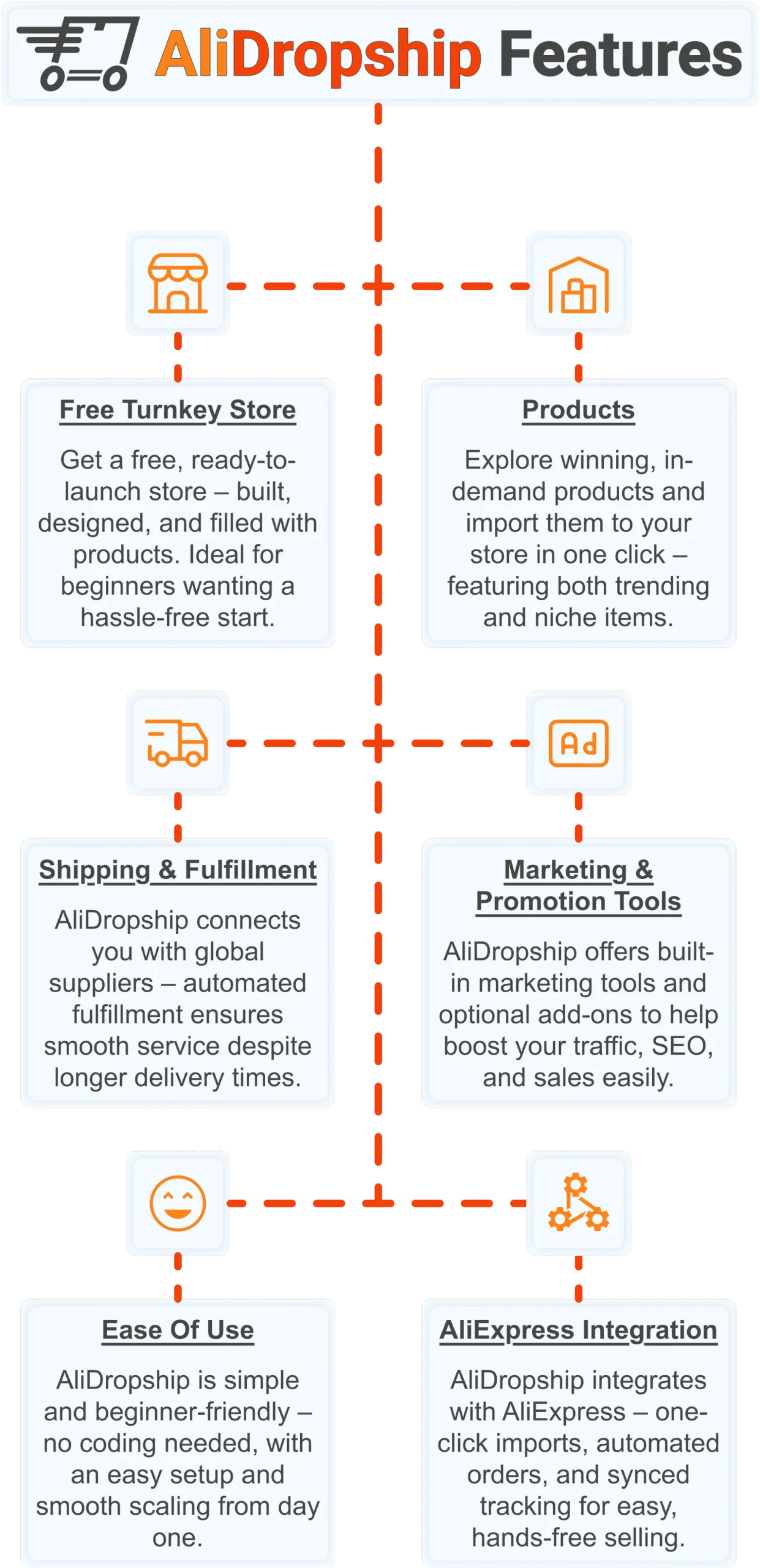
Get a free turnkey store – built, designed, and filled with products. Ideal for beginners wanting a hassle-free start, the store comes fully optimized to attract customers right away, saving you time on setup. Plus, it includes professional design elements to give your business a polished, trustworthy look from day one. This ready-made foundation makes it easy to move seamlessly into product selection.
Products 📦
Once your store is set up, you can explore winning, in-demand products and import them in one click – featuring both trending and niche items. This wide selection lets you cater to diverse customer interests and test what works best. Regular updates ensure you always have fresh products, keeping your store competitive and relevant. With great products in place, smooth shipping becomes the next essential step.
Shipping & fulfillment 🚚
AliDropship connects you with global suppliers, and automated fulfillment ensures seamless order processing despite international delivery times. Customers receive real-time tracking updates, which builds confidence and trust in your store. Once shipping is handled reliably, you can focus on promoting your store and attracting traffic.
Marketing & promotion tools 📣
To maximize sales, AliDropship offers built-in marketing tools and optional add-ons that help boost traffic, SEO, and conversions. From email campaigns and discounts to social media integration, these tools empower you to reach and retain customers without needing prior marketing experience. With promotion strategies in place, managing your business becomes simpler and more efficient.
Ease of use 👌
AliDropship is beginner-friendly – no coding needed, with an intuitive dashboard that guides you through every step. Easy setup and smooth scaling let you expand your store without stress. As your business grows, adding new features, products, and marketing campaigns remains hassle-free, giving you more time to focus on sales.
AliExpress integration 🛒
Finally, AliDropship integrates seamlessly with AliExpress, enabling one-click imports, automated orders, and synced tracking. Your inventory stays up-to-date with the latest products and prices, while automated order processing frees you from manual tasks. Combined with the turnkey setup, reliable shipping, and built-in marketing tools, this integration ensures your dropshipping business is fully equipped for growth and success.
Canva AI gives you the creative tools to make your store look outstanding – but an AI influencer is what turns that attention into revenue. Claim your free store and AI influencer team today and start selling with everything already in place.
What is Canva AI and what can it do?
Is Canva AI free to use?
Canva AI is partially free. The free plan includes limited access to Magic Media with around 50 generation credits per month and a lifetime allowance of 25 Magic Write uses. However, key ecommerce tools such as Background Remover and Magic Resize are only available on Canva Pro, which costs approximately 15 dollars per month for a single user. For occasional personal projects the free plan is sufficient, but sellers producing content at volume will need Pro to avoid hitting limits.
How can I use Canva AI for my ecommerce store?
The most practical workflow for ecommerce sellers involves four stages. First, use Background Remover to create clean product cut-outs from supplier photos. Second, use Magic Media to generate lifestyle backgrounds that match your brand. Third, use Magic Design to produce ad templates and social content around your products. Fourth, use Magic Resize to export each design across all the platform formats you need. Magic Write can handle product descriptions and ad copy throughout. This system reduces the time needed to produce a full suite of product visuals from several hours to under one hour per product.
Is Canva AI good enough to replace a professional designer?
For most standard ecommerce creative tasks, Canva AI produces results that are good enough to use commercially without additional professional work. Background Remover, Magic Resize, and Magic Design are reliable and consistent for everyday product content. Magic Media image generation has improved significantly and handles lifestyle and background imagery well. Where a professional designer still has an advantage is in complex brand identity work, highly custom illustration, and precise typographic layouts. For day-to-day content production, Canva AI covers 80 to 90 percent of what a solo ecommerce seller needs.
What are the best Canva AI tools for ecommerce marketing in 2026?
The five Canva AI tools that deliver the most value for ecommerce marketing in 2026 are Background Remover for clean product images, Magic Media for generating lifestyle imagery at scale, Magic Resize for multi-platform ad campaigns, Magic Write for drafting product descriptions and ad copy, and Magic Design for producing complete post and banner layouts quickly. Together these tools allow a single operator to maintain a professional visual presence across a store, social channels, and paid advertising without outsourcing design work or investing in multiple separate software subscriptions.