What Is The Best Online Business To Start? A 2026 Guide

Ask ten people what the best online business to start is, and you will probably get ten different answers. Most of them will not be wrong – they will just be incomplete. The honest answer depends on what you are starting with: your budget, your existing skills, and how quickly you need results. This guide cuts through the noise and gives you a practical breakdown of the top online business models in 2026, what each one realistically pays, and which fits your situation best.
Quick Answer: The best online business to start in 2026 is dropshipping for low-investment beginners, and freelancing for anyone with an existing marketable skill. Dropshipping can reach $500–$2,000/month within 90 days of consistent effort. Freelancing can generate income in the first 1–2 weeks. Both are scalable, legitimate, and accessible without technical experience.
Whether you are after a passive income online business or something you can grow into a full-time operation, the eight models covered below span the full range. Before exploring the options in detail, it helps to understand how to evaluate any online business idea so you can make a decision that actually holds up over time – not just one that sounds good on paper.

What is the best online business to start?
An online business is any income-generating operation you run primarily over the internet – selling products, offering services, creating content, or building an audience around a niche. What makes it different from a traditional business is the cost structure: no commercial lease, no local foot traffic requirement, and no large upfront inventory in most models. You can start lean, test fast, and scale what works.
The right model depends on three factors: how much capital you can invest upfront, what skills you already bring to the table, and how quickly you need to see a financial return. A graphic designer can sell their services on Fiverr this week. A complete beginner with $50 can launch a dropshipping store and test products in the same time frame. Neither path is wrong – they serve different starting points.
What separates a viable online business from a time sink is alignment between the model and the operator. The best online business to start with no money looks different from the best online business to start from home with a modest budget and a few focused hours each day. Both profiles are covered in this guide – matched to the right model in the final section.
One framework worth keeping in mind: the best online businesses combine low overhead with high scalability. The models that fit this description best in 2026 are dropshipping, affiliate marketing, and selling digital products. All three can run with minimal staff, zero inventory risk, and income that grows without proportionally increasing your time investment.
How much can you realistically earn from an online business?
Online business income varies enormously depending on the model, niche, and effort level. The table below gives a realistic snapshot of what consistent operators earn across the most popular models in 2026:
These figures reflect what real, consistent operators earn – not outlier viral cases. Most beginners see their first meaningful income after 60–90 days of genuine effort. Full-time results typically require 6–12 months of sustained work regardless of the model you choose.
One note on the ceiling figures: The “+” numbers in the table are real, but they require strong niche selection, reliable traffic, or both. Treat the lower end as your realistic 90-day target and the upper end as a 12-month horizon built on full-time effort and continuous testing.
The barrier to entry has never been lower across all of these models. Most can be started with under $100, and several require nothing more than a laptop and an internet connection. The models in the next section are presented in two groups: low-investment options for beginners starting from scratch, and skill-based models for anyone who can convert existing knowledge into immediate income.
Read through both groups before deciding. Many of the strongest setups combine one model from each – a product-based income stream running in the background while a skill-based one covers shorter-term cash flow needs.
The best online business ideas for 2026
Below are eight of the most tested and accessible paths to building an online income this year. Each includes a realistic earning range, a brief breakdown of how it works, and an honest note on what it actually takes to make it work.
Low-investment online business models
These models are designed for people starting with little or no capital. You do not need a product warehouse, a marketing degree, or a large team. What you need is a clear niche, a proven platform, and the consistency to follow a plan over 60–90 days.
Dropshipping
Dropshipping is one of the most recommended online business ideas for beginners in 2026 – and with good reason. You sell products through an online store without holding any inventory. When a customer places an order, your supplier ships directly to them. Your profit is the difference between what the customer pays and what the supplier charges.
Startup costs are low: a domain, a hosting plan, and a product sourcing tool are all you need to get started. Platforms like AliDropship automate the entire process – from product import to order fulfillment – and connect your store directly to AliExpress suppliers. A beginner store in a focused niche can realistically reach $500–$2,000/month within the first 90 days of consistent product testing and traffic work.
Under 10%
Tight — hard to sustain on paid traffic
10–15%
Marginal — slim cushion for refunds and ad cost shifts
15–20%
Healthy — cohort median sits at 19.2%
20–25%
Strong — outperforming the median operator
25%+
Excellent — top-tier product economics
Earning potential: $500–$10,000+/month, depending on niche, traffic source, and ad spend.
Why this works in 2026: Global ecommerce is growing at over 10% annually, and supplier networks have become significantly faster and more reliable – reducing the main historical complaint about the model: long delivery times.
Print on demand
Print on demand (POD) works similarly to dropshipping: you sell custom-designed products – t-shirts, mugs, phone cases, tote bags – and a third-party supplier prints and ships each item after a sale. Platforms like Printful and Printify integrate directly with Etsy, Shopify, and WooCommerce, with minimal setup required.
POD is an excellent model for anyone with a creative angle or an existing audience in a specific niche. Design skills help, but free tools like Canva make it accessible to complete beginners. The margin per item is smaller than dropshipping – typically $5–$15 per unit – which means volume and sharp niche targeting matter more here than in a standard ecommerce store.
Earning potential: $100–$3,000+/month. Realistic 60-day target: $300–$500/month with active promotion in a focused niche.
Affiliate marketing
Affiliate marketing is one of the most popular passive income online business models available today. You promote other companies’ products via unique referral links – on a blog, a YouTube channel, an email list, or a social profile – and earn a commission on every sale your link generates. You never handle inventory, customer service, or fulfillment.
Commission rates vary significantly by program. Amazon Associates pays 1–10% per sale depending on the category. Software and SaaS affiliate programs often pay 20–40% recurring commissions, which is where serious long-term affiliate income lives. A well-optimized blog post targeting a high-intent keyword can generate passive commissions for years with no ongoing effort once it ranks on Google.
Earning potential: $200–$5,000+/month for consistent affiliates. High-commission SaaS niches with strong organic traffic can reach $3,000–$10,000/month for established operators.
Why this works in 2026: Search demand for product comparisons and “best [X]” queries continues to grow. Niche authority sites built around genuine expertise consistently outperform broad content aggregators in search rankings.
Skill-based online business models
If you already have a marketable skill – writing, design, coding, teaching, or social media – you can convert it into income faster than any product-based model. These businesses trade time for money at the start, but most can be systematized and scaled over time with the right client base or audience.
Freelancing
Freelancing covers a wide range of services: copywriting, graphic design, web development, video editing, SEO consulting, and more. Platforms like Upwork, Fiverr, and Toptal give beginners direct access to a global client base without needing an existing professional network or a portfolio built for major brands.
Income scales with your rate and your capacity. Entry-level freelance writers typically earn $25–$50/hour. Experienced developers on specialist platforms charge $80–$200/hour. The main challenge is landing your first clients, which usually takes 2–4 weeks of active profile optimization and outreach on the right platform. After that, referrals and repeat clients reduce the need for constant prospecting.
Earning potential: $500–$8,000+/month. Freelancers with a stable client roster typically reach $3,000–$6,000/month within 6–12 months of consistent work.
Online tutoring and coaching
If you have expertise in any subject – academic, professional, or personal development – you can monetize it through online tutoring or coaching. Platforms like Teachable, Kajabi, and Udemy let you package your knowledge into structured courses. Tutoring marketplaces like Tutor.com and Varsity Tutors connect you directly with students who are actively searching for help in your area.
One-on-one coaching typically earns $50–$200/hour depending on the niche and your positioning. A well-built Udemy course in a popular category can generate $200–$1,500/month in passive income with no ongoing effort beyond occasional updates. The real upside comes when you combine live coaching with a scalable course product – one handles cash flow, the other builds passive income.
Earning potential: $300–$5,000+/month. Creators in business, productivity, and tech niches with an established audience regularly scale past $10,000/month.
Social media management
Businesses of all sizes need help managing their social media presence – creating content, scheduling posts, running paid ads, and growing their following. Social media management is one of the most profitable online business ideas for people who already understand how platforms like Instagram, TikTok, LinkedIn, or X actually work from an audience-growth perspective.
As a social media manager, you typically work with 3–6 clients at a time, charging $500–$2,000 per client per month depending on deliverables and platform scope. Building a portfolio from scratch takes 2–4 weeks – offer a discounted trial to a local business, manage a friend’s brand account, or build your own niche profile as a public proof of concept.
Earning potential: $1,000–$6,000+/month as a solo operator. An agency model with a small team can scale this well past $15,000/month.
Content creation and blogging
Blogging remains one of the best online businesses to start from home for anyone willing to play a longer game. A niche blog monetized through display ads (Mediavine or Raptive), affiliate links, and sponsored content can generate $1,000–$4,000/month – but reaching meaningful traffic levels typically requires 12–18 months of consistent publishing in a well-chosen niche.
YouTube and short-form video can move faster. Viral content can generate significant reach overnight, and monetization through AdSense, brand deals, merchandise, and affiliate links compounds over time. The key is picking a niche with clear audience demand and multiple monetization routes – not just the topic you find most interesting.
Earning potential: $100–$4,000+/month for established blogs. YouTube channels with 50,000+ subscribers can earn $500–$10,000+/month depending on niche and monetization mix.
Selling digital products
Digital products – ebooks, Notion templates, design presets, spreadsheet tools, printable planners, stock photography packs – are among the best low investment online business options available today. You create the product once and sell it unlimited times with no fulfillment cost. Gumroad, Etsy digital downloads, and WooCommerce are the most popular platforms for getting started.
A well-positioned Etsy digital product listing targeting a specific search term can generate $200–$800/month in passive income once it gains traction in platform search. Bundled template packs and organized product libraries tend to convert better than single-item listings. The main challenge is validating demand before investing time in creation – a quick search for competing listings on Etsy gives you a fast read on what buyers are actually looking for.
Earning potential: $200–$5,000+/month. Creators with an existing social media audience and a curated product library regularly exceed $3,000/month from Etsy and Gumroad alone.
Legal and ethical considerations for online businesses
Starting an online business is straightforward. Keeping it compliant and sustainable long-term is where many beginners fall short. These are the most commonly overlooked legal and ethical areas in the first year of operation.
Business registration: In most countries, generating income through an online operation – even from home – requires some form of business registration. In the US, forming an LLC is the most common structure for solo online business owners. It separates personal and business liability and typically costs $50–$500 depending on the state.
Taxes: Online income is taxable income. Freelancers, affiliate marketers, and ecommerce operators all need to track revenue and expenses, file quarterly estimated taxes if based in the US, and understand whether they are required to collect sales tax on products sold across different state or country lines.
FTC disclosure: If you earn affiliate commissions, you are legally required to disclose this to your audience – a clear statement at the top of any blog post, video, or social post that contains affiliate links. This is not optional under FTC guidelines, and non-compliance carries real penalty risk.
Key principle: Build on transparent practices from the start. Fake reviews, undisclosed sponsorships, and misleading product claims do not just risk legal penalties – they erode the audience trust that makes any online business sustainable over the long term.
The practical path forward: write honest reviews that acknowledge product weaknesses, disclose affiliate relationships clearly, use real product images, and grow your list with genuine opt-ins. These habits compound into long-term credibility that no paid campaign can replicate or buy.
Following these foundations does not slow you down – it actually removes the risk of losing everything you build to a policy strike or legal challenge. Every sustainable most profitable online business you can name is built on some version of these same transparent practices.
Which online business model is right for you?
Not every model suits every person. The right match comes down to your starting resources, available time, and income timeline. Here is a practical breakdown by reader profile.
Complete beginner
If you are starting from zero with little capital and no established skills, dropshipping is the clearest path into the best online business to start with no money. It requires minimal upfront investment, no product creation, and platforms like AliDropship handle the technical setup and supplier connections for you. Your job is niche selection and driving traffic – both learnable skills you can develop quickly and test with a small ad budget. A realistic 90-day target is $500–$1,500/month.
Intermediate / part-time operator
If you have some experience with online marketing, content creation, or an existing social media following, affiliate marketing combined with a niche blog or YouTube channel is a strong fit. The income curve is slower than dropshipping in the early months, but the passive income component compounds significantly over time. Budget 10–15 hours per week and expect meaningful income within 4–6 months of consistent publishing and link building.
Advanced / full-time goal
If your goal is to replace a full-time income within 12 months, combining an ecommerce store with a content marketing strategy gives you the best blend of near-term revenue and long-term scalability. A dropshipping store with consistent SEO-driven content can reach $3,000–$8,000/month within a year of focused effort. A freelance or consulting income stream in the early months can cover living costs while the store builds its own momentum.
Across all three profiles, the common thread is this: the best online business to start from home is the one you execute consistently. Ideas have no ceiling. Half-executed plans earn nothing. The eight models in this guide all work – the difference is the operator behind them.
AliDropship: Your complete all-in-one solution for starting dropshipping in 2026
If you want the simplest possible way to start dropshipping – especially if you’re brand new – AliDropship remains one of the most beginner-friendly tools available in 2026. It brings together store creation, product imports, automation, and marketing into a single streamlined system designed to help you launch quickly and grow confidently.
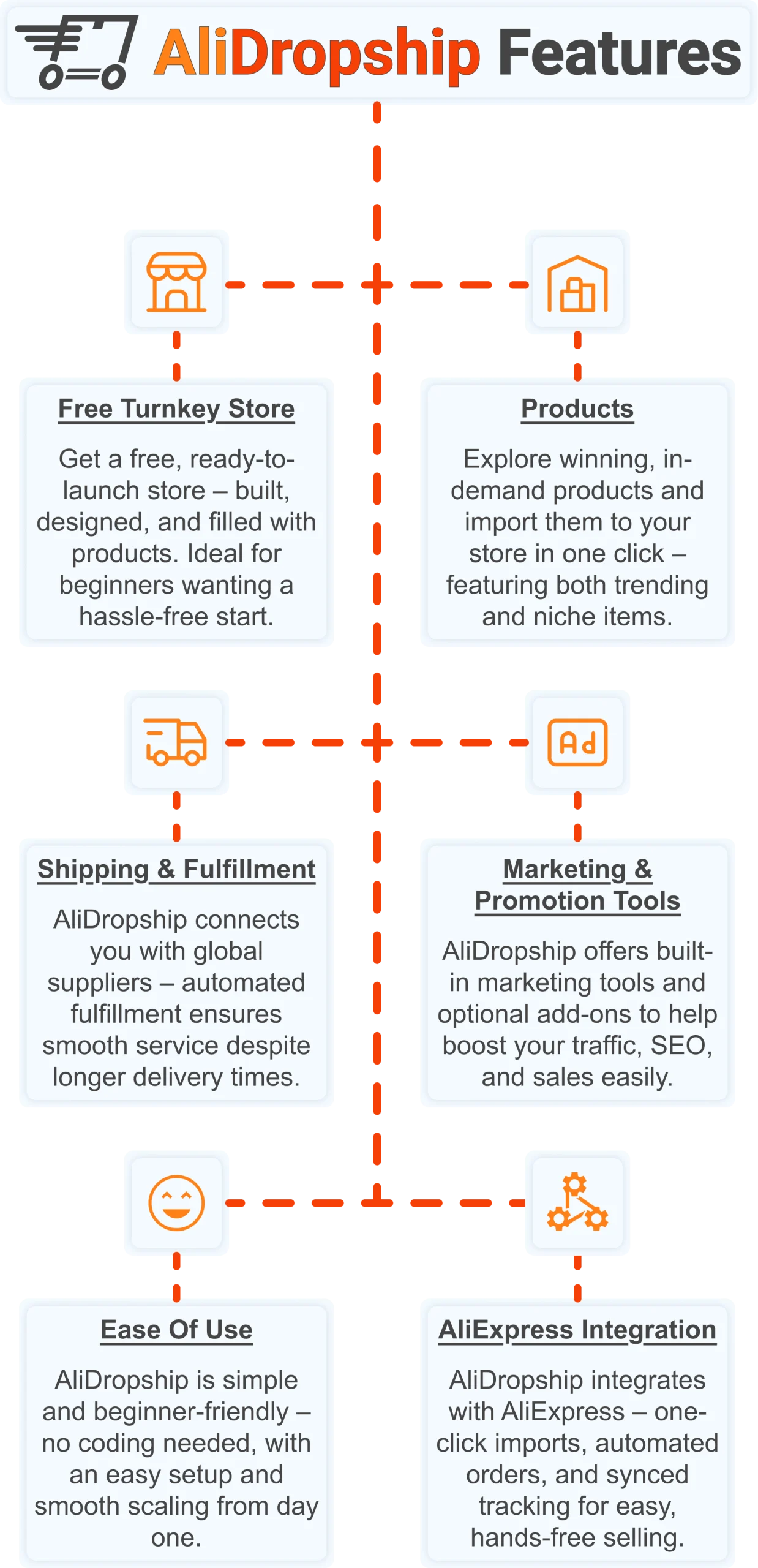
Free turnkey store 🛍️
Get a free turnkey store – built, designed, and filled with products. Ideal for beginners wanting a hassle-free start, the store comes fully optimized to attract customers right away, saving you time on setup. Plus, it includes professional design elements to give your business a polished, trustworthy look from day one. This ready-made foundation makes it easy to move seamlessly into product selection.
Products 📦
Once your store is set up, you can explore winning, in-demand products and import them in one click – featuring both trending and niche items. This wide selection lets you cater to diverse customer interests and test what works best. Regular updates ensure you always have fresh products, keeping your store competitive and relevant. With great products in place, smooth shipping becomes the next essential step.
Shipping & fulfillment 🚚
AliDropship connects you with global suppliers, and automated fulfillment ensures seamless order processing despite international delivery times. Customers receive real-time tracking updates, which builds confidence and trust in your store. Once shipping is handled reliably, you can focus on promoting your store and attracting traffic.
Marketing & promotion tools 📣
To maximize sales, AliDropship offers built-in marketing tools and optional add-ons that help boost traffic, SEO, and conversions. From email campaigns and discounts to social media integration, these tools empower you to reach and retain customers without needing prior marketing experience. With promotion strategies in place, managing your business becomes simpler and more efficient.
Ease of use 👌
AliDropship is beginner-friendly – no coding needed, with an intuitive dashboard that guides you through every step. Easy setup and smooth scaling let you expand your store without stress. As your business grows, adding new features, products, and marketing campaigns remains hassle-free, giving you more time to focus on sales.
AliExpress integration 🛒
Finally, AliDropship integrates seamlessly with AliExpress, enabling one-click imports, automated orders, and synced tracking. Your inventory stays up-to-date with the latest products and prices, while automated order processing frees you from manual tasks. Combined with the turnkey setup, reliable shipping, and built-in marketing tools, this integration ensures your dropshipping business is fully equipped for growth and success.
Starting the best online business does not have to mean building everything from scratch – AliDropship gives you a fully operational ecommerce store from day one. Get your free turnkey store today and start turning your online business goals into real, consistent income.
What is the best online business to start with no money?
Which online business model is most profitable for beginners?
How long does it take to make money with an online business?
What is the best low investment online business to start from home?
How much can a beginner realistically earn from an online business?