The Best AI A/B Testing Tools For Your Online Business In 2026
If you are running a dropshipping store, you have probably already changed a headline, a product photo, or a price at some point and just hoped it helped. Most sellers make these calls on gut feeling because that is faster than setting up a real test, but gut feeling is also how a lot of good pages get quietly turned into worse ones.
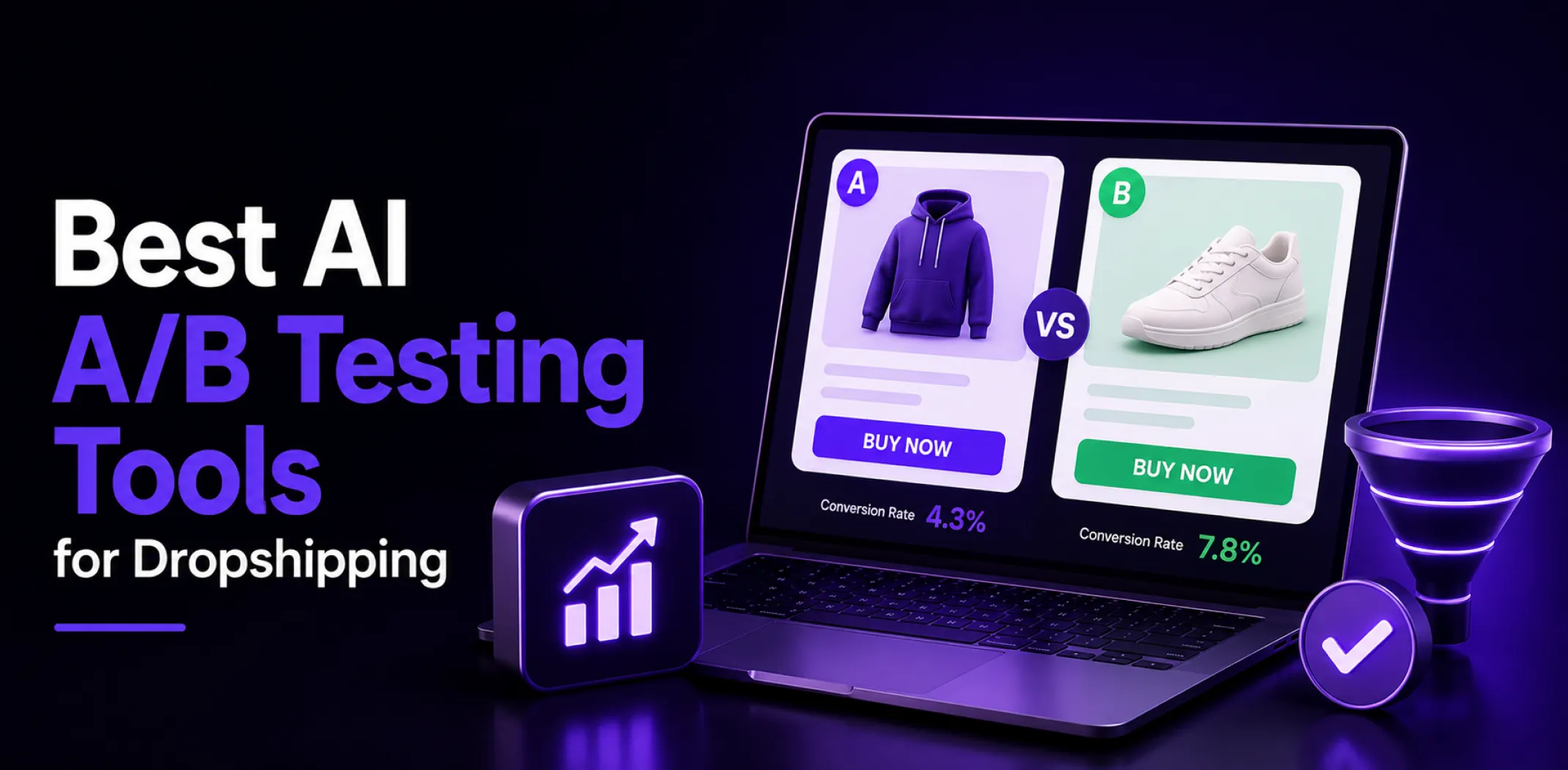
That is exactly the gap AI A/B testing tools are built to close in 2026: instead of guessing which version of a page performs better, you can show both versions to real visitors and let the data decide, before the wrong version ships permanently.
⚡
Quick Answer
Shopify Rollouts, free with any paid Shopify plan, is the best starting point for most dropshipping sellers, with VWO and Shoplift as the top picks once you want AI-generated test ideas beyond basic theme changes. All five options we tested are broken down below.
This guide profiles the AI tools sellers are actually using to test pages and pricing right now, not just the ones with the flashiest homepage. We looked at real, currently operating tools, checked their pricing, and paid attention to whether each one actually has enough traffic-handling depth to produce a trustworthy result rather than just a nicer dashboard.
Every tool below was checked against its own current pricing page rather than an old review, since plan tiers and platform features in this category shift within months of a tool launching.
One thing worth saying up front: none of these tools run your online store for you. They tell you which version of a page wins, not the business behind it. If you do not have a store ready to test in the first place, an AI A/B testing tool is solving the wrong problem, since there is nothing to optimize on a store that does not exist yet.
🛍️
📦
📣
Testing a page still needs a store to test on
14-day free trial • Cancel anytime • $39/month after trial
We will come back to that later in this guide, once the tools themselves are out of the way, because the store behind a winning test matters just as much as the test itself, no matter how confident the result looked.
Why AI A/B testing tools matter for dropshipping sellers in 2026
Most sellers do not test at all, and the ones who do rarely test enough to notice. Around 67 percent of ecommerce businesses run fewer than 5 A/B tests a year, which means most of the changes made to a store are simply never checked against what was there before or confirmed to actually help sales.
Stores testing fewer than 5 times a year
67%
67 percent of ecommerce businesses run fewer than 5 A/B tests a year, leaving most page changes unverified.
Test ideas that actually win
~12%
Analysis of over 127,000 experiments found only about 12 percent of tested ideas produce a real, statistically significant winner.
Lift from a winning product page test
12% to 28%
Product page tests, when they win, can drive conversion growth of 12 to 28 percent for that page.
Those numbers point at an uncomfortable truth: if only about 12 percent of test ideas actually win, that means the vast majority of changes sellers ship without testing are probably doing nothing, or quietly making things worse.
Most dropshipping sellers do not have a data scientist on staff, so the appeal of an AI A/B testing tool is not really about running more experiments for the sake of it, it is about finding out which of your instincts were actually right before you build a whole store around the wrong one, wasting time and traffic in the process without ever knowing why.
🛍️
📦
📣
Your store can launch while tests run
14-day free trial • Cancel anytime • $39/month after trial
Not every tool in this category is built the same way, and the differences matter more once you are actually running a store rather than just experimenting with a demo.
A tool that looks impressive testing a headline can still fall short once you are trying to test something that actually moves revenue, like a price or a shipping threshold, between customer messages and everything else a small store needs that day, all while a new product launch is also waiting on that decision.
Here is the criteria we used to evaluate the tools in this guide, and what each one means in practice for a dropshipping seller working with a modest budget and limited monthly traffic to run a test on.
🛍️
AI-generated test ideas, not just a blank builder
A tool that suggests what to test based on real visitor behavior saves you from guessing where to start. Look for AI-assisted test generation, not just an empty canvas.
Example: An AI suggestion that flags your mini-cart as underperforming can save weeks of guessing where to test first.
💸
Pricing that fits your actual order volume
Several tools in this category scale steeply with order volume, so a plan that lists at one price can quote at several times that once your store grows. Model the cost against your real traffic before committing.
Example: A plan listed at 349 dollars a month can be quoted at 1,279 dollars or more once a store passes a few hundred thousand orders.
🆓
A free tier or trial you can actually use
A real free plan or trial lets you run a first test before any money changes hands, which matters most when you are still building traffic and are not sure a test will even reach significance.
Example: A free plan supporting up to 50,000 monthly tracked visitors is usually enough for a new store first several tests.
🔗
Coverage for what you actually want to test
Some tools only reach theme and page layout, others can test prices, shipping thresholds, and offers. Match the tool to the test you actually need, not the other way around.
Example: A theme-only tool cannot test whether a 5 dollar price change affects profit per visitor.
With those four criteria in mind, here is how the tools sellers are actually using for A/B testing in 2026 stack up against each other, starting with the option that costs nothing beyond a paid Shopify plan and ending with the tool built for sellers who need to test across more than just a single storefront.
The best AI A/B testing tools in 2026
We profiled five tools sellers are actually using right now, from a native option built into Shopify itself to platforms built for pricing tests or cross-platform experimentation. Pricing and features below were checked against each tool own site rather than assumed, since this is a category that changes fast and a plan that looked generous a few months ago can quietly shrink its free tier without much notice.
AI Tool · Native theme and checkout testing
Shopify Rollouts
Free
Ease of useVery high
Testing depthLimited
Built into Shopify admin No third-party script Pairs with AI SimGym
Rollouts, found under Markets in the Shopify admin, lets you A/B test theme, checkout, and customer-account configurations natively, with audience splitting and statistical confidence built in, no third-party tool required. It pairs with SimGym, an AI simulation feature that tests changes against simulated shoppers before real traffic sees them. It does not test prices, discounts, or offer logic, which still requires a dedicated app.
✓
Tip: Use this as your baseline first for theme and layout tests, since it costs nothing beyond your existing Shopify plan and needs no extra script on your storefront.
AI Tool · Established experimentation platform
VWO
Free tier
Ease of useStrong
Testing depthStrong
Free up to 50K monthly users AI-suggested tests Bayesian SmartStats
VWO integrates with Shopify through a script tag and connects to any other platform too, offering AI-suggested experiments based on your traffic patterns and a Bayesian statistical engine that reports probability-to-beat-baseline in plain terms. A genuine free plan covers up to 50,000 monthly tracked users, with paid plans unlocking server-side testing and feature flags.
✓
Tip: The free tier is genuinely usable for a new store, so it is worth testing here before paying for a more specialized Shopify app.
AI Tool · Shopify theme and page testing
Shoplift
From ~$74/mo
Ease of useVery high
Testing depthStrong
Lift Assist AI variants Zero page flicker 14-day free trial
Shoplift runs split tests directly inside the Shopify theme customizer, and its Lift Assist feature analyzes shopper behavior to auto-generate branded test variants without writing code. It also tests product prices and shipping alongside theme and page layout. Entry pricing is reported from around 74 to 99 dollars a month depending on the source and plan tier.
⚠️
Warning: Reviewers report a measurable page speed impact from running split tests through the theme, so weigh that against the value of the tests you plan to run.
Those three cover the free-to-affordable end of the spectrum, and any one of them is a reasonable place to start if you are testing theme and page-level changes. The next two lean more toward sellers who specifically want to test pricing and profit, or who need to run experiments beyond just Shopify, since neither one makes much sense until basic layout tests are already running.
🛍️
📦
📣
Your store can be ready before your test even finishes
14-day free trial • Cancel anytime • $39/month after trial
Revenue-aware analytics Live price and shipping tests Unlimited tests on every tier
Intelligems is consistently ranked as the strongest Shopify tool for testing prices, shipping thresholds, and offers, with analytics built around revenue and profit rather than clicks alone. Entry content-testing plans start around 49 to 79 dollars a month, with live price and shipping testing gated to a higher plan around 499 dollars, and every tier scales with your order volume.
⚠️
Warning: The sticker price is only the entry point. Every plan scales with order volume, so a plan that lists at a few hundred dollars can quote significantly higher once your store grows.
AI Tool · Cross-platform experimentation
Convert.com
From ~$299/mo
Ease of useStrong
Platform flexibilityExceptional
Shopify, WooCommerce, headless Flat-rate pricing tiers Scales by tested users
Convert.com works across Shopify, WooCommerce, custom stacks, and headless commerce setups, which makes it a fit for sellers running more than one storefront or planning to move off Shopify eventually. Plans publish flat rates that scale by monthly tested users, starting around 299 dollars a month for 100,000 tested users on annual billing.
✓
Tip: This is the tool to reach for if you are running tests across more than one storefront or platform, not just a single Shopify store.
Here is how all five compare side by side on the basics, so you can shortlist one or two before reading further into how each one actually fits a dropshipping workflow, particularly if you are deciding between a native option and a dedicated app.
Tool
Best for
Starting price
Shopify Rollouts
Zero-cost theme and checkout testing
Free with a paid Shopify plan
VWO
AI-suggested tests, genuine free tier
Free up to 50K monthly users
Shoplift
AI-generated theme and page variants
From about 74 to 99 dollars a month
Intelligems
Live price and profit testing
From about 49 dollars, scaling with orders
Convert.com
Testing beyond a single Shopify store
From about 299 dollars a month
A quick note on how fast this list can change: AI A/B testing tool pricing, order-volume scaling, and platform features are revised often, and Shopify own native testing capability has expanded more than once within the past year alone. That is not a reason to avoid the category, it is just a reason to check the live pricing page rather than trust a number from an older review, including this one, before you commit to any single platform.
⚠️
Warning
Confirm current pricing and exactly how it scales with your order volume on the tool own site before you subscribe. A published price from even a few months ago can already be out of date.
With that caution noted, the practical starting point for most sellers is Shopify Rollouts for theme tests, then a paid tool once you know whether the bottleneck is pricing, page design, or testing across more than one storefront. Jumping straight to the most expensive tool rarely buys better results if traffic is not yet high enough to reach a trustworthy conclusion in a reasonable amount of time.
🛍️
📦
📣
Your store is faster to launch than a test cycle
14-day free trial • Cancel anytime • $39/month after trial
Every seller ends up asking some version of the same question: do I really need a testing tool when I could just pick the version that looks better to me and move on. The honest answer is that it depends on how much revenue is riding on the decision, how many products the change affects, and how confident you actually are that your gut feeling matches what real visitors will do.
Gut-feeling path
Picking the version you prefer
No data, just a personal call
Cost0 dollars
Confidence in the resultNone, just an opinion
Risk of shipping a loserAbout 88 in 100 ideas
Time to decideMinutes
Where it livesWhatever you shipped
⚠️ Costs nothing and feels productive, but with only about 12 percent of ideas actually winning, most gut calls are a coin flip at best.
Testing path
Running a real A/B test
VWO, Shoplift, Intelligems, or Convert.com
CostFree to about 300 plus dollars
Confidence in the resultStatistical significance
Risk of shipping a loserCaught before it ships
Time to decideAt least 2 full weeks
Where it livesReal visitor data
✓ It takes longer to get an answer, but that answer is backed by real visitor behavior instead of a guess made in a few minutes.
A common pattern among sellers who scale past their first few products is to start with Shopify Rollouts for basic theme tests, then add a dedicated pricing or cross-platform tool once traffic is high enough to reach statistical significance in a reasonable timeframe.
Testing a small change with very little traffic usually just means waiting a long time for an inconclusive result, since the free option already covers early-stage testing well and the money is often better spent building traffic first.
14-day free trial · Cancel anytime · $39/month after trial
Common mistakes and objections
Before you pick a tool and start testing, it helps to clear up the three things almost every seller wonders about before touching an AI A/B testing tool for the first time, since hesitating over these questions is usually what delays the first real test the longest.
Before you scroll past
The three things most people wonder about
🤔
Do I have enough traffic to run a valid test?
Detecting a meaningful change in conversion typically takes tens of thousands of visitors per test. If your store is still new, start with high-impact pages that get the most traffic first, rather than testing a low-traffic corner of the site.
💸
Is not A/B testing just for big enterprise stores?
No. Several tools in this guide have genuine free tiers or entry plans under 100 dollars a month, built specifically for smaller stores rather than enterprise teams.
🔍
What if my test does not show a clear winner?
That is still useful information. It usually means the change was not the leverage point you thought it was, which tells you to redirect testing effort toward a higher-impact page instead of guessing again.
Once those questions are out of the way, the last piece is deciding whether the tool needs to work harder, or your offer does. A winning test result can only do so much if the store it runs on is slow, confusing, or missing basic trust signals, which is where having a store built for conversion, not just a page tuned by testing, starts to matter just as much as the traffic that reached that page in the first place, no matter how carefully that traffic was earned.
Skip the guesswork on your next test
Keep up to 70%
14-day free trial • Cancel anytime • $39/month after trial
Picking a tool is only half the job, and it is usually the smaller half. These are the habits that separate sellers who get genuinely trustworthy results from these tools from sellers who call a winner too early and ship a change that never actually helped.
01
Run a test for at least 2 full weeks before calling a winner
Shopper behavior shifts across weekdays and weekends. Calling a winner based on a few days of partial data is one of the most common causes of false positives in ecommerce testing.
02
Target 95 percent statistical confidence, not just a better-looking number
A variation that looks 3 percent better after 2 days is not the same as a variation confirmed to actually convert better. Wait for the confidence level your tool reports before shipping the change.
03
Test high-leverage pages first, not just button colors
Product page structure, pricing, and checkout flow tend to move revenue far more than a color swap. Spend your limited traffic on the tests most likely to actually matter.
04
Make sure you have enough traffic before testing a small change
A subtle change on a low-traffic page can take months to reach significance, if it ever does. Save subtle tests for your highest-traffic pages and start with bigger, more obvious changes elsewhere.
05
Track revenue per visitor, not just clicks or conversion rate alone
A variation can lift clicks while quietly lowering average order value, or lift conversion while lowering profit margin. Watching revenue per visitor catches trade-offs a simple click count misses.
None of these habits require a big team or a big budget. They just require treating testing as an ongoing discipline rather than a one-time experiment, which is exactly what these AI tools are designed to support once a real testing habit takes hold week after week.
✓
Tip
Keep a running log of every test you run, win or lose. A losing test still tells you something about what visitors do not respond to, and that record becomes genuinely useful once you have run a dozen or more experiments.
Once you have a testing habit running, the next question is usually not about the tool at all. It is about what happens after a test confirms a winner, which is where the store behind the page starts to matter just as much as the test itself, no matter how confident that result turned out to be or how long it took to reach it.
Are you ready to stop guessing what works?
Your AliDropship store comes prebuilt and stocked, ready for whatever your tests prove works.
14-day free trial · Cancel anytime · $39/month after trial
AliDropship: The store your tests prove out
No experience? No problem. If you want the simplest way to start an online business in 2026, AliDropship is one of the most beginner-friendly platforms out there. It brings your store, your products, your fulfillment, and your marketing together in one place, so you can launch fast and grow with confidence.
Over 1,500,000 stores have already been built on AliDropship, and the platform has been featured by Forbes, Entrepreneur, Inc., NBC, Business, and Fox News.
1.5M+
stores launched
4.7★
on Trustpilot
150+
countries served
🛍️
Free turnkey store
Your store comes fully built, designed, and stocked with products, ready to go the moment you sign up. There is nothing to code and nothing to design from scratch. It looks polished and professional from day one, so you can skip the setup work and get straight to the business.
📦
Products
Once your store is live, you can build your catalog with digital products like guides, courses, and AI-powered toolkits that are delivered instantly and let you keep up to 70 percent margin of each sale, plus a smaller curated lineup of physical items if you want more variety. New products are added regularly, so your store always has something fresh to offer. With your lineup sorted, fulfillment is the next box to check.
⚡
Instant fulfillment
Every digital product delivers itself the moment a customer buys, no packing, no shipping, no waiting. Guides, courses, and AI-powered toolkits arrive automatically, so you never touch a single box. If you also carry physical items, AliDropship supplier network ships those directly to the buyer too. Either way, fulfillment runs itself, so you are free to focus on bringing in customers.
📣
Marketing and promotion tools
To help you sell, AliDropship built-in ad system is its most popular feature, while most platforms expect you to learn and manage your own marketing, this one does it for you, so there is no need to set up Google Ads or Facebook Ads yourself. Choose your daily budget, anywhere from $10 to $50, and the system handles targeting, creatives, and optimization behind the scenes. No marketing background needed: your store can start selling the same day you turn ads on.
👌
Ease of use
AliDropship is built for beginners: no coding, no confusing dashboards, just a simple, guided setup that walks you through every step. The whole platform works right from your phone, and a personal growth manager is available by chat if you ever get stuck. As you grow, adding new products, ads, and features stays just as simple, so scaling never feels overwhelming.
Think of the tools in this guide as the method, and AliDropship as the store that method gets applied to. A confirmed winning test with no real store behind it is just a spreadsheet full of statistics, however solid the confidence level looked.
Pairing genuine, tested improvements with a store that is already built, stocked, and ready to sell is what turns a validated result into an actual outcome instead of an interesting number that never earns back the time spent running the test.
Before you decide
Everything included to make starting easy
🆓
14-day free trial
Full platform access. No credit card required to start.
🎯
$40 ad coupon included
Your first campaign costs nothing, the coupon covers it.
❌
Cancel anytime
No lock-in. No cancellation fees. Leave any time.
🏪
Store built for you
No setup, no design, no coding. It is ready when you are.
📦
No inventory ever
Suppliers handle everything. You never touch a product.
If you have already confirmed a winning test and traffic is responding well, this is usually the point where having a store already built saves you the most time, since scrambling to fix an unfinished storefront after a test proves out means losing the exact window when that validated change could actually compound into real, lasting revenue.
Whether you start with Shopify Rollouts alone or add a dedicated testing platform, the store your test results feed into matters just as much as the test itself. The tools in this guide can tell you which version wins, but only a real, ready-to-sell store can turn that winning version into a customer, and that is the part worth getting right before you run another test or spend another hour comparing tools.
Your store comes prebuilt and stocked, so every winning test has somewhere real to prove itself.
14-day free trial $39/month after Cancel anytime $40 ad coupon included
✓ Store built for you ✓ No inventory ✓ Automated fulfillment
FAQ
What is the best AI A/B testing tool for dropshipping?
There is no single best tool for every seller. Shopify Rollouts is free with any paid Shopify plan and covers basic theme and checkout tests, which is enough for most sellers just getting started. For pricing tests or cross-platform experimentation, sellers commonly pair that with a paid tool such as VWO, Shoplift, Intelligems, or Convert.com, with entry pricing ranging from free to about 299 dollars a month.
Do I need coding skills to run an A/B test?
No. Most tools, including Shopify Rollouts and Shoplift, let you build a test inside a visual editor or theme customizer, and some include AI features that generate a test variant for you automatically.
How much does it cost to A/B test a dropshipping store?
Costs range from free to about 300 dollars a month, and some tools scale their price with your order volume, so the sticker price is not always the final cost. Fraud-style enterprise tools quote custom pricing based on traffic.
How long should an A/B test run before I trust the result?
Most guidance recommends running a test for at least 2 full weeks to account for weekday and weekend behavior, and waiting for 95 percent statistical confidence before treating a result as reliable.
Can I use AI A/B testing to promote an AliDropship store?
Yes. AI A/B testing tools identify which version of a page or price performs better, and AliDropship provides the store, products, and fulfillment behind the click. The two work together rather than replacing each other, since even a proven winning test still needs a real store to sell on.