AI Tools To Make Money Online: The Ecommerce Edition


AI is no longer a nice-to-have for online sellers. In 2026, it is the single biggest lever separating stores that grow from stores that stall. Whether you are writing product descriptions, recovering abandoned carts, or figuring out which items to stock next, there is an AI tool that does it faster – and usually better – than the manual approach.
The question is not whether to use AI tools to make money with ecommerce. The question is which ones actually move the needle, and how to plug them into your store without wasting a month testing software that goes nowhere.
Quick answer: The best AI tools to make money with ecommerce in 2026 cover five core areas – product research, content creation, SEO, customer support, and marketing automation. Used together, they can save 15–20 hours a week and materially lift conversion rates.
This guide walks you through each category, names the tools worth your time, and gives you a realistic picture of what each one can earn you – or save you – per month. No fluff, no tools included just to pad the list.
What does “AI tools to make money” actually mean for ecommerce?
The phrase gets used broadly – sometimes to mean AI art generators, sometimes chatbots, sometimes crypto trading bots. For ecommerce sellers, it means something more specific: software that uses machine learning or large language models to automate a task that previously required manual effort, a freelancer, or an expensive agency.
In practice, that covers a wide range of functions. An AI writing tool generates product descriptions in seconds instead of hours. An AI SEO platform tells you exactly why your page is not ranking and what to change. An AI customer support agent answers buyer questions at 2 a.m. without a human on call. An AI product research tool scans sales data across thousands of listings to surface trending items before they peak.
Each of these is a direct path to more revenue or lower costs – which is the same thing as making more money. The key is to think of AI tools not as a replacement for your business strategy, but as an accelerant for the parts of your workflow that eat time without generating proportional value.
Why this works in 2026: AI adoption in ecommerce has crossed a tipping point. Over 50% of ecommerce businesses are now using some form of AI, and stores that automate effectively are consistently outpacing competitors who rely on manual processes across every key metric.
GET YOUR AI INFLUENCER + STORE
How much can you realistically earn with AI-powered ecommerce?
The honest answer depends heavily on how you use these tools and how much effort you put into your store overall. AI does not run a business for you – it removes friction from the parts that usually slow you down. With that said, the numbers are genuinely encouraging for people who apply them consistently.
These figures are not ceilings – they are realistic starting points for a store with modest traffic and a lean team. As your volume grows, the compounding effect of automation becomes significantly more pronounced.
One note on income expectations: AI tools amplify what is already working. If your store has solid products and a real audience, these tools accelerate growth. If your fundamentals need work, no tool will substitute for them. Plan for 60–90 days before you see meaningful results from SEO or marketing automation changes.
The stores consistently hitting $50–$150/day in net profit in 2026 are not doing so through exotic strategies. They are doing it by systematically removing bottlenecks – and AI tools are the most efficient way to do that at low cost.
BUILD YOUR INCOME WITH AN AI INFLUENCER
The best AI tools to make money with ecommerce in 2026
Here is a practical breakdown by category – the tools that have demonstrated real results for ecommerce store owners, with notes on what each one actually does and where it fits in your workflow.
AI tools for product research and trend spotting
Picking the right products is still the single most important decision in dropshipping. AI has made the process dramatically faster – and more accurate – than manual research on AliExpress or Amazon bestseller lists.
Sell The Trend
Sell The Trend uses machine learning to scan sales data across multiple marketplaces and surface products with rising demand before they hit mainstream awareness.
The platform tracks engagement metrics, order velocity, and cross-platform trends simultaneously, so you are not relying on a single data point. It also includes a one-click import feature compatible with major ecommerce platforms, which removes the gap between spotting a product and actually listing it.
Earning potential: Access to trending products before saturation is the difference between $5 margins and $25+ margins on the same item. Stores using data-driven product selection consistently report higher average order values.
Minea
Minea focuses on ad intelligence – it shows you which products are currently being advertised on Facebook, TikTok, and Pinterest, and how those ads are performing.
For dropshippers, this is invaluable: if a competitor is spending money on ads for a product, it is already selling. Minea removes the guesswork from your ad creative research at the same time, because you can see exactly what formats and angles are getting engagement.
Earning potential: Validated products from ad intelligence research tend to convert 20–40% better than self-sourced products, because market demand has already been confirmed.
AliExpress Dropshipping Center
Free and often underused, the AliExpress Dropshipping Center includes an AI-powered product analysis tool that scores items on order volume, seller reliability, and shipping performance. It is not as sophisticated as Sell The Trend or Minea, but it requires no subscription and integrates directly with your AliDropship store. Use it as a first filter before committing to deeper research on a niche.
Earning potential: Filtering out unreliable suppliers before listing saves you from refund spirals that can wipe out weeks of margin.
AI tools for content creation and product descriptions
Writing product descriptions, email sequences, and ad copy manually is one of the biggest time sinks in ecommerce. It is also one of the easiest to hand off to AI – with consistently good results once you know how to prompt correctly.
ChatGPT (GPT-4o)
ChatGPT remains the most versatile AI content tool available for ecommerce in 2026. A Plus plan at $20/month gives you access to GPT-4o, which handles product descriptions, email subject line testing, ad copy variations, blog outlines, and customer FAQ drafts.
The key is setting up a system prompt that encodes your brand voice, target audience, and tone – once that is done, content output becomes highly consistent and requires only light editing before publishing.
Earning potential: Replacing freelance copywriting with ChatGPT saves most solo store owners $300–$600/month. More importantly, faster content production means faster product launches.
Jasper AI
Jasper is more expensive than ChatGPT at $49/month, but it earns its place for stores with multiple writers or VAs. Its brand voice feature ensures that every piece of content – regardless of who writes it – sounds like the same store.
For ecommerce teams producing high-volume content across product pages, email campaigns, and blog posts, that consistency has a measurable impact on trust and conversion. Jasper also has templates built specifically for ecommerce use cases, which reduces the time spent on prompt engineering.
Earning potential: Consistent brand voice across all touchpoints typically lifts repeat purchase rates, which is where most ecommerce profit actually comes from.
Grammarly
Grammarly is often overlooked as a serious ecommerce tool, but its AI-powered writing assistant does more than catch typos. The Business plan includes tone adjustment, clarity scoring, and brand consistency checks that are genuinely useful when you are publishing dozens of product pages per month.
A product description with a grammar error or an off-tone sentence signals unprofessionalism to a buyer who is already on the fence – Grammarly eliminates that risk efficiently. A free plan covers basic checking, with paid plans starting around $12/month.
Earning potential: Cleaner, more professional copy reduces bounce rates on product pages and increases the likelihood of conversion from cold traffic.
AI tools for SEO and organic traffic
Paid ads are expensive and increasingly competitive. Organic traffic – built through solid SEO – is the most sustainable revenue source for any ecommerce store. AI has made SEO work faster and more precise than it has ever been.
Surfer SEO
Surfer SEO analyzes the top-ranking pages for any keyword and tells you exactly what your content needs to match or beat them – word count, keyword density, heading structure, internal links, and more. Its real-time content editor scores your work as you write, which removes the guesswork from on-page optimization.
For store owners publishing blog content or product category pages targeting specific search terms, Surfer is one of the most direct paths to ranking faster.
Earning potential: A well-optimized blog driving consistent organic traffic can generate 30–80% more monthly visits within 60–90 days of implementation, translating directly to store revenue without additional ad spend.
Semrush AI Writing Assistant
Semrush has long been a standard in professional SEO, and its AI Writing Assistant brings content optimization directly into the content creation workflow. It evaluates your text against top-performing pages, flags keyword gaps, and suggests structural improvements – all without switching between tools.
For store owners who are already using Semrush for keyword research, the AI assistant is a natural addition that tightens the loop between research and execution.
Earning potential: Closing keyword gaps in existing product and category pages often produces revenue gains faster than creating new content, because the pages are already indexed.
AI tools for customer support and retention
Customer support is where many growing ecommerce stores hit a wall. Order volume increases, but so do the number of questions, complaints, and refund requests. AI support tools handle the volume without proportionally increasing your costs.
Tidio
Tidio is the go-to AI customer support tool for small and mid-sized ecommerce stores. Its AI chatbot handles pre-sale questions, order status enquiries, and simple returns automatically – 24 hours a day, seven days a week.
The setup is fast, the interface is clean, and it integrates directly with WooCommerce and other major platforms. For stores that do not yet have a dedicated support agent, Tidio effectively removes the ceiling on how many customers you can serve simultaneously.
Earning potential: Instant responses to pre-sale questions convert hesitant buyers at significantly higher rates than a 24-hour email reply window. Tidio users report conversion improvements of 10–20% on chat-assisted sessions.
Gorgias
Gorgias is built for higher-volume Shopify and WooCommerce stores that need AI-assisted replies integrated into a proper helpdesk workflow.
Rather than fully automating responses, Gorgias surfaces suggested replies based on previous conversations, order data, and your support documentation – letting a single human agent handle a volume that would normally require a small team. If you are already past the stage where Tidio is sufficient, Gorgias is the natural next step.
Earning potential: Maintaining fast, high-quality support at scale reduces churn and increases the lifetime value of your existing customer base – which is always more cost-effective than acquiring new buyers.
AI tools for marketing automation and conversion
The average ecommerce store loses 70% of potential revenue to cart abandonment. Marketing automation powered by AI recovers a meaningful portion of that, while also improving repeat purchase rates from existing customers.
Klaviyo
Klaviyo is the most widely used AI-powered email marketing platform in ecommerce, and for good reason.
Its predictive analytics engine segments customers based on purchase behavior, predicts who is likely to buy again and when, and triggers automated flows – welcome sequences, abandoned cart recovery, post-purchase follow-ups, and win-back campaigns – without any manual input once they are set up.
The platform also handles SMS marketing within the same interface, which simplifies multi-channel automation considerably.
Earning potential: Well-configured abandoned cart flows alone recover 10–15% of lost revenue per month. For a store generating $5,000/month, that is $500–$750 in otherwise-missed sales.
Wisepops
Wisepops uses AI to generate personalized product recommendations delivered through popups, embedded widgets, and onsite notification feeds. It analyzes browsing behavior and purchase history to suggest relevant items at the right moment – which meaningfully increases average order value without requiring a larger traffic budget.
For stores with 100+ products, the difference between a generic “you might also like” widget and an AI-personalized recommendation is measurable in both click-through rate and revenue per session.
Earning potential: AI-driven personalized recommendations contribute to a 15–20% increase in conversion rates across ecommerce stores that implement them consistently.
Comparing the top AI tools by use case and cost
Most solo store owners can build a functional AI stack for $80–$150/month by starting with ChatGPT, Tidio, and Klaviyo – then adding SEO and product research tools once revenue justifies the additional spend.
START SELLING WITH AN AI INFLUENCER
How to use AI tools to make money: practical tips for ecommerce sellers
Having the right tools is one thing. Knowing how to deploy them in a way that actually improves your bottom line is another. Here are the practices that separate stores getting real results from stores that are paying for software they barely use.
Start with your biggest bottleneck, not the flashiest tool
The most common mistake new AI adopters make is chasing novelty. They sign up for an AI image generator or a trend prediction platform before they have fixed the obvious problems in their store – slow product pages, no email follow-up sequence, or product descriptions written in broken English. Audit your store first. Identify where the most revenue is being lost. Then match an AI tool to that specific problem.
Use AI to compress the product launch cycle
One of the clearest competitive advantages AI gives ecommerce sellers is speed. From trend identification to live listing, a process that used to take days – research, supplier outreach, photography, copywriting, SEO setup – can now happen in hours.
Use Sell The Trend or Minea to validate a product, use ChatGPT to write the description and email announcement, and use Surfer SEO to ensure the product page is optimized before it goes live. Moving faster than competitors on trending products is one of the most reliable ways to capture margin before a market gets saturated.
Do not neglect the post-purchase sequence
Most AI marketing advice focuses on driving traffic and converting new buyers. Repeat customers are significantly more valuable and significantly cheaper to retain.
Set up a Klaviyo post-purchase flow that thanks the customer, sets shipping expectations, asks for a review, and presents a relevant upsell 7–10 days after delivery. This sequence runs automatically and compounds in value as your customer base grows.
Test and measure before scaling
AI tools frequently include A/B testing functionality – use it. Whether it is subject line variants in Klaviyo, popup timing in Wisepops, or content scoring targets in Surfer, run controlled tests before applying changes site-wide. A 5% improvement in conversion rate compounded across all your traffic is worth considerably more than any individual tool subscription.
Combine AI tools with a solid store foundation
This point is worth stating plainly: AI tools amplify what is already working. A professionally built store with clean navigation, fast load times, and trustworthy product pages will see dramatically better results from AI marketing and SEO tools than a generic template store with no brand identity. The foundation matters – and it is the one thing that should not be rushed or skimped on.
Pro Tip: Run a monthly AI tool audit. For each subscription, ask what specific metric has improved since you started using it. If you cannot answer that question, either you have not given it enough time or it is not the right tool for your current stage.
Which AI tools should you start with? A guide by seller profile
Complete beginner
If you are starting from zero, do not try to implement every tool at once. Begin with ChatGPT for your product descriptions and store copy – it is affordable, flexible, and immediately useful. Pair it with Tidio on the free plan to handle basic customer queries. These two tools together cost $20/month or less and cover the most critical early-stage needs. Focus on getting your first 10–20 sales before adding complexity.
Intermediate – running a store, growing toward full-time
At this stage, your biggest leverage points shift to SEO and marketing automation. Add Surfer SEO to optimize your product category pages and blog content for organic traffic. Set up Klaviyo email flows – abandoned cart recovery and post-purchase sequences are the highest priority. Budget $80–$120/month for this expanded stack and expect meaningful traffic and revenue improvements within 60–90 days.
Advanced – full-time seller, scaling aggressively
At full-time scale, your AI stack should cover every stage of the funnel. Layer in Minea or Sell The Trend for continuous product research, Jasper for brand-consistent content at volume, Gorgias for high-ticket support management, and Wisepops for AI-driven personalization and upsell.
Your total tool spend will likely run $200–$400/month, but the returns on automation at this level are proportionally much larger. Focus on consolidation – fewer, deeper tool integrations beat a fragmented stack every time.
Seller focused on organic growth over paid ads
If you want to build a store that does not depend on an ongoing ad budget, SEO and content are your primary levers. Prioritize Surfer SEO, Semrush, and a consistent ChatGPT-assisted blog publishing schedule. This approach takes longer – plan for 90–180 days before organic traffic becomes a meaningful revenue driver – but the long-term unit economics are significantly stronger than ad-dependent models.
CLAIM YOUR AI INFLUENCER OFFER
Legal and ethical considerations when using AI tools
AI tools are legitimate and powerful – but there are a few areas where misuse creates real risk for your business, both legally and reputationally.
Do not publish AI content without reviewing it
AI writing tools occasionally produce inaccurate claims, outdated data, or phrasing that does not reflect your brand correctly. Every piece of AI-generated content – product descriptions, emails, blog posts – should pass through a human review before it is published. This is not about distrust of AI; it is about maintaining the accuracy and quality that your customers expect. A product description that overstates a feature or uses a supplier-specific claim that is not verified by you creates a customer service problem and a potential returns liability.
Key principle: AI is a first draft, not a final draft. Edit before you publish.
Do not use AI to generate fake reviews
This is worth stating clearly because it does come up. AI can write convincing fake reviews – but publishing them on your store or on third-party platforms is deceptive, violates platform terms of service, and in many jurisdictions is now explicitly illegal under consumer protection law.
The risk of account suspension, legal exposure, and brand damage far outweighs any short-term conversion lift. Legitimate review generation through post-purchase email sequences – which Klaviyo handles automatically – is both more effective and entirely above board.
Be transparent about AI-generated content where it matters
In most ecommerce contexts – product descriptions, email copy, ad creatives – there is no obligation to disclose AI use, and doing so would be unusual.
However, if you are producing educational content, reviews, or comparison articles as part of a content marketing strategy, the expectation of human expertise and genuine experience is real. AI-assisted research and drafting is fine; passing off an AI-generated opinion as a personal tested review is not.
AliDropship: Your complete all-in-one solution for starting dropshipping in 2026
If you want the simplest possible way to start dropshipping – especially if you’re brand new – AliDropship remains one of the most beginner-friendly tools available in 2026. It brings together store creation, product imports, automation, and marketing into a single streamlined system designed to help you launch quickly and grow confidently.
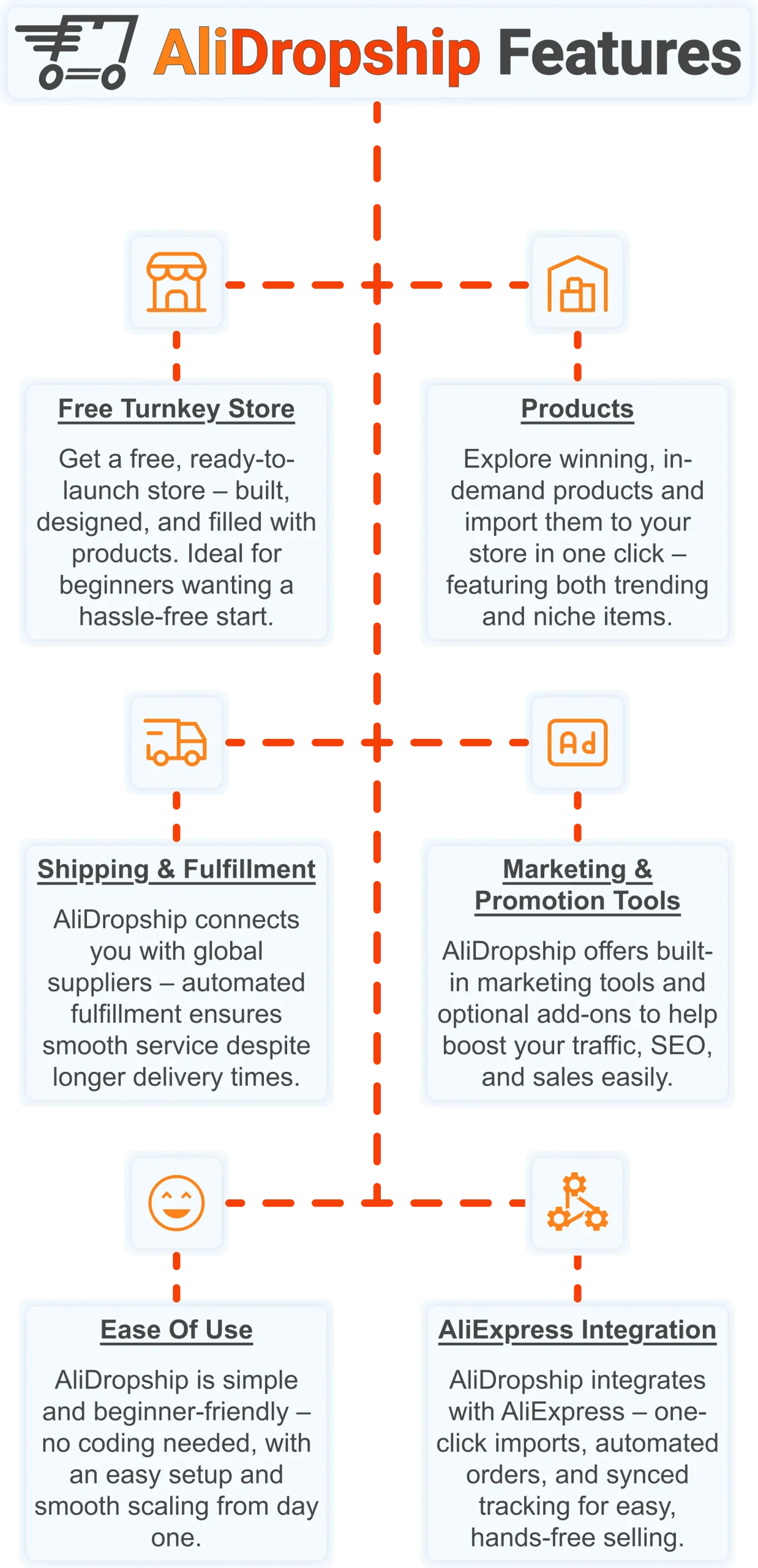
Free turnkey store 🛍️
Get a free turnkey store – built, designed, and filled with products. Ideal for beginners wanting a hassle-free start, the store comes fully optimized to attract customers right away, saving you time on setup. Plus, it includes professional design elements to give your business a polished, trustworthy look from day one. This ready-made foundation makes it easy to move seamlessly into product selection.
Products 📦
Once your store is set up, you can explore winning, in-demand products and import them in one click – featuring both trending and niche items. This wide selection lets you cater to diverse customer interests and test what works best. Regular updates ensure you always have fresh products, keeping your store competitive and relevant. With great products in place, smooth shipping becomes the next essential step.
Shipping & fulfillment 🚚
AliDropship connects you with global suppliers, and automated fulfillment ensures seamless order processing despite international delivery times. Customers receive real-time tracking updates, which builds confidence and trust in your store. Once shipping is handled reliably, you can focus on promoting your store and attracting traffic.
Marketing & promotion tools 📣
To maximize sales, AliDropship offers built-in marketing tools and optional add-ons that help boost traffic, SEO, and conversions. From email campaigns and discounts to social media integration, these tools empower you to reach and retain customers without needing prior marketing experience. With promotion strategies in place, managing your business becomes simpler and more efficient.
Ease of use 👌
AliDropship is beginner-friendly – no coding needed, with an intuitive dashboard that guides you through every step. Easy setup and smooth scaling let you expand your store without stress. As your business grows, adding new features, products, and marketing campaigns remains hassle-free, giving you more time to focus on sales.
AliExpress integration 🛒
Finally, AliDropship integrates seamlessly with AliExpress, enabling one-click imports, automated orders, and synced tracking. Your inventory stays up-to-date with the latest products and prices, while automated order processing frees you from manual tasks.
Combined with the turnkey setup, reliable shipping, and built-in marketing tools, this integration ensures your dropshipping business is fully equipped for growth and success.
The AI tools covered in this guide are most powerful when they are running inside a store that already has an audience — and an AI influencer is how you get one. Get your free store and AI influencer team today and plug in your AI stack from day one.
LAUNCH WITH YOUR AI INFLUENCER
What are the best AI tools to make money with ecommerce in 2026?
How much does it cost to build an AI tool stack for an ecommerce store?
Can AI tools help a beginner make money with dropshipping?
What is the fastest way to use AI tools to increase ecommerce sales?
Are AI tools to make money with ecommerce actually worth it?