How To Use AI In Ecommerce To Start Your Online Store In 2026

Artificial intelligence used to be something only big retailers with huge tech budgets could afford. Not anymore. In 2026, AI in ecommerce is accessible to anyone with a laptop and a product idea – and the beginner who understands how to use it has a genuine edge over everyone still doing things the old way.
According to Shopify’s most recent merchant survey, three out of four ecommerce business owners now use AI tools. That shift happened fast, and it is still accelerating.
So what does that actually mean for you as someone looking to start an online store? It means you can automate hours of repetitive work, write better product descriptions in minutes, run customer support around the clock, and make data-driven decisions from day one – all without hiring a team or knowing a single line of code.
Quick Answer: AI in ecommerce refers to tools powered by machine learning and automation that help online store owners handle tasks like product descriptions, customer service, pricing, and marketing more efficiently. For beginners in 2026, these tools lower the barrier to entry and dramatically reduce the time it takes to go from idea to first sale.
This guide walks you through what AI in ecommerce really means in practical terms, which tools are worth your attention, and how a complete beginner can use them today to build a store that earns.
What is AI in ecommerce?
AI in ecommerce is the application of artificial intelligence technologies – machine learning, natural language processing, computer vision, and predictive analytics – to the tasks involved in running an online store.
In plain terms, it means software that can learn from data and make smart decisions on your behalf, whether that is recommending the right product to the right customer or automatically adjusting your prices based on competitor activity.
For big retailers like Amazon and Walmart, AI has been part of the infrastructure for years. What changed in 2024 and 2025 is that the same capabilities became available through affordable, beginner-friendly platforms. Today, you do not need a data science team. You need a few well-chosen tools and a willingness to experiment.
The use cases in ecommerce break down into a few clear categories: content creation (product descriptions, blog posts, ad copy), customer engagement (AI chatbots for ecommerce, personalized recommendations), operations (inventory forecasting, order routing, fraud detection), and marketing (email automation, dynamic pricing, SEO optimization).
As a beginner, you will not need all of these on day one – but knowing what exists helps you grow deliberately rather than reactively.
Why this works in 2026: Generative AI has made content creation dramatically faster and cheaper. Small store owners who once spent days writing product pages now do it in hours – and the output is often better optimized for search than what a non-specialist could produce manually.
How much can you realistically earn with an AI-powered ecommerce store?
The honest answer depends on the model you choose, how much effort you put in, and how effectively you apply the tools available to you. AI does not generate income on its own – it amplifies what you are already doing.
A well-set-up dropshipping store using AI for product research and content can realistically reach $30–$80 per day in profit within 60–90 days of consistent effort. Scaling past that requires reinvestment and iteration, not just better tools.
Here is a realistic comparison of ecommerce approaches for beginners in 2026:
The numbers above reflect real earning ranges for active store owners who apply AI tools consistently – not passive income figures. The biggest variable is traffic. AI helps you convert visitors better and create content faster, but you still need to drive people to your store through organic search, paid ads, or social media.
One note on ceiling figures: The upper ranges assume a store that has been running for at least 3–6 months, has found winning products, and reinvests earnings into ads or SEO. Brand-new stores in their first 30 days should focus on setup and their first 10–20 sales rather than targeting four-figure monthly revenue immediately.
That said, the AI-assisted path genuinely compresses the timeline. Tasks that once took a week – writing product descriptions, setting up email flows, building an FAQ page – now take an afternoon. That freed-up time compounds quickly when you redirect it into customer acquisition.
START FREE WITH AN AI INFLUENCER
The most useful AI tools for ecommerce beginners in 2026
You do not need to subscribe to ten platforms at once. The goal for a beginner is to cover the highest-impact areas first – content creation, customer support, and product research – then expand as your store grows. Below are the categories and tools worth knowing about.
AI for product descriptions and content
Writing unique, SEO-optimized product descriptions for dozens or hundreds of products is one of the most time-consuming parts of running an online store. AI writing tools solve this almost entirely.
ChatGPT (OpenAI)
ChatGPT remains the most versatile starting point for ecommerce content in 2026. You can use it to write product descriptions, category page copy, email subject lines, ad copy, and blog posts. The free tier is functional, and the Plus plan at $20/month gives you access to the more capable models.
For most beginners, it is the only writing tool they need initially. Give it a product name, a list of features, and a target keyword – and it produces a solid draft in seconds.
Jasper AI
Jasper is designed specifically for marketing copy and includes templates built for ecommerce use cases – product descriptions, Facebook ad copy, Google Ads headlines, and email sequences.
It is more expensive than ChatGPT (plans start around $49/month) but becomes cost-effective at scale if you are managing a large catalog or running a team. For solo beginners just starting out, ChatGPT or Claude cover the same ground for less.
Surfer SEO
Surfer SEO helps you write content that actually ranks. It analyzes the top-ranking pages for your target keyword and gives you a real-time content score as you write, flagging which terms to include, what word count to hit, and how to structure your headings.
For anyone serious about organic traffic from search, it is one of the highest-ROI tools available. Plans start at $89/month, which makes more sense once your store has consistent revenue – but it is worth knowing about from day one.
AI chatbot for ecommerce and customer support
Customer support is one of the first things to become overwhelming as your store grows. An AI chatbot for ecommerce handles the repetitive questions – order status, return policies, shipping estimates – around the clock without any human involvement.
Tidio
Tidio is one of the most beginner-friendly AI chatbot for ecommerce solutions available. It integrates with WordPress and WooCommerce stores easily, includes a pre-trained chatbot that can answer common questions out of the box, and offers a free tier that works well for stores just getting started.
The AI component learns from your product catalog and past conversations, improving its answers over time without any manual retraining on your part.
Gorgias
Gorgias is the choice for stores that have moved past the early stage and are handling real volume. It integrates with your order management system and gives support agents – including AI agents – full order context when responding to customers.
Pricing starts at around $10/month for very small stores, scaling up with ticket volume. The AI features automate responses to your most common ticket types, which for most stores covers 30–40% of all incoming messages.
AI ecommerce personalization and product research
AI ecommerce personalization is what separates stores that convert at 1% from stores that convert at 3–5%. When the right product is shown to the right customer at the right time, the math changes dramatically.
Spocket
Spocket uses AI-powered product recommendations to help you identify winning items to add to your store. It focuses on US and EU-based suppliers, which means faster shipping times compared to platforms that source exclusively from Asia. The interface is genuinely beginner-friendly, and the AI surfacing of trending products saves hours of manual research. Paid plans start at around $29.99/month and include access to a much wider supplier catalog.
Canva Magic Studio
Canva’s AI image generation, background removal, and Magic Resize tools make it possible to create professional-looking product visuals, banners, and social media graphics without any design experience. The brand kit feature keeps your colors, fonts, and logos consistent across every asset.
At $13/month for the Pro plan, it is one of the best-value tools in any ecommerce stack – and most beginners already have a free Canva account they are underusing.
Klaviyo
Klaviyo’s AI-powered email flows – welcome sequences, abandoned cart emails, and post-purchase flows – are consistently the highest-ROI marketing activity for ecommerce stores at any stage. Well-configured flows can generate 20–30% of total store revenue on autopilot.
Setup takes a few hours, and Klaviyo’s free tier covers up to 250 contacts, which is enough to learn the platform properly before you need to upgrade.
How to use AI in ecommerce: A practical starting point for beginners
Knowing which tools exist is one thing. Knowing how to integrate them into a real workflow on day one is what actually moves the needle. Here is how a beginner can use AI in ecommerce practically, without getting overwhelmed.
The combined time savings above – 14–28 hours per week – is the real competitive advantage AI gives beginners. That is time you can redirect into product research, paid ads testing, or building out more store content. It is not about replacing your effort; it is about making each hour count more.
Start with product descriptions
Your first AI task should be writing product descriptions. Open ChatGPT, give it the product name, the key features (from the supplier page), and a target keyword. Ask it to write a 150–200 word description in a conversational tone for online shoppers. Review the output, adjust anything that is inaccurate, and publish.
This process takes 3–5 minutes per product instead of 20–30 minutes. Do this for your first 20 products and you will have a functioning catalog in a single afternoon.
Set up an AI chatbot for ecommerce early
Install Tidio or a similar chatbot tool during your store setup, not after your first complaints come in. Build out answers to the five or six questions every new customer asks – shipping times, return policy, order tracking, payment methods, and product availability.
Once that foundation is in place, the chatbot handles the majority of support volume automatically, and you only need to step in for genuinely complex issues.
Use AI for ecommerce automation in email marketing
Set up your abandoned cart flow within the first week of launching. This single ecommerce automation recovers sales that would otherwise be lost entirely – industry averages put cart abandonment recovery rates from email at 5–15% of abandoned sessions.
With Klaviyo, the basic three-email sequence (immediate reminder, 24-hour follow-up, 72-hour offer) takes around 2 hours to configure and then runs on its own indefinitely.
Lean on AI for product research
Instead of spending hours manually scrolling supplier catalogs, use tools like Spocket or AliDropship’s built-in product search to surface trending items in your niche.
You can also use ChatGPT to validate product ideas – ask it what problems a specific type of customer faces, which product categories address those problems, and what they are searching for on Google. It will not replace real keyword research tools, but it is a fast way to pressure-test ideas before you commit.
LAUNCH WITH YOUR AI INFLUENCER
What to watch out for: common beginner mistakes with AI ecommerce tools
AI tools are genuinely useful, but they are also easy to misuse in ways that can hurt your store’s credibility and search rankings. A few things to keep in mind before you scale up.
Do not publish raw AI output without editing
AI-generated product descriptions that are copied directly from the output – without any review – often contain inaccuracies, generic phrases, and identical phrasing across products. Search engines are increasingly good at detecting low-effort AI content, and duplicate descriptions across a catalog can actively suppress your rankings.
The rule of thumb: use AI to write a solid first draft, then spend 3–5 minutes reviewing and personalizing each one before publishing.
Do not rely on AI chatbots for complex or sensitive situations
AI chatbots handle volume well, but they handle nuance poorly. A customer who received a damaged item, a payment dispute, or a situation involving personal data needs a human response.
Configure your chatbot with a clear escalation path – a “talk to a real person” option that routes to your email or support inbox – and monitor chatbot conversations weekly in the early months to catch anything being mishandled before it becomes a negative review.
Do not ignore AI ecommerce personalization data
Most AI tools generate useful analytics you never look at. Klaviyo shows you which email flows are converting and which are not. Tidio logs which questions your chatbot cannot answer. Canva’s brand kit usage shows you which visual formats your audience engages with most.
These signals are free and actionable. Building a habit of reviewing tool analytics once a week – even for 15 minutes – compounds significantly over 6–12 months.
Key principle: AI tools are amplifiers, not shortcuts. The store owner who uses AI thoughtfully and reviews outputs carefully will outperform the one who treats it as a fire-and-forget system every single time.
Which approach is right for you?
AI in ecommerce is not a one-size-fits-all subject. Where you should start depends on where you are right now – your budget, your time, and what kind of store you want to run.
Complete beginner (no store yet)
Your first move is to get a store up and running before optimizing with AI tools. Trying to learn eight platforms simultaneously while also building a store from scratch is a reliable way to get nothing done.
Focus on one AI tool – ChatGPT for product descriptions is the highest-leverage starting point – and use it daily while your store takes shape. Once you have your first 20–30 products live and have made your first few sales, then layer in a chatbot and email automation.
Intermediate (store exists, looking to grow)
If you already have a functioning store with some traffic, AI ecommerce personalization and email automation are your highest-leverage next steps. Set up Klaviyo flows if you have not already, run your top 10 product pages through Surfer SEO, and install a chatbot if you are handling customer support manually. These three moves alone can increase revenue by 20–40% without adding a single new product.
Advanced (scaling toward full-time income)
At the scaling stage, ecommerce automation across your entire operation becomes the priority. That means AI for dynamic pricing, AI-powered ad creative testing, and integrating your store data into a coherent analytics dashboard.
Merchants using AI at this stage are, according to Shopify’s research, significantly more likely to base decisions on data than non-AI users – and that is precisely why they tend to grow faster. The tools are there; the discipline to use them well is what separates stores that plateau from stores that scale.
AliDropship: Your complete all-in-one solution for starting dropshipping in 2026
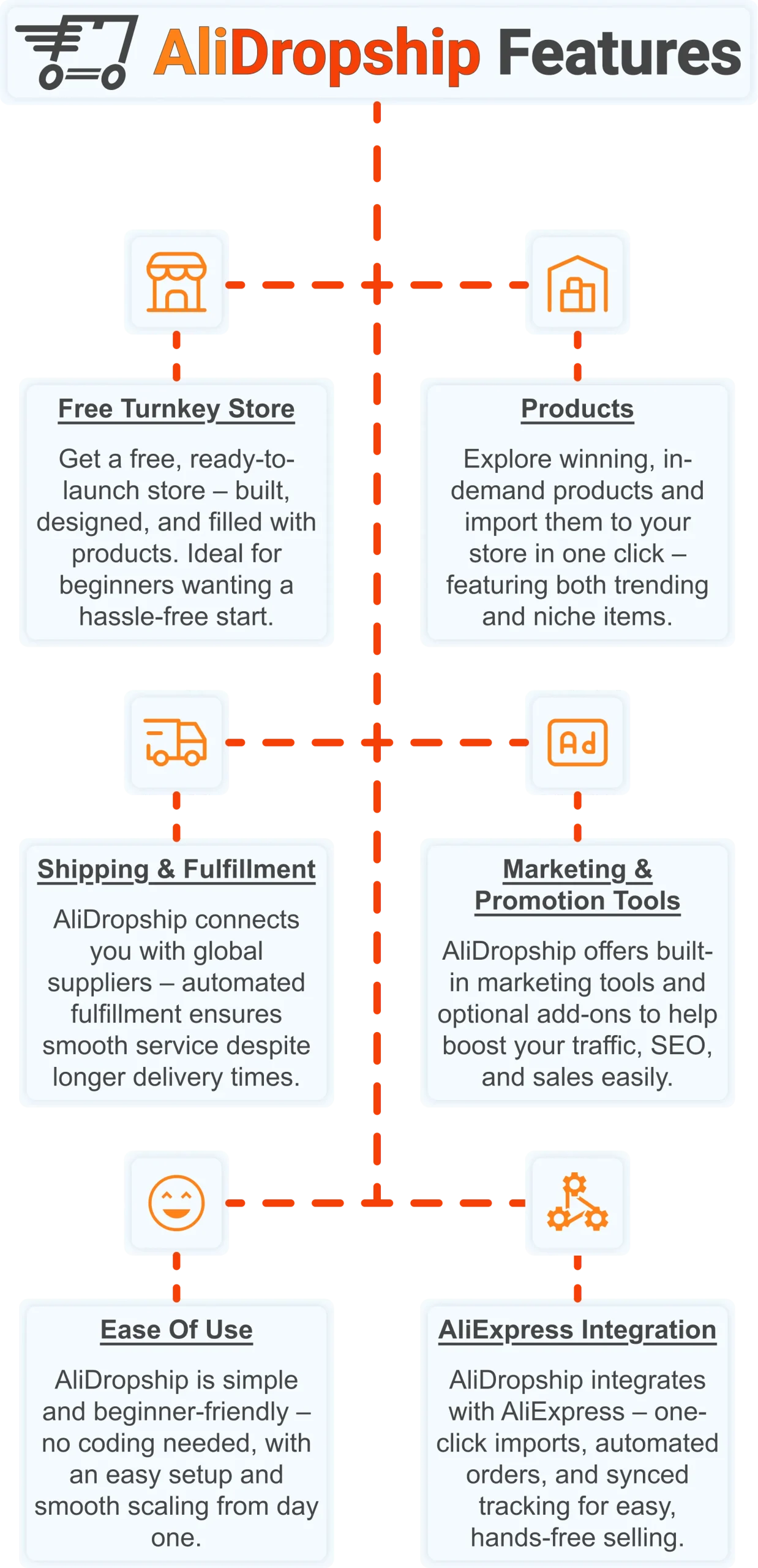
If you want the simplest possible way to start dropshipping – especially if you’re brand new – AliDropship remains one of the most beginner-friendly tools available in 2026. It brings together store creation, product imports, automation, and marketing into a single streamlined system designed to help you launch quickly and grow confidently.
Free turnkey store 🛍️
Get a free turnkey store – built, designed, and filled with products. Ideal for beginners wanting a hassle-free start, the store comes fully optimized to attract customers right away, saving you time on setup. Plus, it includes professional design elements to give your business a polished, trustworthy look from day one. This ready-made foundation makes it easy to move seamlessly into product selection.
Products 📦
Once your store is set up, you can explore winning, in-demand products and import them in one click – featuring both trending and niche items. This wide selection lets you cater to diverse customer interests and test what works best.
Regular updates ensure you always have fresh products, keeping your store competitive and relevant. With great products in place, smooth shipping becomes the next essential step.
Shipping & fulfillment 🚚
AliDropship connects you with global suppliers, and automated fulfillment ensures seamless order processing despite international delivery times. Customers receive real-time tracking updates, which builds confidence and trust in your store. Once shipping is handled reliably, you can focus on promoting your store and attracting traffic.
Marketing & promotion tools 📣
To maximize sales, AliDropship offers built-in marketing tools and optional add-ons that help boost traffic, SEO, and conversions. From email campaigns and discounts to social media integration, these tools empower you to reach and retain customers without needing prior marketing experience. With promotion strategies in place, managing your business becomes simpler and more efficient.
Ease of use 👌
AliDropship is beginner-friendly – no coding needed, with an intuitive dashboard that guides you through every step. Easy setup and smooth scaling let you expand your store without stress. As your business grows, adding new features, products, and marketing campaigns remains hassle-free, giving you more time to focus on sales.
AliExpress integration 🛒
Finally, AliDropship integrates seamlessly with AliExpress, enabling one-click imports, automated orders, and synced tracking. Your inventory stays up-to-date with the latest products and prices, while automated order processing frees you from manual tasks.
Combined with the turnkey setup, reliable shipping, and built-in marketing tools, this integration ensures your dropshipping business is fully equipped for growth and success.
AI in ecommerce gives you the tools to move faster – and an AI influencer paired with AliDropship gives you the audience and the store to move into. Get your free store and AI influencer team today and start building the business AI makes possible.
What is AI in ecommerce and how does it work?
What are the best AI tools for ecommerce beginners?
How does AI ecommerce personalization increase sales?
Can I use AI for dropshipping with no experience?
How long does it take to see results from AI ecommerce automation?