Affiliate Marketing Vs Dropshipping – A Honest Comparison For 2026

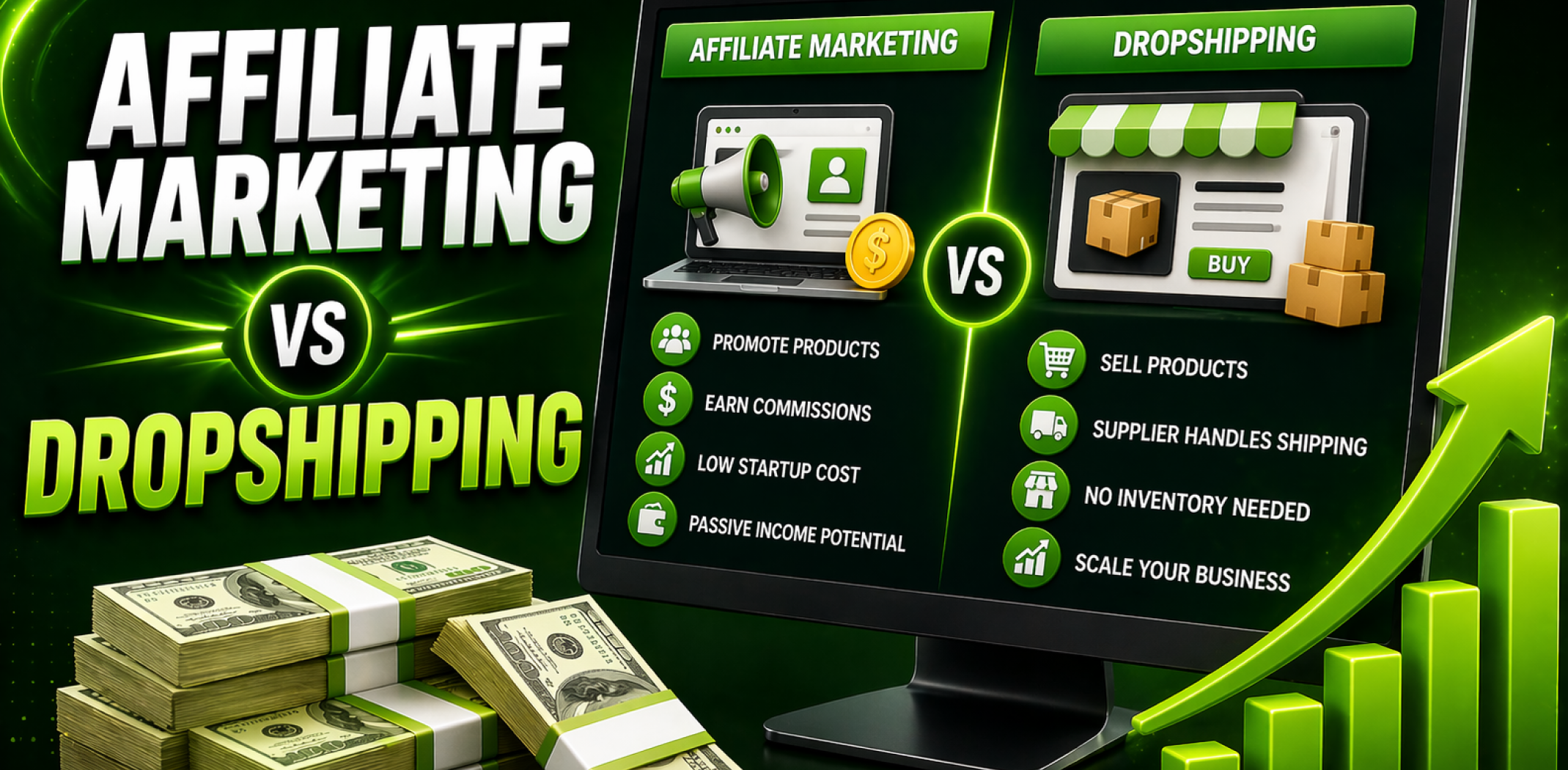
Two business models dominate most “make money online” conversations in 2026 – affiliate marketing and dropshipping. Both are legitimate, both can generate real income, and both are accessible to beginners with no prior experience. But they work very differently, and choosing the wrong one for your situation can cost you months of wasted effort.
This guide breaks down affiliate marketing vs dropshipping honestly – what each model actually involves, how much you can realistically earn, and which one gives you more long-term control over your income. If you are weighing up both options right now, you are in the right place.
Quick Answer: Affiliate marketing is simpler to start but limits your earning ceiling and gives you no ownership. Dropshipping requires more setup but puts you in control of your store, your brand, and your profits – making it the stronger long-term business model for most people.
What is affiliate marketing vs dropshipping?
Before you can choose between them, you need to understand what you are actually comparing. These two models share some surface-level similarities – both happen online, both require no physical inventory, both can be run solo – but the mechanics underneath are completely different.
Affiliate marketing means promoting someone else’s products or services in exchange for a commission. You sign up for an affiliate program (Amazon Associates, ShareASale, individual brand programs), get a unique tracking link, and earn a cut every time someone clicks your link and makes a purchase. You never handle the product, never deal with the customer, and never touch the transaction. Your job is traffic – getting the right people in front of the right offer.
Dropshipping means running your own ecommerce store where products are shipped directly from a supplier to your customer. You set the price, you own the customer relationship, and you keep the margin between what the customer pays and what the supplier charges. You do not hold inventory or pack boxes – but you do own the storefront, the brand, and the experience.
The core difference: affiliate marketing makes you a promoter working for someone else’s business. Dropshipping makes you a business owner. That distinction matters more than almost anything else when you are deciding which path to take.
How much can you realistically earn?
Income claims in this space are all over the place, so let’s put some real numbers on the table. The table below compares both models across three dimensions that actually matter – effort level, startup cost, and realistic earning potential.
Affiliate marketing has a lower barrier to entry, but the earning ceiling is directly tied to your traffic volume and the commission rates set by the brands you promote – rates you have no control over. Dropshipping requires more initial setup, but every sale goes through your store, at your price, with your margin.
One note on these figures: Both models require consistent effort over 60–90 days before you see meaningful income. Anyone promising $1,000 in your first week is selling a course, not running a real business. Full-time income from either model typically takes 4–6 months of genuine work.
The gap between the two models widens significantly as you scale. An affiliate marketer earning $3,000/month is likely driving enormous traffic volumes and managing multiple content channels. A dropshipping store earning $3,000/month in profit might be running on a few hundred orders at a healthy margin – a much more sustainable position per unit of effort.
Affiliate marketing vs dropshipping: a direct comparison across what matters most
Let’s go category by category and see how both models stack up against each other on the factors that will actually affect your daily experience running the business.
Ownership and control
This is where the two models diverge most sharply – and it is arguably the most important factor for anyone thinking long-term.
With affiliate marketing, you own nothing. You own your content (a blog, a YouTube channel, a newsletter), but the product, the brand, the checkout experience, and the customer relationship all belong to someone else. If the brand changes its commission structure – and they do, regularly – your income drops overnight. If the affiliate program shuts down, your revenue stream disappears with it. Amazon Associates, one of the most popular programs in the world, cut commission rates dramatically in 2020, and affiliates who had built entire businesses around it lost 30–70% of their income in a single announcement.
With dropshipping, you own the store. You own the brand name, the product listings, the email list, the customer data, and the pricing. You can change suppliers, switch niches, run promotions, and make business decisions without asking anyone’s permission. That ownership is the foundation of a real business – not just a traffic-dependent side hustle.
Startup cost and technical barrier
Affiliate marketing wins on pure accessibility. You can sign up for Amazon Associates in 10 minutes, write a review post, and have a live affiliate link the same afternoon. There is no storefront to build, no supplier to contact, no product page to design. For someone with zero budget and zero experience, that low friction is genuinely appealing.
Dropshipping has a slightly higher setup threshold – you need a store, a domain, and a product catalog. But the gap has narrowed significantly. Tools like AliDropship provide a free turnkey store built and filled with products, which removes the main technical barrier that used to make dropshipping feel intimidating. The practical startup cost for a properly set up dropshipping store in 2026 is lower than most people assume.
Important: “Low barrier to entry” in affiliate marketing also means high competition. The niches with the best commission rates – finance, software, health – are saturated with established content sites that have been building domain authority for years. Breaking in as a newcomer takes longer than most people expect.
Profit margins and revenue structure
Affiliate marketing commissions typically range from 3–10% on physical products (Amazon Associates caps most categories at 4–8%) and up to 20–40% on digital products and SaaS tools. Your revenue is a percentage of someone else’s sale price – and that percentage is set by them, not you.
Dropshipping margins depend on your niche and sourcing, but 20–40% net margins are achievable on physical products, and some niches run higher. More importantly, you set the retail price. If you source a product for $12 and sell it for $35, that margin is yours to keep. You can also build in upsells, bundles, and loyalty programs that increase average order value – none of which are available to an affiliate marketer.
Under 10%
Tight — hard to sustain on paid traffic
10–15%
Marginal — slim cushion for refunds and ad cost shifts
15–20%
Healthy — cohort median sits at 19.2%
20–25%
Strong — outperforming the median operator
25%+
Excellent — top-tier product economics
Earning potential: $500–$3,000/month for a beginner dropshipping store within 60–90 days of launch; $10,000+/month for scaled operations with proven products.
Customer relationships and data
Affiliate marketing puts a wall between you and the buyer. Once someone clicks your link and lands on the merchant’s site, that customer belongs to the merchant. You get a commission notification – the merchant gets a customer email address, purchase history, and the ability to market to that person forever. You are essentially doing the acquisition work for someone else’s customer database.
In dropshipping, every customer who buys from your store is your customer. Their email, their order history, their preferences – all of it lives in your store’s backend. That means you can run email marketing campaigns, retarget past buyers, offer loyalty discounts, and build a repeat-purchase business over time. Repeat customers are significantly cheaper to convert than new ones, and that compound effect is a major driver of long-term profitability that affiliate marketing simply cannot replicate.
Scalability
Affiliate marketing scales through content volume – more articles, more videos, more channels, more traffic. That is a legitimate path, but it is slow, requires constant content production, and is heavily dependent on search engine and platform algorithm changes outside your control. Many affiliate marketers saw major income drops after Google’s Helpful Content Updates in 2023 and 2024 because their sites were deranked overnight.
Dropshipping scales through paid advertising, product expansion, and supplier relationships. If a product is working, you increase the ad spend and the revenue scales proportionally. You can add new product lines without rebuilding your content strategy from scratch. Store-level optimizations – better checkout flow, stronger product descriptions, smarter email sequences – compound over time and benefit every sale, not just the next article you publish.
Where affiliate marketing has a genuine edge
This is a fair comparison, which means acknowledging where affiliate marketing legitimately wins – and there are a few real scenarios where it makes sense.
If you already have an established audience – a blog with real traffic, a YouTube channel with subscribers, a newsletter list – affiliate marketing can monetize that audience with almost no additional work. Recommending products you genuinely use and inserting affiliate links into existing content is low effort for incremental income. For creators, it can be an excellent supplementary revenue stream layered on top of their main business.
Affiliate marketing is also genuinely easier for complete beginners who are not ready to commit to building a brand. If you want to understand how online sales funnels work, how traffic converts, and how to write product-focused content before investing in your own store, affiliate marketing is a useful learning ground with minimal financial risk.
And for high-ticket digital products – software subscriptions, online courses, financial services – affiliate commissions can be substantial. A single SaaS affiliate sale paying $200–$500 in recurring commission changes the math considerably compared to Amazon’s 4% on a $30 product.
But even with those advantages in mind, the structural limitations remain. You are building on rented land. Commission rates change. Programs shut down. Traffic algorithms shift. None of those risks exist in the same way when you own your store and your customer relationships outright.
Can you combine affiliate marketing and dropshipping?
Yes – and it is worth addressing because a lot of people ask this question. The two models are not mutually exclusive.
Some dropshipping store owners use affiliate marketing as an additional monetization layer – adding affiliate links in blog content that drives organic traffic to their store, or recommending complementary products through an email list. Conversely, affiliate marketers sometimes use dropshipping as a way to transition from promoting other people’s products to selling their own once they have built an audience.
The more common and more effective sequence, though, is to start with dropshipping – build your store, learn the product and customer side of ecommerce – and then layer in content marketing and SEO over time to reduce your dependence on paid ads. That combination gives you owned infrastructure (the store) with compounding organic traffic (the content) working together.
Trying to run both from scratch simultaneously is not recommended. Each model has its own learning curve, and splitting your focus early tends to produce two mediocre efforts instead of one solid foundation. Pick the one that matches your situation and goals, build it to profitability, then expand.
Which model is right for you? A guide by reader profile
The honest answer is that it depends on where you are starting from and what you are trying to build. Here is a straightforward breakdown by situation.
Complete beginner with no audience and no budget
Dropshipping is the better starting point. With a free turnkey store available through AliDropship, the financial barrier is essentially zero. You get a real business with real products and a real storefront – not just a collection of affiliate links hoping someone clicks. The learning curve is manageable, the feedback loop is faster (you see real sales data quickly), and you are building something with long-term value from day one.
Intermediate – part-time, some online experience
If you have been dabbling in online income for a while – maybe you have tried affiliate marketing already and hit the traffic wall – dropshipping is the logical next step. You already understand how online sales work, you know how to write product-focused content, and you are ready to own the full transaction. The skills transfer directly. Your content experience becomes an asset that drives organic traffic to your store rather than to someone else’s checkout page.
Advanced – full-time income goal within 12 months
If you are serious about replacing a full-time income within a year, dropshipping is the only model of the two that gives you the tools to realistically get there. The scaling mechanics – paid ads, product expansion, email marketing, supplier negotiation – allow for geometric income growth in a way that affiliate marketing’s content-volume model does not. A well-run dropshipping store can reach $5,000–$15,000/month in profit within 12 months of focused effort. Reaching that figure through affiliate marketing alone, starting from scratch, is considerably harder and takes longer for most people.
Creator with an existing audience
If you already have a significant following – 10,000+ real subscribers, readers, or followers – affiliate marketing is worth exploring as an additional income layer. But even here, launching a dropshipping store to sell products directly to your audience is almost always more profitable per sale than a commission link. Creators with existing audiences who pivot to direct sales consistently outperform the affiliate revenue they were earning from the same audience.
AliDropship: Your complete all-in-one solution for starting dropshipping in 2026
If you want the simplest possible way to start dropshipping – especially if you are brand new – AliDropship remains one of the most beginner-friendly tools available in 2026. It brings together store creation, product imports, automation, and marketing into a single streamlined system designed to help you launch quickly and grow confidently.
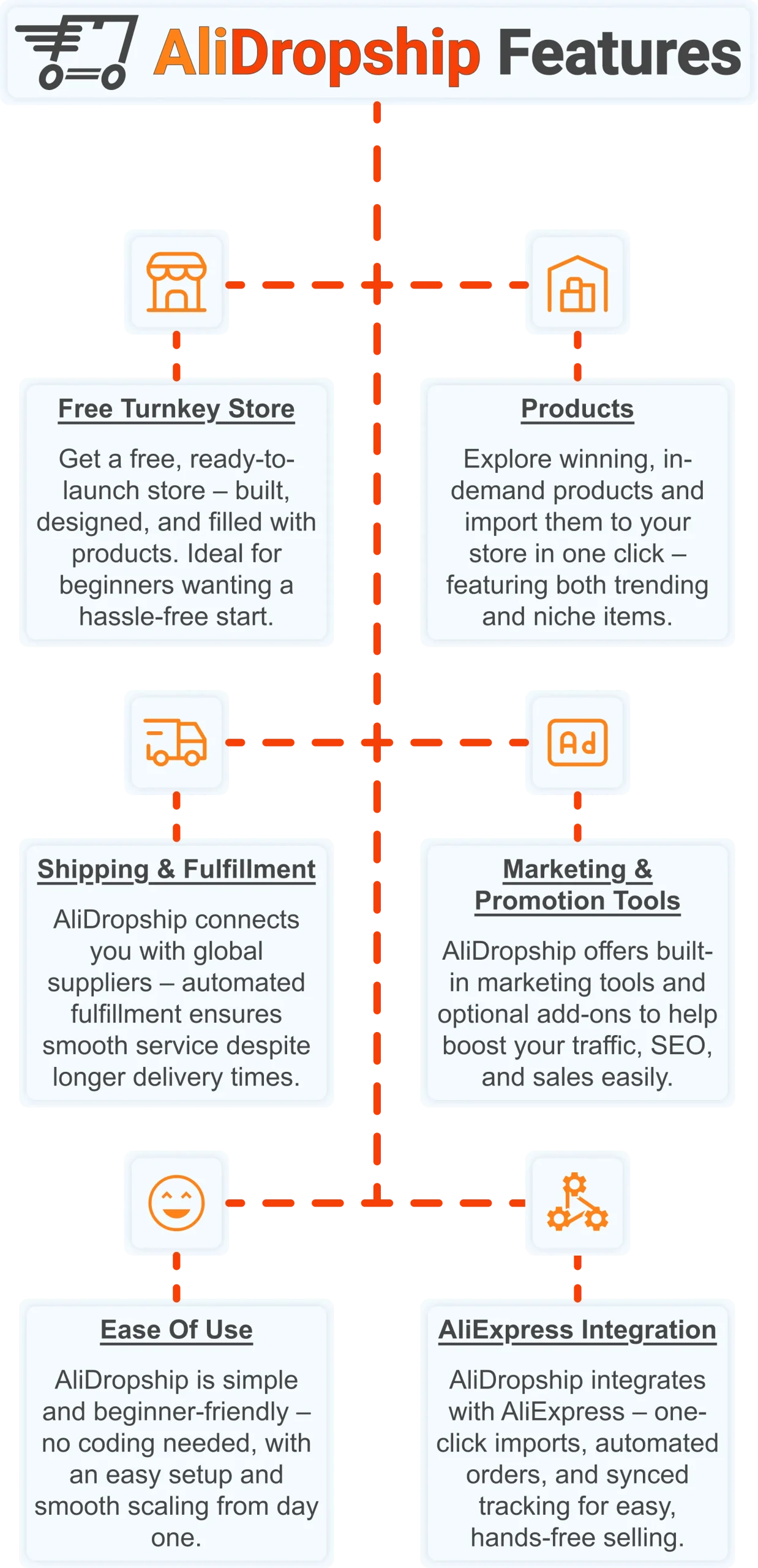
Free turnkey store 🛍️
Get a free turnkey store – built, designed, and filled with products. Ideal for beginners wanting a hassle-free start, the store comes fully optimized to attract customers right away, saving you time on setup. Plus, it includes professional design elements to give your business a polished, trustworthy look from day one. This ready-made foundation makes it easy to move seamlessly into product selection.
Products 📦
Once your store is set up, you can explore winning, in-demand products and import them in one click – featuring both trending and niche items. This wide selection lets you cater to diverse customer interests and test what works best. Regular updates ensure you always have fresh products, keeping your store competitive and relevant. With great products in place, smooth shipping becomes the next essential step.
Shipping & fulfillment 🚚
AliDropship connects you with global suppliers, and automated fulfillment ensures seamless order processing despite international delivery times. Customers receive real-time tracking updates, which builds confidence and trust in your store. Once shipping is handled reliably, you can focus on promoting your store and attracting traffic.
Marketing & promotion tools 📣
To maximize sales, AliDropship offers built-in marketing tools and optional add-ons that help boost traffic, SEO, and conversions. From email campaigns and discounts to social media integration, these tools empower you to reach and retain customers without needing prior marketing experience. With promotion strategies in place, managing your business becomes simpler and more efficient.
Ease of use 👌
AliDropship is beginner-friendly – no coding needed, with an intuitive dashboard that guides you through every step. Easy setup and smooth scaling let you expand your store without stress. As your business grows, adding new features, products, and marketing campaigns remains hassle-free, giving you more time to focus on sales.
AliExpress integration 🛒
Finally, AliDropship integrates seamlessly with AliExpress, enabling one-click imports, automated orders, and synced tracking. Your inventory stays up-to-date with the latest products and prices, while automated order processing frees you from manual tasks. Combined with the turnkey setup, reliable shipping, and built-in marketing tools, this integration ensures your dropshipping business is fully equipped for growth and success.
When you compare affiliate marketing vs dropshipping side by side, dropshipping gives you something affiliate marketing never can – a real business you own, with customers who come back and margins you control. Get your free AliDropship store today and start building on a foundation that is actually yours.
What is the main difference between affiliate marketing vs dropshipping?
Which is more profitable – affiliate marketing or dropshipping?
Can you do affiliate marketing and dropshipping at the same time?
Is dropshipping better than affiliate marketing for beginners?
How long does it take to make money with dropshipping vs affiliate marketing?