How To Start An Affiliate Marketing Side Hustle In 2026


Millions of people search for a flexible way to earn extra money online every year – and affiliate marketing keeps showing up at the top of the list. It sounds almost too simple: share a link, someone buys, you get paid. But is that actually how it works, and can a complete beginner realistically make money from it?
Quick Answer: Yes – affiliate marketing is a legitimate side hustle that beginners can start for free, with realistic part-time earnings of $200–$800/month after 3–6 months of consistent effort. It takes time to build, but the cost of entry is low and the ceiling is genuinely high.
This guide covers everything you need to know: how affiliate marketing actually works, which platforms to start with, how much you can expect to earn, and how to avoid the common mistakes that slow most beginners down. No fluff – just a clear, honest roadmap for getting started in 2026.

What is affiliate marketing as a side hustle?
Affiliate marketing is a performance-based income model where you earn a commission for driving sales or leads to another company’s product or service. You sign up for an affiliate program, receive a unique tracking link, and then promote that link through your content – whether that’s a blog, a YouTube channel, social media, or an email list. When someone clicks your link and completes a purchase, you earn a percentage of that sale.
As a side hustle, affiliate marketing stands out because of how low the barrier to entry is. You do not need to create a product, handle inventory, manage shipping, or deal with customer service. Your job is to connect the right people with the right products – and collect a cut when the match works.
In 2026, affiliate marketing has grown into a $17 billion global industry, and it is still expanding. The rise of content-led ecommerce, influencer-driven shopping, and niche community audiences has made it easier than ever to carve out a profitable corner of the market, even without a large following.
Why this works in 2026: Consumers increasingly trust peer recommendations over brand advertising – which means a genuine, helpful review or tutorial from someone with niche authority can outperform a full ad campaign.
How much can you realistically earn?
The honest answer: it depends heavily on your niche, your traffic volume, and how consistently you produce content. The numbers below reflect realistic ranges for each stage of the journey – not the headline figures you see in YouTube thumbnails.
These figures reflect real-world trajectories seen across affiliate communities on Reddit and reported case studies. Beginner stages are slow by nature – your first months are about building content, not collecting commissions.
One note on the top figures: The $10,000+/month tier exists, but it typically requires a well-established content library, strong SEO authority or a large social following, and often multiple affiliate programs running simultaneously. Treating those numbers as a 90-day target is a fast path to burnout.
Most affiliate marketers who stick with it consistently for 6–12 months land somewhere in the $300–$1,500/month range as a side income, working around a day job. That is a realistic, meaningful number – and one that compounds as your content ages and accumulates traffic.
How to start affiliate marketing from scratch
Starting an affiliate marketing side hustle does not require a website, a budget, or prior experience. What it does require is a plan. Here is how to move from zero to your first commission in a structured, sustainable way.
Step 1 – Pick your niche
Your niche is the specific topic area you will create content around. This is arguably the most important decision you make as a beginner, and it is worth spending a few days on before you do anything else.
How to choose a profitable niche
A good affiliate niche sits at the intersection of three things: something you know or care about, an audience actively searching for it, and products or services with affiliate programs attached. Broad niches like “fitness” or “tech” are dominated by established publishers. Narrower sub-niches – such as “home gym equipment for apartment dwellers” or “budgeting apps for freelancers” – give beginners a more realistic shot at ranking and converting.
Use free tools like Google Trends, AnswerThePublic, or the Reddit search bar to test whether real people are asking questions in your chosen area. If a topic has active subreddits, YouTube channels, and Amazon product listings, it is a sign that demand exists and affiliate programs probably do too.
Important: Passion alone is not enough – your niche needs products people are willing to buy. Verify that at least two or three affiliate programs exist in the space before committing.
Step 2 – Choose your content platform
Where you publish your affiliate content shapes everything – your audience growth speed, the types of products you can promote effectively, and how long your content stays relevant.
Blog / website
A self-hosted WordPress blog is the most durable long-term platform for affiliate marketing. SEO-optimized articles can rank on Google for years and generate passive traffic without ongoing effort. The tradeoff is that results take 60–180 days to materialize – Google does not index and rank new sites overnight. Hosting costs $3–$10/month, making it one of the lowest-cost options available.
YouTube channel
Video is particularly effective for product reviews, tutorials, and comparisons. YouTube is the second-largest search engine in the world, and affiliate links placed in video descriptions convert well when the content directly demonstrates a product in use. The learning curve involves video production, but smartphone-quality footage is entirely acceptable for most niches.
Social media (TikTok, Instagram, Pinterest)
Short-form video on TikTok and Instagram Reels can generate fast bursts of traffic, particularly in lifestyle, beauty, home decor, and fashion niches. Pinterest functions more like a visual search engine and works especially well for evergreen content in categories like recipes, DIY, and home improvement. The disadvantage of social-only strategies is algorithm dependency – your reach can drop overnight with a platform update.
Email newsletter
Email is often overlooked by beginners but delivers some of the highest affiliate conversion rates of any channel. If you already have a small audience from a blog or social account, capturing those readers into an email list with a tool like Mailchimp or ConvertKit gives you a direct line that no platform can take away. Commission rates on email-driven affiliate sales frequently run 20–30% higher than cold traffic.
Step 3 – Join affiliate programs
Once your platform is set up and you have published a few pieces of content, it is time to apply to affiliate programs. Here are the categories worth knowing as a beginner.
Amazon Associates
Amazon Associates is the most accessible starting point for new affiliates. Almost any physical product on Amazon can be promoted, commissions range from 1–10% depending on category, and the brand trust makes conversions easier. The main drawback is low commission rates – you need real volume to earn meaningfully. Cookie duration is 24 hours, which is shorter than most other programs.
Affiliate networks (ShareASale, CJ, Impact)
Affiliate networks act as marketplaces connecting publishers with hundreds or thousands of individual brand programs. ShareASale, Commission Junction (CJ), and Impact are among the most established. These networks give you access to mid-size and enterprise brands that do not run their own standalone programs, and commission rates are often significantly higher than Amazon – sometimes 10–50% on software and digital products.
SaaS and software programs
Software affiliate programs are among the highest-paying in the industry. Many SaaS companies offer recurring commissions – meaning you earn a percentage of the subscription fee every month for as long as your referred customer stays active. Tools in the email marketing, SEO, project management, and ecommerce space commonly offer 20–40% recurring commissions, which can compound into significant monthly income over time.
Earning potential: $50–$300/month from Amazon Associates with moderate traffic; $200–$2,000+/month from SaaS recurring programs with a focused content strategy.
Step 4 – Create content that converts
Content is the engine of your affiliate marketing side hustle. Without it, no one finds your links. The types of content that consistently drive affiliate sales fall into a few well-tested formats.
Product reviews
A thorough, honest product review targeting a specific search query (like “best standing desk under $300” or “Jasper AI review 2026”) can rank well and convert for years. Reviews work because the reader is already in buying mode – they just need confirmation and a trusted recommendation before they click.
Comparison articles
Head-to-head comparisons (“X vs. Y: which is better?”) attract high-intent searchers who are close to a purchasing decision. These articles typically rank for mid-competition keywords and can include affiliate links to both products, meaning you earn regardless of which option the reader chooses.
Tutorial and how-to content
Step-by-step tutorials that naturally reference a tool or product in action are one of the most persuasive content types in affiliate marketing. When a reader follows your instructions and sees results, the recommendation feels earned. This format works especially well on YouTube but translates equally well to long-form blog posts.
Listicles and “best of” roundups
Articles like “7 best budgeting apps for students” or “top 10 home office tools under $50” aggregate multiple affiliate opportunities into a single piece of content. These rank well for informational queries and give you multiple commission chances per reader. They also tend to attract backlinks, which helps your overall SEO authority.
Pro Tip: Add a comparison table near the top of every listicle – readers who skim (most of them) will click from the table, and a higher percentage of those clicks convert because the reader has already narrowed their choice.
How to grow your affiliate income over time
Getting your first commission is a milestone – but growing past the $200–$300/month plateau requires a shift in approach. The beginner phase is about producing content; the growth phase is about optimizing what is working and doubling down on it.
Track everything from day one
Most affiliate dashboards provide click data, conversion rates, and earnings per click. Use this data actively. If a particular article or video is driving 80% of your commissions, that is your signal to create more content in that format, on related topics, targeting similar keywords. Ignoring your analytics is one of the most common reasons beginner affiliate marketers plateau early.
Build your email list in parallel
Every platform you publish on – your blog, YouTube, TikTok – should be feeding readers and viewers into an email list. Offer a simple lead magnet (a free checklist, a resource guide, a mini-course) in exchange for an email address. Even a list of 500 engaged subscribers can generate $300–$600/month in affiliate commissions from a single well-timed email campaign, because the trust level is far higher than cold search traffic.
Diversify your affiliate programs
Relying on a single affiliate program is a business risk. Commission structures change, programs get discontinued, and brands pivot. Most successful affiliate marketers run 3–6 programs simultaneously across their content, mixing one-time commissions with recurring ones. This smooths out income variability and protects you from sudden drops if one program adjusts its rates.
Improve existing content before creating new content
After 6–12 months, you will have articles or videos that rank on page 2 or 3 of Google – close to meaningful traffic but not quite there. Updating and expanding those pieces is often more efficient than writing brand-new content. Add fresh data, improve the structure, answer new questions, and strengthen internal linking. A content refresh that takes 2 hours can double the traffic to a page that already has domain authority and backlinks.
Use SEO tools to find low-competition keywords
Free tools like Google Search Console and Google Keyword Planner give you enough data to work with as a beginner. Paid tools like Ahrefs or Semrush unlock more detailed keyword difficulty scores and competitor gap analysis. Focus on long-tail keywords – 4–6 word phrases with clear search intent and lower competition – rather than broad, high-volume terms that established sites already dominate. A post ranking #1 for a 90-search-per-month keyword can still generate $50–$150/month in commissions if the intent is strong.
Legal and ethical considerations
Affiliate marketing has a legitimate, sustainable version – and a grey-area version that gets people penalized, banned, and sometimes in legal trouble. Knowing the difference is not just ethical; it is practical. Short-term tactics that game the system rarely survive long enough to generate meaningful income.
The most important legal requirement for affiliate marketers in most countries – including the US, UK, EU, and Australia – is disclosure. You are legally required to clearly inform your audience when a link is affiliate-compensated. The FTC in the United States is explicit: disclosure must be clear, conspicuous, and placed near the affiliate content – not buried in a footer or hidden behind a link.
Key principle: Disclose every affiliate relationship, every time, in a way that a first-time visitor to your content will immediately understand.
What to avoid
Fake reviews written for products you have never used damage your credibility with real readers and increasingly trigger Google’s spam detection systems. Stuffing affiliate links into unrelated content, using misleading “download now” buttons that link to affiliate pages, or building link farms to manipulate SEO rankings are all tactics that have been systematically penalized in algorithm updates since 2022. They do not work at scale anymore, and they never built sustainable businesses.
Important: Purchasing fake reviews on Trustpilot or other platforms to inflate a product’s reputation before promoting it is against the terms of service of virtually every affiliate network – and in some jurisdictions, it is illegal under consumer protection law.
What to do instead
Authentic, experience-based recommendations outperform manufactured ones in every meaningful metric: click-through rate, conversion rate, audience retention, and long-term SEO performance. If you have not personally used a product, say so – and explain the research you did instead. Readers respect transparency, and transparent affiliates build the kind of trust that sustains income for years, not weeks.
Which approach is right for you?
Affiliate marketing is not a single path – it looks different depending on where you are starting from and what you actually want to build. Here is an honest summary by reader profile.
Complete beginner
If you are starting from zero – no website, no audience, no content – start with a single platform and a tight niche. A beginner blog on a topic you genuinely know, combined with Amazon Associates or a relevant SaaS program, is the most forgiving starting point. Expect your first 60–90 days to produce little to no income. That is normal, not a failure. Your job in that window is to publish consistently and learn how your content performs.
Intermediate / part-time
If you already have some content published or a small audience somewhere, the priority shift is from creating to optimizing. Audit what is already working, join higher-commission programs in your niche, and start building your email list if you have not already. With 8–12 hours per week of focused effort, this stage can realistically reach $500–$1,500/month within 6–12 months.
Advanced / full-time goal
If your goal is to replace your full-time income with affiliate revenue, the strategy becomes about systems – content pipelines, link management tools, traffic diversification, and recurring-commission programs that generate income while you sleep. Most affiliates reaching the $3,000–$10,000/month range have been publishing consistently for 18–36 months, have strong SEO authority in their niche, and treat the business with the same discipline as a conventional job.
Whatever your starting point, the most important variable is consistency. Affiliate marketing rewards compounding effort – content published today can generate income three years from now, but only if you keep building instead of waiting for results to appear immediately.
AliDropship: Your complete all-in-one solution for starting dropshipping in 2026
If you want the simplest possible way to start dropshipping – especially if you’re brand new – AliDropship remains one of the most beginner-friendly tools available in 2026. It brings together store creation, product imports, automation, and marketing into a single streamlined system designed to help you launch quickly and grow confidently.
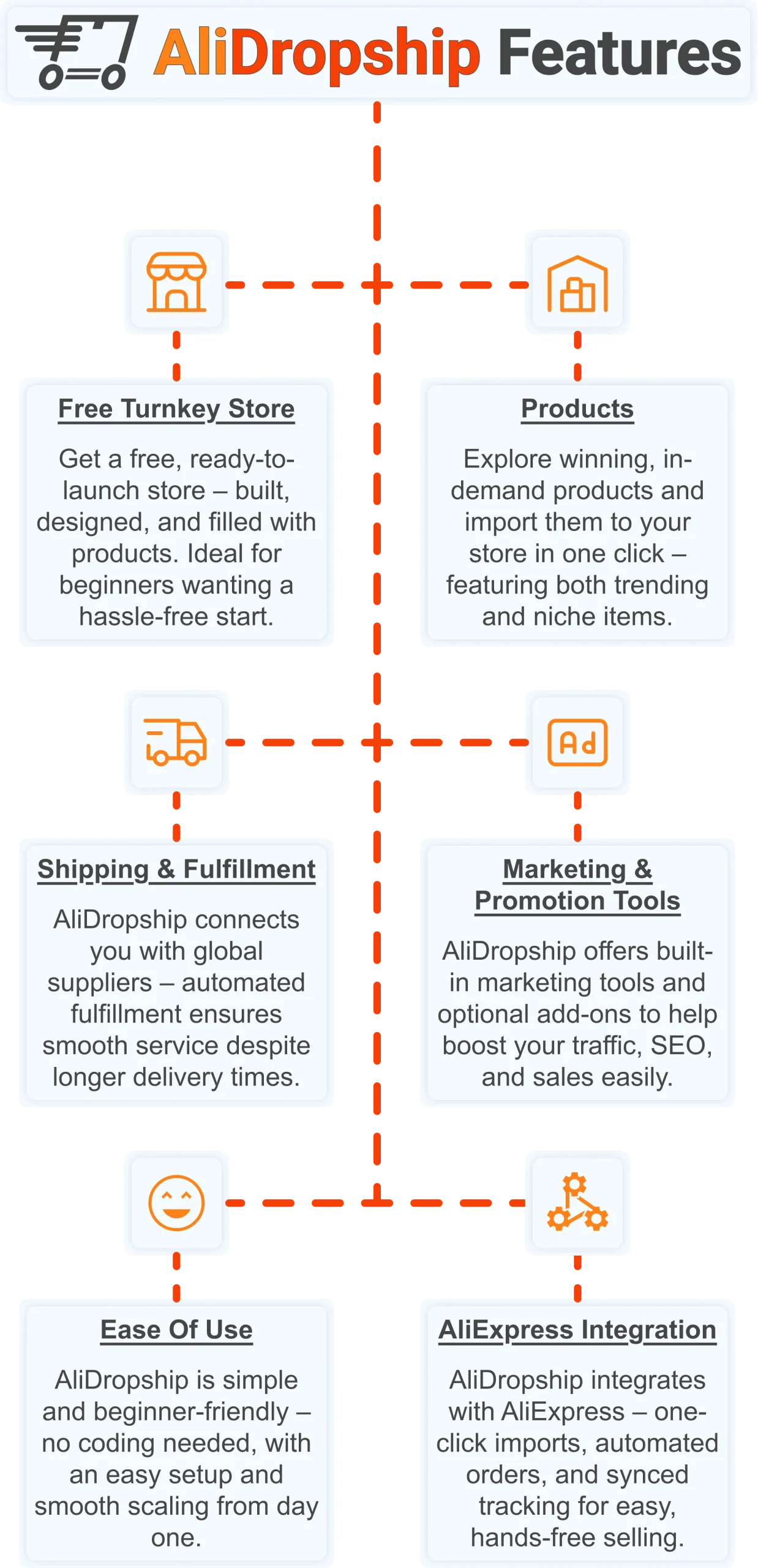
Free turnkey store 🛍️
Get a free turnkey store – built, designed, and filled with products. Ideal for beginners wanting a hassle-free start, the store comes fully optimized to attract customers right away, saving you time on setup. Plus, it includes professional design elements to give your business a polished, trustworthy look from day one. This ready-made foundation makes it easy to move seamlessly into product selection.
Products 📦
Once your store is set up, you can explore winning, in-demand products and import them in one click – featuring both trending and niche items. This wide selection lets you cater to diverse customer interests and test what works best. Regular updates ensure you always have fresh products, keeping your store competitive and relevant. With great products in place, smooth shipping becomes the next essential step.
Shipping & fulfillment 🚚
AliDropship connects you with global suppliers, and automated fulfillment ensures seamless order processing despite international delivery times. Customers receive real-time tracking updates, which builds confidence and trust in your store. Once shipping is handled reliably, you can focus on promoting your store and attracting traffic.
Marketing & promotion tools 📣
To maximize sales, AliDropship offers built-in marketing tools and optional add-ons that help boost traffic, SEO, and conversions. From email campaigns and discounts to social media integration, these tools empower you to reach and retain customers without needing prior marketing experience. With promotion strategies in place, managing your business becomes simpler and more efficient.
Ease of use 👌
AliDropship is beginner-friendly – no coding needed, with an intuitive dashboard that guides you through every step. Easy setup and smooth scaling let you expand your store without stress. As your business grows, adding new features, products, and marketing campaigns remains hassle-free, giving you more time to focus on sales.
AliExpress integration 🛒
Finally, AliDropship integrates seamlessly with AliExpress, enabling one-click imports, automated orders, and synced tracking. Your inventory stays up-to-date with the latest products and prices, while automated order processing frees you from manual tasks. Combined with the turnkey setup, reliable shipping, and built-in marketing tools, this integration ensures your dropshipping business is fully equipped for growth and success.
Affiliate marketing is a great side hustle – but if you want to build something you own from top to bottom, a dropshipping store gives you full control over your brand, margins, and growth. Get your free turnkey store from AliDropship and start selling today.
What is affiliate marketing as a side hustle?
How much can beginners earn from affiliate marketing?
What are the best affiliate programs for beginners?
How long does it take to make money with affiliate marketing?
Is affiliate marketing worth starting in 2026?