How To Make Money In College: 15 Real Methods


College is expensive. Tuition, rent, food, textbooks – it adds up fast, and a part-time shift at the campus café rarely covers the gap. The good news? In 2026, there are more legitimate ways to make money in college than at any point in history – and a surprising number of them work around your class schedule instead of competing with it.
This guide covers 15 real methods students are using right now, from quick cash gigs to income streams that can follow you well beyond graduation. You will find honest earning estimates, step-by-step starting points, and a clear picture of what actually takes off versus what sounds better than it is.
Quick Answer: The best ways to make money in college include freelancing, tutoring, selling online, and starting a dropshipping store – with monthly earnings ranging from $100–$200 for casual gigs up to $1,000–$3,000+ for students who put in consistent effort over 60–90 days.
Before diving into the list, it helps to understand what separates a forgettable side hustle from one that actually builds something. The methods below are grouped by time commitment and skill requirement, so you can find the right fit wherever you are right now.

What does “making money in college” actually look like in 2026?
The phrase gets thrown around a lot, but the reality is more specific than most posts let on. Making money in college in 2026 typically means one of three things: trading time for hourly pay, building a skill-based service, or building a small online business that generates revenue with less direct input over time.
The first category – hourly work – is the most accessible but also the most limited. You earn while you work and stop earning the moment you stop. Campus jobs, food delivery, and task-based gig apps all fall here. They are reliable for filling short-term gaps but do not compound.
The second category – skill-based services – includes freelancing, tutoring, and consulting. Your hourly rate improves as your reputation grows, and you can eventually charge enough to match or beat a full-time entry-level salary on part-time hours. The ceiling is higher, but it takes a few months to build a client base.
The third category – online business – has the highest upside and the slowest start. Dropshipping, print-on-demand, and content creation all take 60–90 days before you see meaningful traction. But students who stick with them often find these income streams outlasting their degree.
How much can you realistically earn?
Here is an honest breakdown of earning potential across the most common student income methods. These figures reflect what real students report on Reddit communities like r/personalfinance and r/Entrepreneur – not headline numbers from promotional content.
One note on these figures: The upper ranges assume consistent effort over at least 60–90 days. Very few students hit $2,000+/month from a cold start in week one. Most legitimate income streams take time to build – plan accordingly and do not quit a method before giving it a full quarter.
The other variable worth flagging is time. A method that earns $900/month from delivery driving might require 60–70 hours of your time. A dropshipping store at the same revenue level might require 10–15 hours per week once it is set up. Hourly rate matters as much as the total number.
15 ways to make money in college
The methods below are split into three groups: quick-start options that pay within days, skill-based services that pay better over time, and online business models with the highest ceiling. Start wherever fits your current situation, then layer in more as you get comfortable.
Quick-start options: earn within the first week
1. Food and grocery delivery
Apps like DoorDash, Uber Eats, and Instacart let you set your own hours, which makes them a natural fit for students with unpredictable schedules. You can work three hours between classes on a Tuesday and take the weekend off entirely. Pay varies by city and time of day – peak hours (lunch, dinner, and weekends) generally earn $18–$25/hour including tips in mid-size cities.
The catch is vehicle dependency. Most delivery apps require a car or at least a bike in dense cities. Factor in gas and wear when calculating your real hourly take-home. Grocery delivery through Instacart or Shipt tends to tip better than food delivery, so it is worth testing both.
Earning potential: $400–$900/month working 15–25 hours per week.
2. Campus gig work and task apps
TaskRabbit, Handybook, and university job boards regularly post one-off gigs: furniture assembly, moving help, research participation, event staffing. These pay well per hour ($20–$40) and require zero skill beyond showing up reliably. Check your university’s student employment portal first – campus jobs often pay above minimum wage and work directly around your class schedule.
Research studies run by your own university are also underused. Psychology, medical, and business departments frequently pay $20–$75 for a one-hour session. A quick search of your school’s research participation board can turn up several options per semester.
Earning potential: $200–$600/month from a mix of campus gigs and task apps.
3. Sell unused items online
Before spending time building income streams, look around your dorm or apartment. Clothes, textbooks, electronics, and even furniture can sell quickly on Facebook Marketplace, Depop, Mercari, or eBay. Textbooks especially move fast at the start and end of each semester – buy used at the start, resell at near-purchase price at the end, and you effectively used them for free.
Students who expand this into a small resale side hustle – thrifting items to flip – often clear $200–$400/month with a few hours of sourcing per week. Depop in particular skews young and moves fast for vintage and streetwear items.
Earning potential: $100–$400/month depending on inventory sourcing frequency.
4. Participate in paid surveys and focus groups
Platforms like Respondent.io and User Interviews pay $50–$200 per session for professional research interviews. This is a step above the typical survey panel – sessions are longer (45–90 minutes) but the pay reflects it. You qualify based on demographic criteria, so not every session will fit, but checking weekly takes five minutes.
Standard survey panels like Prolific and Survey Junkie pay less per session ($1–$10) but are consistently available. Do not chase these as a primary income source – they are better suited for idle time between classes rather than a planned earning strategy.
Earning potential: $50–$300/month from a combination of panels and focus groups.
Skill-based services: earn more as you grow
5. Tutoring
If you are strong in any subject – math, science, writing, a language, test prep – tutoring is one of the highest return-on-time options available to college students. Rates on platforms like Wyzant, Tutor.com, and Superprof range from $20–$60/hour for general subjects and $50–$100/hour for standardized test prep like SAT, ACT, GRE, or GMAT.
Starting on campus is often the fastest path. Post on department boards, offer sessions through your RA network, or approach your school’s tutoring centre about referrals. Once you have two or three regular students, word of mouth handles the rest. A schedule of five to seven hours per week can easily generate $300–$500/month.
Earning potential: $300–$800/month with a stable client roster of 4–6 students.
6. Freelance writing and content creation
Content demand has not slowed down. Businesses, blogs, and agencies consistently need writers, and a college student with strong writing skills – especially in a specific niche – can land paying clients faster than most expect. Rates for beginner freelancers on platforms like Upwork and Fiverr start around $15–$25 per article, but once you build a portfolio, $50–$100 per article is achievable within a semester.
The fastest path in is picking a niche that overlaps with your major. A finance student writing for fintech startups, or a biology student covering health and wellness brands, will stand out over a generalist. Use your first few projects to build a portfolio, then pitch directly to brands in your niche via LinkedIn or cold email.
Earning potential: $300–$1,500/month once you have 3–5 regular clients.
7. Graphic design and visual content
Canva has lowered the floor for entry-level design work, but clients who need custom branding, social media graphics, or presentation design still pay well for someone who understands visual communication. If you have design skills – even self-taught – platforms like 99designs, DesignCrowd, and Upwork are worth exploring.
A simpler starting point: offer Canva-based social media packages to local small businesses. A set of 12 monthly Instagram graphics, a business card design, and a logo refresh can be packaged for $150–$300 and completed in a weekend. Approach businesses in your college town that look like they are using stock photos or outdated visuals.
Earning potential: $400–$1,200/month with a client base of 3–5 monthly retainers.
8. Social media management
Small businesses often know they need a social media presence but do not have the time or knowledge to maintain one. If you use Instagram, TikTok, or LinkedIn regularly, you already understand the basics better than many business owners twice your age. Offer to manage two to three accounts, schedule posts, and write captions for a flat monthly retainer of $200–$500 per client.
Local restaurants, salons, gyms, and retail shops are the easiest first targets – they are close, approachable, and visually driven. Bring a sample post or a simple audit of their current profile to the first conversation. Getting two clients at $300/month puts you at $600 recurring with 8–10 hours of work per week.
Earning potential: $400–$1,500/month managing 2–5 small business accounts.
9. Photography and video work
If you own a decent camera or even shoot well on a smartphone, there is demand for budget-friendly photography at the college level. Event photography, headshots, real estate listings, and product shots for Etsy sellers are all niches where a student photographer can charge $100–$300 per session without needing years of experience.
Event photography is the fastest entry point – contact student clubs, Greek organizations, and local event venues. Build a portfolio from your first 5–10 sessions and raise rates once you have consistent work. Video editing, similarly, is in high demand for content creators who shoot their own footage but cannot edit.
Earning potential: $300–$900/month from a mix of events, headshots, and editing projects.
Online business models: the highest ceiling
10. Dropshipping
Dropshipping is consistently one of the most talked-about ways for students to make money online – and for good reason. The model lets you sell products through your own online store without holding inventory. When a customer places an order, your supplier ships directly to them. Your margin is the difference between what you charge and what you pay the supplier.
What makes it particularly student-friendly is the low upfront cost. You do not need to rent a warehouse, buy bulk stock, or hire staff. AliDropship, for example, gives you a free turnkey store already built and stocked with products, plus a $100 voucher – so you can launch and test your first products without putting significant money on the line.
The realistic timeline is 60–90 days to first consistent sales, assuming you are testing products and running basic ad campaigns or social content. Students who treat it as a genuine business – not a passive income button – typically reach $500–$1,500/month by month three and scale from there.
Why this works in 2026: Consumer comfort with online shopping has never been higher, and tools like AliDropship have reduced the technical barrier to a point where a complete beginner can launch a functional store in a single afternoon.
Earning potential: $500–$3,000+/month after an initial 60–90 day ramp-up period.
11. Print-on-demand
Print-on-demand (POD) works like dropshipping but for custom-designed products – t-shirts, hoodies, mugs, phone cases, tote bags. You upload a design, list the product on platforms like Printful, Printify, or Redbubble, and the platform prints and ships when a sale comes in. No inventory, no upfront stock.
The advantage over traditional dropshipping is built-in marketplaces. Redbubble and Merch by Amazon have their own traffic, which means you do not always need to run ads to get eyes on your products. The downside is lower margins ($3–$8 per sale on many items) – so volume matters. Niche designs targeting specific communities tend to outperform generic art.
Earning potential: $150–$600/month with 20–50 active listings on multiple platforms.
12. Selling digital products
If you have knowledge worth packaging – study guides, templates, Notion setups, Lightroom presets, Excel spreadsheets – you can sell them repeatedly without any additional work after creation. Gumroad, Etsy Digital, and Payhip are the most beginner-friendly platforms for this.
A well-structured set of lecture notes for a popular university course, a budgeting spreadsheet for college students, or a resume template for entry-level jobs in your field can each sell dozens of times with zero marginal effort. The upfront work is real, but the payoff compounds without adding more hours.
Earning potential: $100–$500/month from 3–5 digital products with consistent promotion.
13. YouTube or TikTok content creation
Content creation has a long runway – most channels take 6–12 months before they generate meaningful income from ads or brand deals. But for students with 2–3 years of college left, starting now means graduating with an established platform. YouTube pays roughly $2–$5 per 1,000 views through AdSense. TikTok’s creator fund pays less, but brand partnerships kick in at smaller follower counts.
The students who build audiences fastest pick a specific niche with genuine demand: study-with-me content, college finance, dorm organization, major-specific career advice. Broad lifestyle content is oversaturated. Specific content compounds.
Earning potential: $0–$500/month in year one; $1,000–$5,000+/month for channels with 50,000+ subscribers or strong brand deal pipelines.
14. Reselling and arbitrage
Retail arbitrage – buying discounted items in-store or at thrift shops and reselling them at a profit – is a legitimate business model used at scale by full-time Amazon FBA sellers and part-time side hustlers alike. As a student, you can start small: scan clearance sections with the Amazon Seller app to check if items are profitable, buy the winners, and list them on Amazon or eBay.
Thrift flipping – sourcing items at Goodwill or estate sales and reselling on Depop, Poshmark, or eBay – follows the same logic. Vintage clothing, branded sportswear, and collectibles move reliably. The learning curve is mostly about knowing what to look for, which improves fast with practice.
Earning potential: $200–$700/month sourcing 5–10 hours per week.
15. Micro-SaaS or app development (for CS students)
If you study computer science or software engineering, you have an unusual advantage: you can build things other people cannot. A small tool that solves a specific problem – a browser extension, a scheduling app for a niche industry, a WordPress plugin – can be sold on Gumroad, ProductHunt, or AppSumo for $10–$50 one-time or on a subscription model.
The most successful micro-SaaS products from student builders tend to solve problems the builder personally experienced. If you built a tool to track your assignments and it works well, there are thousands of students who would pay $5/month for it. That is a small audience, but 500 subscribers is $2,500/month in recurring revenue.
Earning potential: $0–$500/month in early stages; $2,000–$10,000+/month for products that find product-market fit.
What to avoid: common pitfalls when trying to earn money as a student
Not every “easy money” opportunity you will encounter as a college student is legitimate. Some are outright scams. Others are legal but will cost you more in time or reputation than they return in income. Here is what to watch out for.
Key principle: If an opportunity promises significant income with zero effort, zero skill, and zero time – it is either a scam, a legal grey area, or a pyramid scheme. All three are worth avoiding entirely.
Multi-level marketing schemes
MLMs are disproportionately targeted at college students because of the campus social network and financial pressure. The pitch sounds like a business opportunity, but the structure makes meaningful income nearly impossible unless you are at the very top of the pyramid. The Federal Trade Commission has documented repeatedly that the vast majority of MLM participants earn little to nothing after expenses. Do not recruit your friends into these – it will cost you relationships as well as money.
Essay writing for hire
Contract cheating services – sites that pay students to write essays submitted by other students – are not just ethically problematic. They carry real legal and academic risk. If your university connects your writing to a submitted paper (which detection tools increasingly can), you face the same academic integrity consequences as the person who submitted it. The pay is also poor – typically $5–$15 per page for work that can take several hours.
Paid-to-click and low-value survey spam
There is a difference between legitimate research panels (Respondent.io, Prolific) and the flood of “make $500/day clicking ads” sites that populate Google results. The latter earn fractions of a cent per action, have opaque payout thresholds, and frequently never pay out at all. Spending two hours on one of these platforms for $1.20 is not a side hustle – it is a loss of time that could have gone toward something that compounds.
Fake freelance job listings
Freelance platforms attract scammers alongside legitimate clients. Red flags include: clients who ask you to buy gift cards, pay a “security deposit,” or accept overpayment via check and wire back the difference. On Upwork and Fiverr, verified payment methods are required from buyers – so scams are more common on Craigslist, Facebook groups, and unsolicited email outreach. Always communicate and accept payment through the platform rather than moving off it.
Important: Never provide personal financial information – account numbers, routing numbers, or Social Security details – to a potential client or employer who has not been verified through a legitimate platform’s hiring process.
How to choose the right method for you
The honest answer to “which method is best” depends entirely on where you are starting from. Here is a practical breakdown by profile.
Complete beginner
Start with one quick-start option – delivery driving, campus gigs, or selling items you already own – to generate immediate cash flow. Simultaneously, begin setting up a low-barrier online income stream like dropshipping with AliDropship’s free turnkey store. The delivery income covers your expenses while the store builds traction over 60–90 days. By the end of a semester, you have both an immediate income stream and a business in motion.
Intermediate – you have one side hustle already
If you are already tutoring, freelancing, or doing gig work, the next move is to add something that earns without your direct time input. That means starting a dropshipping store, listing digital products, or adding print-on-demand products. These do not require you to drop what is already working – they run in the background and build momentum independently.
Advanced – you want income that outlasts graduation
For students thinking beyond the degree, the priority is building something with a defensible asset at its core – a client base, a content platform, or a branded online store. An AliDropship store built and optimized during your college years can be operating at $2,000–$5,000/month by the time you graduate, giving you the option to pursue it full-time or continue scaling it alongside a job.
The students who end up in this position started early, treated the business seriously from day one, and reinvested early revenue into ads and product testing instead of pulling it all out. The compounding effect of 2–3 consistent years is significant.
Whatever profile you are starting from, the most important move is picking one method and staying with it long enough to see real results. Jumping between ideas every few weeks is the most common reason student side hustles never gain traction. Give each method a genuine 60–90 day run before evaluating.
AliDropship: Your complete all-in-one solution for starting dropshipping in 2026
If you want the simplest possible way to start dropshipping – especially if you’re brand new – AliDropship remains one of the most beginner-friendly tools available in 2026. It brings together store creation, product imports, automation, and marketing into a single streamlined system designed to help you launch quickly and grow confidently.
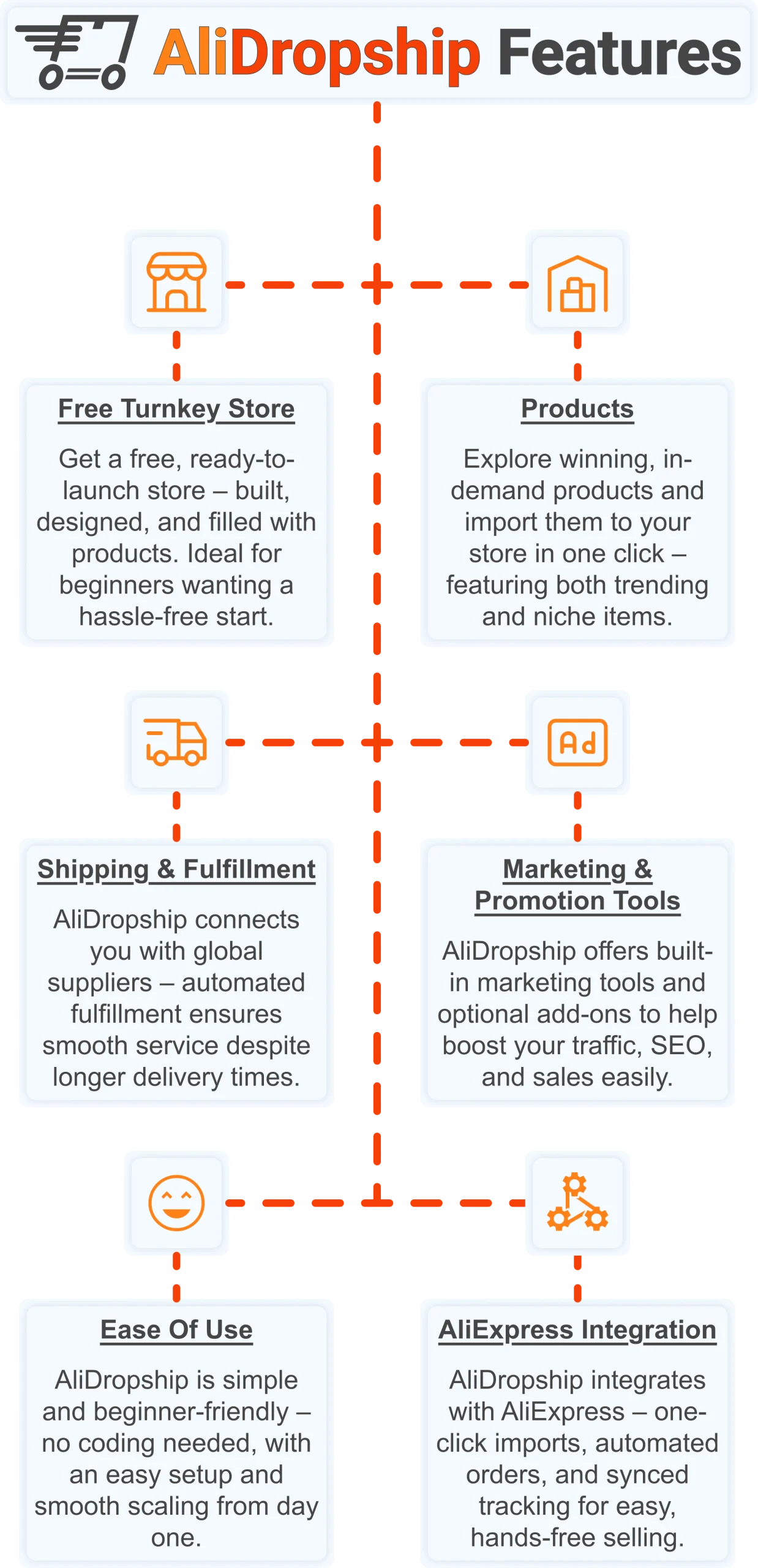
Free turnkey store 🛍️
Get a free turnkey store – built, designed, and filled with products. Ideal for beginners wanting a hassle-free start, the store comes fully optimized to attract customers right away, saving you time on setup. Plus, it includes professional design elements to give your business a polished, trustworthy look from day one. This ready-made foundation makes it easy to move seamlessly into product selection.
Products 📦
Once your store is set up, you can explore winning, in-demand products and import them in one click – featuring both trending and niche items. This wide selection lets you cater to diverse customer interests and test what works best. Regular updates ensure you always have fresh products, keeping your store competitive and relevant. With great products in place, smooth shipping becomes the next essential step.
Shipping & fulfillment 🚚
AliDropship connects you with global suppliers, and automated fulfillment ensures seamless order processing despite international delivery times. Customers receive real-time tracking updates, which builds confidence and trust in your store. Once shipping is handled reliably, you can focus on promoting your store and attracting traffic.
Marketing & promotion tools 📣
To maximize sales, AliDropship offers built-in marketing tools and optional add-ons that help boost traffic, SEO, and conversions. From email campaigns and discounts to social media integration, these tools empower you to reach and retain customers without needing prior marketing experience. With promotion strategies in place, managing your business becomes simpler and more efficient.
Ease of use 👌
AliDropship is beginner-friendly – no coding needed, with an intuitive dashboard that guides you through every step. Easy setup and smooth scaling let you expand your store without stress. As your business grows, adding new features, products, and marketing campaigns remains hassle-free, giving you more time to focus on sales.
AliExpress integration 🛒
Finally, AliDropship integrates seamlessly with AliExpress, enabling one-click imports, automated orders, and synced tracking. Your inventory stays up-to-date with the latest products and prices, while automated order processing frees you from manual tasks. Combined with the turnkey setup, reliable shipping, and built-in marketing tools, this integration ensures your dropshipping business is fully equipped for growth and success.
For students looking for ways to make money in college that build into something real, dropshipping with AliDropship is one of the few options that can follow you past graduation. Get your free turnkey store and start building your income today.
What are the best ways to make money in college with no experience?
How much can a college student realistically earn from a side hustle?
Is dropshipping a good way to make money in college?
What are the easiest ways to make money in college fast?
Can you make money in college without a car?