What Is A Marketing Plan Example And How Do You Use One?

Most businesses that struggle to grow share one common problem — they have no written marketing plan. They post on social media when inspiration hits, run ads without a clear goal, and wonder why nothing sticks. A solid marketing plan example gives you a framework to follow so every action connects to a real outcome.
This guide walks you through what a marketing plan actually looks like in practice, breaks down each section with real examples, and shows you how to build one — even if you are starting from scratch with no marketing background.
Quick Answer: A marketing plan is a written document that defines your target audience, your goals, your channels, and your budget. A good marketing plan example shows you how those pieces fit together in a real business context — so you can adapt the structure to your own situation.

What is a marketing plan?
A marketing plan is a strategic document that outlines how a business intends to reach its target customers and convert them into buyers. It covers everything from audience research and channel selection to budget allocation and performance tracking. Without one, marketing efforts tend to be reactive — driven by trends or guesswork rather than clear business goals.
A marketing plan is not the same as a marketing strategy, though the two are closely related. Your strategy is the big-picture direction — for example, “we want to own the budget fitness niche online.” Your plan is the operational document that turns that direction into specific actions, timelines, and measurable targets.
In 2026, the need for a written plan is greater than ever. The number of channels available to small businesses — search, social, email, video, influencer, paid — has expanded significantly. Without a plan, it is easy to spread your budget too thin and see weak results across the board. A focused marketing plan keeps you deliberate.
How much does good marketing actually cost?
One of the first questions small business owners ask is how much they need to spend. The honest answer is that it depends heavily on your channel mix and your timeline. Here is a realistic breakdown by approach:
Most small businesses starting out land in the first or second row. A well-structured plan helps you get the most from whatever budget you have by focusing spend on the channels most likely to convert your specific audience.
One note on budget figures: these ranges reflect typical small business and ecommerce scenarios. Agency-managed campaigns or large product catalogs will sit at the higher end. Starting lean and scaling what works is almost always the smarter move.
Marketing plan examples: what each type looks like in practice
Before building your own plan, it helps to see what a real marketing plan example looks like across different business types. The structure is similar across the board — but the channels, tone, and priorities shift depending on what you sell and who you sell to.
Marketing plan example: ecommerce store
Business overview
An online store selling home organization products targeting first-time homeowners aged 25–40 in the US.
Goals
Generate 500 monthly orders within 90 days of launch. Achieve a 3x return on ad spend (ROAS) on paid channels by month three.
Target audience
Renters and new homeowners who follow home improvement accounts on Instagram and Pinterest. Price-conscious but willing to spend on products that solve a clear problem.
Channels
- Instagram and Pinterest organic content (product in use, before/after)
- Google Shopping ads for high-intent search terms
- Email welcome sequence for new subscribers
Budget
$600/month — split $400 on paid ads and $200 on content tools and email platform.
KPIs
Cost per acquisition (CPA), ROAS, email open rate, monthly revenue.
Marketing plan example: small service business
Business overview
A freelance graphic designer targeting early-stage startups and small businesses that need branding work.
Goals
Land 4 new clients per month at an average project value of $800. Build a referral pipeline within 6 months.
Target audience
Founders and solopreneurs aged 28–45, active on LinkedIn and in startup communities on Reddit and Slack.
Channels
- LinkedIn content and direct outreach
- Portfolio website optimized for local and niche search terms
- Referral program offering a discount for introductions
Budget
$150/month — LinkedIn Premium subscription plus basic SEO tools.
KPIs
Number of qualified leads per month, proposal-to-close rate, referral count.
Marketing plan example: digital product creator
Business overview
A creator selling Notion templates and productivity guides targeting remote workers and students.
Goals
Reach $2,000/month in passive digital product sales within 120 days. Grow an email list to 3,000 subscribers.
Target audience
Remote workers and university students aged 18–34 who follow productivity accounts on TikTok and YouTube.
Channels
- TikTok and YouTube Shorts showing product walkthroughs
- Gumroad or Etsy storefront optimized for search
- Weekly newsletter with free tips to drive product interest
Budget
$80/month — email platform and basic design tools.
KPIs
Monthly revenue, email list growth rate, content views, conversion rate from traffic to sales page.
Marketing plan example: local brick-and-mortar business
Business overview
A coffee shop in a mid-sized city targeting remote workers and students looking for a reliable workspace.
Goals
Increase weekday foot traffic by 25% within 60 days. Build a loyalty program with 500 active members in 3 months.
Target audience
Remote workers and students aged 20–38 within a 3-mile radius who use Google Maps and Instagram to discover local spots.
Channels
- Google Business Profile optimization and review generation
- Instagram Stories showing the workspace, drinks, and daily specials
- Local SEO targeting “coffee shop with wifi near me” type searches
Budget
$200/month — social scheduling tool, local ad spend, and loyalty app.
KPIs
Google Maps views and actions, Instagram reach, loyalty app sign-ups, average daily transactions.
How to write your own marketing plan step by step
Now that you have seen several real marketing plan examples, here is how to build your own from scratch. Each section below maps directly to the examples above — so you can reference them as you fill in your own details.
Step 1 — define your business and offer clearly
Start with a one-paragraph description of what your business does, what problem it solves, and who it is for. This is not a mission statement — it is a plain, honest description that grounds everything that follows. If you cannot describe your offer clearly in three sentences, your marketing will struggle to land with anyone.
Important note: Be specific about your niche from the start. “I sell products online” is too vague to build a meaningful plan around. “I sell eco-friendly kitchen products to sustainability-conscious households in the US” gives you a foundation to work from.
Step 2 — set SMART goals
Every strong marketing plan uses SMART goals — Specific, Measurable, Achievable, Relevant, and Time-bound. Vague goals like “grow our audience” are not actionable. A SMART version would be: “Grow our Instagram following from 400 to 1,500 engaged followers by the end of Q2 by posting 5 times per week and running one collaboration per month.”
Set 2–3 goals maximum per quarter. More than that and you dilute your focus. Each goal should map to a real business outcome — revenue, leads, conversions, or retention.
Step 3 — research and define your target audience
Your marketing plan example is only useful if it is built around a real audience profile. At a minimum, define your audience by age range, location, income level, and the main problem your product or service solves for them. Then go deeper: where do they spend time online? What content do they consume? What objections do they typically have before buying?
Free research tools that work well here include Reddit (search for conversations in relevant subreddits), Facebook Groups, Google Trends, and the review sections of competitor product listings on Amazon. Real customer language from these sources is far more valuable than demographic data alone.
Step 4 — choose your marketing channels
The biggest mistake small businesses make in this step is trying to be everywhere at once. Pick 2–3 channels based on where your specific audience already spends time — not based on what is trendy. For most ecommerce businesses in 2026, a combination of one organic social channel, one paid channel, and email covers the essentials without spreading resources too thin.
Match your channel choice to your content strengths as well. If you are comfortable on camera, short-form video on TikTok or Instagram Reels is a natural fit. If you prefer writing, a blog with SEO focus paired with an email newsletter is a more sustainable long-term channel mix.
Step 5 — build your content and campaign calendar
A marketing plan without a calendar is just a wish list. Once you have your channels, map out your content themes and campaign cadence for the next 30–90 days. This does not need to be elaborate — a simple spreadsheet with columns for date, channel, content type, topic, and goal is enough to start.
Plan your content in weekly batches rather than day by day. This gives you enough breathing room to stay consistent without burning out. Batch-create content for one or two channels at a time rather than jumping between all of them simultaneously.
Step 6 — set your budget and allocate spend
Even a zero-budget plan needs a budget section — because your time has a cost. List every tool, platform subscription, ad spend, and contractor cost involved in executing your plan. Then prioritize ruthlessly. If a tool does not directly contribute to a stated goal, cut it for now.
A practical rule of thumb for early-stage ecommerce businesses: allocate roughly 60–70% of your marketing budget to paid acquisition and 30–40% to retention (email, loyalty, content). Adjust based on your results every 30 days.
Step 7 — track, measure, and adjust
The final section of any marketing plan example worth following is measurement. Define your key performance indicators (KPIs) before you launch any campaign — not after. Knowing what “success” looks like in advance prevents you from moving the goalposts when results come in.
Review your KPIs monthly at minimum. If a channel consistently underperforms after 60 days of genuine effort, reallocate that budget or time to your strongest performer. A marketing plan is a living document — it should evolve with your data, not sit untouched in a folder.
Common marketing plan mistakes to avoid
Even with a solid marketing plan template in hand, there are a few mistakes that consistently trip up small business owners and first-time ecommerce sellers.
Targeting everyone
The more specific your audience definition, the more effective your marketing. “Everyone who might like this product” is not a target audience — it is a way to waste budget. Narrow your focus until it feels uncomfortable, then narrow it a little more. You can always expand later once you have proven the core audience converts.
Skipping the research phase
Jumping straight to content creation without understanding your audience is one of the most common and costly mistakes. Spend at least a week before launch reading competitor reviews, exploring relevant subreddits, and looking at what content already performs well in your niche. This research should shape your messaging, not just confirm what you already think.
Setting goals without tracking systems
A goal without a tracking system is just an intention. Before you set any marketing goal, confirm you have the tools in place to measure it. Google Analytics 4 is free and covers the essentials for most ecommerce stores. Pair it with your email platform’s built-in reporting and you have a solid baseline measurement setup at no cost.
Treating the plan as a one-time document
Your first marketing plan will not be perfect — and that is fine. The goal is to start with a structured approach, gather real data, and iterate. Businesses that revisit and update their plan every 30–60 days consistently outperform those that write one document and never touch it again.
How to choose your approach based on your situation
Not every marketing plan example applies equally to every reader. Here is how to match your approach to where you actually are right now.
Complete beginner
If you are building your first marketing plan, start with a single-channel focus. Pick the one channel where your audience is most active and commit to it for 60 days before adding anything else. Use a simple one-page plan template: audience, goal, channel, content calendar, budget, and one KPI. Keep it short enough to actually follow.
Intermediate — part-time business
If you have some marketing experience but are juggling a day job, prioritize channels with the highest return per hour of effort. Email marketing typically wins here — a well-maintained list of even 500 engaged subscribers can outperform a social following of 10,000 passive ones. Add a second channel only when your primary channel is producing consistent results.
Advanced — full-time growth goal
If you are treating this as a full-time business, your marketing plan should include a multichannel approach with dedicated budget for paid acquisition, a content engine (blog + video), and a structured email sequence. At this stage, tracking attribution across channels becomes essential — know which channel is driving which revenue, not just which one is generating the most traffic.
AliDropship: Your complete all-in-one solution for starting dropshipping in 2026
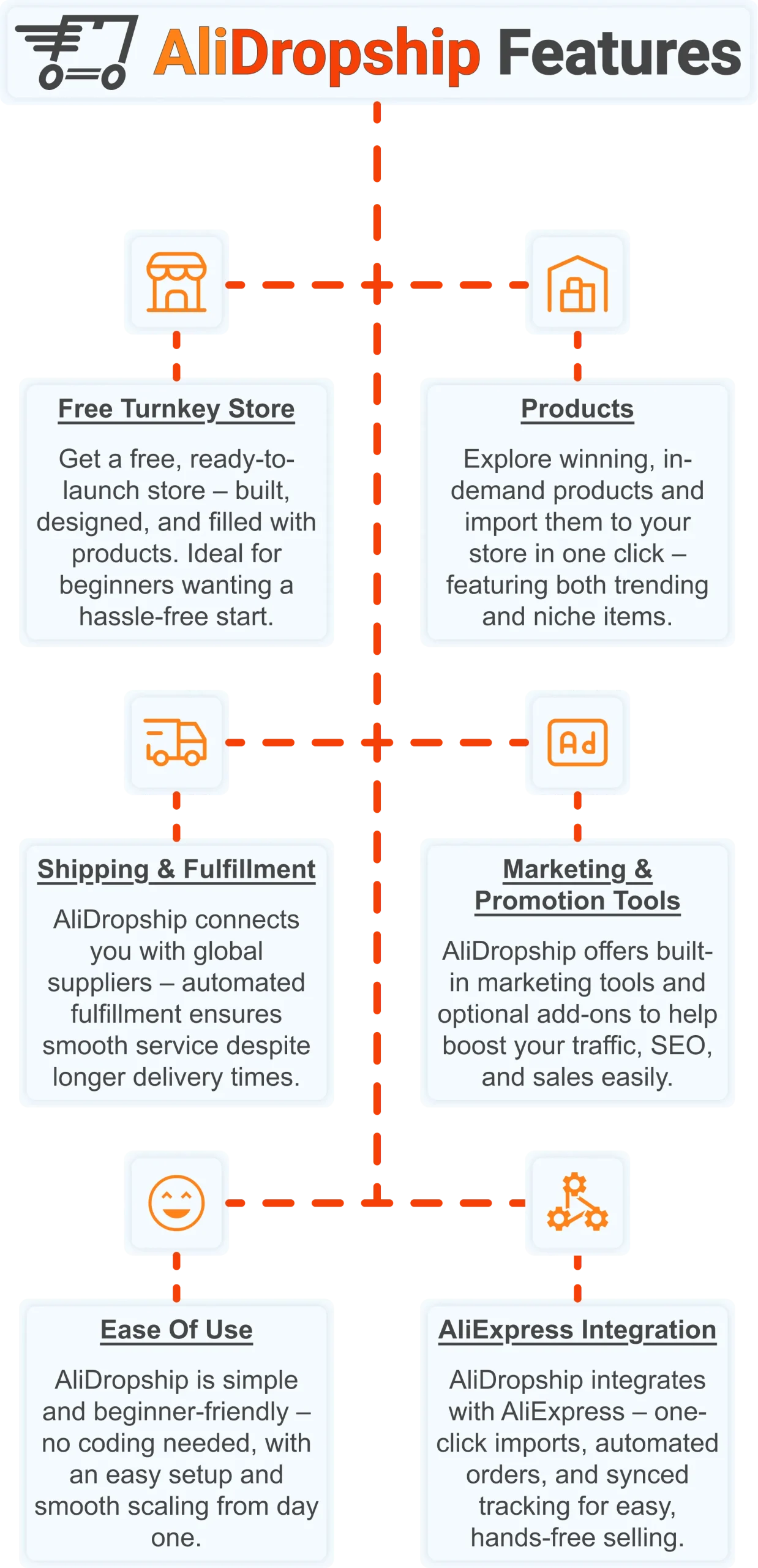
If you want the simplest possible way to start dropshipping – especially if you are brand new – AliDropship remains one of the most beginner-friendly tools available in 2026. It brings together store creation, product imports, automation, and marketing into a single streamlined system designed to help you launch quickly and grow confidently.
Free turnkey store 🛍️
Get a free turnkey store – built, designed, and filled with products. Ideal for beginners wanting a hassle-free start, the store comes fully optimized to attract customers right away, saving you time on setup. Plus, it includes professional design elements to give your business a polished, trustworthy look from day one. This ready-made foundation makes it easy to move seamlessly into product selection.
Products 📦
Once your store is set up, you can explore winning, in-demand products and import them in one click – featuring both trending and niche items. This wide selection lets you cater to diverse customer interests and test what works best. Regular updates ensure you always have fresh products, keeping your store competitive and relevant. With great products in place, smooth shipping becomes the next essential step.
Shipping & fulfillment 🚚
AliDropship connects you with global suppliers, and automated fulfillment ensures seamless order processing despite international delivery times. Customers receive real-time tracking updates, which builds confidence and trust in your store. Once shipping is handled reliably, you can focus on promoting your store and attracting traffic.
Marketing & promotion tools 📣
To maximize sales, AliDropship offers built-in marketing tools and optional add-ons that help boost traffic, SEO, and conversions. From email campaigns and discounts to social media integration, these tools empower you to reach and retain customers without needing prior marketing experience. With promotion strategies in place, managing your business becomes simpler and more efficient.
Ease of use 👌
AliDropship is beginner-friendly – no coding needed, with an intuitive dashboard that guides you through every step. Easy setup and smooth scaling let you expand your store without stress. As your business grows, adding new features, products, and marketing campaigns remains hassle-free, giving you more time to focus on sales.
AliExpress integration 🛒
Finally, AliDropship integrates seamlessly with AliExpress, enabling one-click imports, automated orders, and synced tracking. Your inventory stays up-to-date with the latest products and prices, while automated order processing frees you from manual tasks. Combined with the turnkey setup, reliable shipping, and built-in marketing tools, this integration ensures your dropshipping business is fully equipped for growth and success.
Every marketing plan example in this guide requires a product worth promoting and a store ready to receive traffic — AliDropship gives you both from day one. Get your free turnkey store and start putting your marketing plan into action today.
What should a marketing plan example include?
How long should a marketing plan be for a small business?
What is the difference between a marketing plan and a marketing strategy?
How do you write a marketing plan with no budget?
How often should you update your marketing plan?