
Ecommerce SEO: How To Rank Your Online Store In 2026


Over 43% of all ecommerce traffic comes from organic search. If your store is not showing up in Google results, you are handing a consistent stream of ready-to-buy visitors directly to your competitors. Ecommerce SEO is the discipline of making your store visible to those buyers – and in 2026, it is one of the highest-leverage activities a store owner can invest time in.
Quick Answer: Ecommerce SEO is the practice of optimizing your store’s product pages, category pages, site structure, and content so it ranks in search engines. Done consistently, it drives free, targeted organic traffic that converts into sales at a significantly lower cost per acquisition than paid advertising.
The good news is that you do not need to be a technical expert to see real results. Whether you are setting up your first store or trying to grow an existing one, this guide covers every layer of a solid ecommerce seo strategy – from ecommerce keyword research to technical fixes to the content that actually moves rankings.
A strong ecommerce SEO approach is not just about keywords. It involves site architecture, search intent matching, page speed, backlink authority, and a consistent content rhythm. Each piece builds on the others and compounds over time – which is exactly what makes organic search one of the most durable and cost-efficient traffic channels available to independent store owners.

What is ecommerce SEO?
Ecommerce SEO is the process of optimizing an online store so it appears in search engine results when potential buyers search for the products you sell. It covers everything from the copy on your product pages to how fast your site loads on a mobile device – and it applies whether you are running a WooCommerce store, a Shopify site, or a custom-built solution.
Unlike paid ads, which stop delivering the moment you pause your budget, ecommerce SEO builds a compounding asset. A well-optimized product page can attract buyers for months or even years after you publish it. That durability is what makes seo for online store one of the smartest long-term investments in ecommerce.
The core components of ecommerce SEO include:
- Keyword research – identifying what your target buyers actually type into Google before they buy
- On-page optimization – product titles, meta descriptions, headers, and product copy tailored to those keywords
- Technical SEO – site speed, crawlability, structured data, and mobile performance
- Content marketing – blog posts and buying guides that capture top-of-funnel search traffic
- Link building – earning backlinks that raise your domain authority in Google’s ranking algorithm
In 2026, search engines are prioritizing user experience signals more strongly than ever – page speed, mobile usability, and content depth all feed directly into where your store ranks. A store that delivers both relevant products and a smooth browsing experience has a genuine competitive edge over stores that treat SEO as an afterthought.
Understanding what ecommerce SEO covers is the first step. Knowing what it can realistically earn you is what turns that understanding into action.
How much can good ecommerce SEO realistically earn you?
The honest answer depends on your niche, competition level, and how consistently you execute. But to give you a concrete frame of reference, here is what different levels of SEO effort typically produce for independent ecommerce stores:
Basic on-page optimization alone is enough to move the needle in low-competition niches. A complete strategy – combining technical SEO, targeted content, and link building – is where the significant monthly revenue figures become realistic. Advanced operators who scale content and actively build backlinks are the ones reaching the top tier.
One note on the top-tier figures: Revenue of $5,000–$15,000/month from organic search alone typically takes 12–18 months of sustained effort in a well-chosen niche. These figures reflect what is possible, not what you will see in the first 60 days.
Part-time ecommerce SEO effort – consistent keyword-targeted content and basic technical maintenance – can yield $500–$1,500/month in organic revenue within 6–9 months in a low-competition niche. Full-time focus with link acquisition and daily publishing pushes results toward the higher end of that range.
The most important next step is knowing exactly where to focus your effort. Let us walk through the core pillars of a complete ecommerce SEO strategy.
Ecommerce SEO strategy: the core pillars
A complete ecommerce seo strategy rests on several interconnected pillars. Skipping any one of them creates a ceiling on your rankings. Here is how each layer works and what to prioritize when you are getting started.
Ecommerce keyword research
Ecommerce keyword research is fundamentally different from standard blogging keyword research. You are primarily targeting people who want to buy – not just browse – which means prioritizing transactional and commercial intent keywords over purely informational ones.
Transactional keywords
Transactional keywords are searches like “buy wireless earbuds under 50 dollars” or “best waterproof hiking boots.” The searcher is ready to purchase. These belong on your category pages and product pages, where a well-optimized title tag and product description can convert organic traffic directly into sales.
Earning potential: A category page ranking in the top 5 for a transactional keyword with 500–2,000 monthly searches can realistically generate $800–$3,000/month in organic revenue in a mid-competition niche.
Long-tail product keywords
Long-tail keywords – phrases of four or more words – have lower search volume but significantly higher purchase intent and much lower competition. “Waterproof travel backpack for carry-on” is far easier to rank for than “travel backpack,” and the buyer is more specific, which means higher conversion rates once they reach your page.
Why this works in 2026: Google’s AI-enhanced search systems have become considerably better at understanding conversational and specific queries, giving long-tail optimized product pages a stronger relevance signal advantage over broad, generic pages that try to rank for everything.
Category-level keywords
Your category pages are typically the highest-traffic pages in your store. Targeting mid-volume commercial keywords at the category level – like “affordable office chairs” or “organic skincare gift sets” – creates a traffic hub that also distributes ranking authority down to your individual product pages. Most new store owners ignore this layer entirely, which is one of the most common missed opportunities in ecommerce SEO.
Earning potential: A well-optimized category page in a niche with 500–2,000 monthly searches can contribute $400–$1,200/month in sales once it reaches the top 5 positions.
On-page SEO for online stores
On-page SEO covers every optimization you make directly within your pages. For ecommerce, the highest-impact on-page elements are product titles, meta descriptions, header tags, image alt text, and product descriptions.
Product title optimization
Your product page title tag should lead with the primary keyword, include a meaningful differentiator (material, size, use case, color), and stay under 60 characters to avoid truncation in search results. “Waterproof Travel Backpack 40L – Lightweight and Durable” is a strong product title. “Backpack” is not.
Meta description best practices
Meta descriptions do not directly influence rankings, but they heavily influence click-through rates – and CTR is increasingly a signal Google weighs when assessing whether your ranking is justified. A strong meta description tells the searcher exactly what they will get, includes the primary keyword naturally, and ends with a soft action prompt. Keep it between 140 and 160 characters.
Product description depth
Thin product descriptions – one or two sentences copied directly from a supplier – are a ranking liability. Google rewards pages that genuinely answer the buyer’s questions. A strong product description addresses key features, handles common buyer concerns, includes natural keyword variations, and runs to at least 150–250 words per product. For high-ticket or complex products, 300–500 words is worth the investment.
Important note: Never copy descriptions directly from AliExpress or your supplier. Duplicate content spread across multiple stores is a significant ecommerce SEO risk that can suppress your entire domain’s visibility in search results.
Once your on-page fundamentals are in place, the next layer that separates ranking stores from invisible ones is technical SEO.
Technical SEO for ecommerce: what actually moves rankings
Technical seo for ecommerce is the layer most store owners skip – and it is often the exact reason a well-keyworded, well-written store still fails to rank. Here is a comparison of the most impactful technical factors and the priority at which each needs to be addressed:
Core Web Vitals and mobile usability are the two non-negotiable fixes for any ecommerce store in 2026. Google’s mobile-first indexing means your mobile experience is evaluated for ranking, not your desktop version. Structured data – specifically Product schema and Review schema – is worth implementing early because it generates rich snippets in results: star ratings, price ranges, and stock availability. These lift click-through rates even before your rankings improve.
Important: Use Google Search Console (free) to identify crawl errors, index coverage gaps, and Core Web Vitals failures specific to your store. The data it surfaces is more actionable than most paid audit tools for fixing what actually matters to your rankings.
Ecommerce SEO checklist: five high-impact moves to make now
If you want a practical ecommerce seo checklist to work from, these are the areas that drive results fastest – ranging from quick wins to longer-term plays that build durable authority.
Optimize your URL structure
Clean, descriptive URLs are both a ranking factor and a trust signal. Use short, keyword-rich paths that mirror your site hierarchy: yourstore.com/category/product-name. Avoid dynamically generated URLs with parameter strings like ?id=4521&ref=home. These are harder for Googlebot to crawl efficiently, harder for users to share, and weaker as ranking signals than simple, readable paths.
Build internal links strategically
Internal linking is one of the most underused leverage points in ecommerce SEO. Link from blog posts to relevant category and product pages. Link between related products on each product page. Use descriptive anchor text – “shop waterproof hiking backpacks” rather than “click here.” Each internal link passes ranking authority and helps Google understand the relationships between your pages.
Start a niche content strategy
A consistently published blog is one of the most powerful long-term SEO assets for seo for online store. Buyers rarely start their journey with a direct product search – they often begin with informational queries like “how to choose a hiking backpack” or “best gifts for plant lovers.” Blog content that ranks for these searches attracts cold traffic you can retarget or convert through smart internal links to your product pages.
Get your images right
Image SEO is a quick win most store owners overlook. Use descriptive file names (waterproof-hiking-backpack-40L.webp rather than IMG_4521.jpg), write accurate keyword-inclusive alt text, and compress every image aggressively. Slow image loading is one of the most common Core Web Vitals failures in ecommerce stores – and it directly affects both rankings and bounce rates.
Build backlinks through real value
Backlinks remain one of Google’s strongest ranking signals. For ecommerce stores, the most sustainable approaches are: publishing original buying guides or niche data that other sites reference naturally, developing supplier or partner relationships that include a contextual link, and getting listed in genuine niche directories or review sites. Avoid paid links, link exchanges, and link farms – the short-term ranking boost is not worth the penalty risk.
Why this works in 2026: A handful of links from trusted niche sites consistently outperforms hundreds of low-quality directory links. Relevance and authority matter far more than link volume at this stage of Google’s algorithm.
How to choose your ecommerce SEO approach by reader profile
Not every store owner starts from the same position. Here is how to prioritize your ecommerce SEO effort based on where you are right now.
Complete beginner
If you are new to both ecommerce and SEO, focus on fundamentals first: set up Google Search Console, write unique product descriptions for every product in your store, optimize your title tags and meta descriptions, and confirm your store loads cleanly on mobile. Do not attempt link building or full technical audits in your first month. A solid on-page foundation is the correct starting point.
Intermediate / part-time
If you already have a store with some organic traffic, the next leverage point is content. Start a blog, publish two to four posts per month targeting informational keywords in your niche, and build internal links from those posts to your best product and category pages. At this stage, a basic keyword research tool (Google Keyword Planner, Ubersuggest) is worth using consistently to guide topic selection.
Advanced / full-time
At the advanced level, the focus shifts to three areas: building domain authority through consistent link acquisition, scaling content production with a clear keyword map, and running regular technical audits to catch crawl issues, thin content, and keyword cannibalization before they affect rankings. Tools like Ahrefs or Semrush become cost-effective investments at this stage of growth.
Launching a brand-new store
If you have not launched yet, the single most important SEO decision you will make is niche selection. A low-to-medium competition niche with clear buyer intent keywords gives you a realistic path to page-one rankings within 6–12 months. A broad, highly competitive niche – fashion, general electronics – requires significantly more time and domain authority to see meaningful organic results.
Important note: Niche selection has a larger long-term impact on your ecommerce SEO trajectory than almost any tactical decision you make after launch. Get this right before you build.
Legal and ethical considerations in ecommerce SEO
Most ecommerce SEO practices are entirely legitimate. But grey-area and black-hat tactics regularly circulate in forums and YouTube tutorials – and following them can cause serious, lasting damage to your store’s search visibility.
What to avoid absolutely
- Buying backlinks from link farms or PBNs – Google’s spam detection is now highly effective at identifying unnatural link patterns. A manual penalty can suppress your entire domain’s visibility.
- Keyword stuffing – filling product descriptions or meta tags with repetitive keyword variations reads as spam to search engines and actively discourages buyers from converting.
- Generating or purchasing fake reviews – this violates Google’s guidelines and consumer protection legislation in most markets, including FTC rules in the US.
- Cloaking – showing different content to search engine crawlers than to users is a direct violation of Google’s Webmaster Guidelines and results in manual action against your site.
- Scraped or unedited supplier product copy – using manufacturer descriptions across hundreds of pages without modification creates thin, duplicate content that suppresses domain-wide rankings.
What to do instead
Build your ecommerce SEO on content that genuinely serves the buyer, on technical performance that improves the shopping experience, and on backlinks earned through real value. These are slower methods, but they produce durable rankings rather than fragile ones that collapse with each algorithm update.
Key principle: Every SEO decision should pass a single test – does this make my store more useful and trustworthy to the person searching? If the honest answer is no, the tactic is not worth pursuing.
With the ethical and technical foundations in place, the final step is choosing the right platform to actually build and grow your store on.
AliDropship: Your complete all-in-one solution for starting dropshipping in 2026
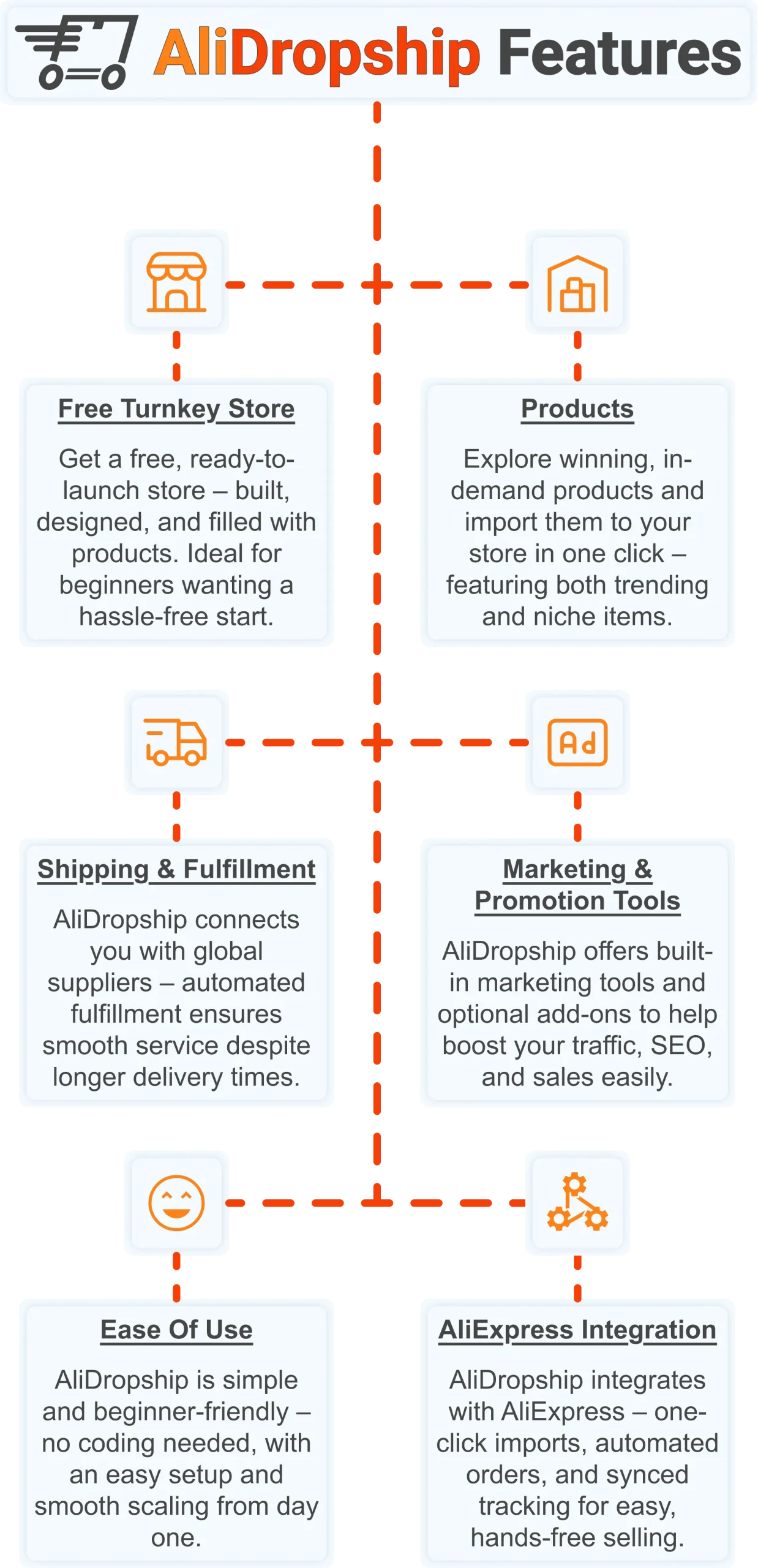
If you want the simplest possible way to start dropshipping – especially if you’re brand new – AliDropship remains one of the most beginner-friendly tools available in 2026. It brings together store creation, product imports, automation, and marketing into a single streamlined system designed to help you launch quickly and grow confidently.
Free turnkey store 🛍
Get a free turnkey store – built, designed, and filled with products. Ideal for beginners wanting a hassle-free start, the store comes fully optimized to attract customers right away, saving you time on setup. Plus, it includes professional design elements to give your business a polished, trustworthy look from day one. This ready-made foundation makes it easy to move seamlessly into product selection.
Products 📦
Once your store is set up, you can explore winning, in-demand products and import them in one click – featuring both trending and niche items. This wide selection lets you cater to diverse customer interests and test what works best. Regular updates ensure you always have fresh products, keeping your store competitive and relevant. With great products in place, smooth shipping becomes the next essential step.
Shipping & fulfillment 🚚
AliDropship connects you with global suppliers, and automated fulfillment ensures seamless order processing despite international delivery times. Customers receive real-time tracking updates, which builds confidence and trust in your store. Once shipping is handled reliably, you can focus on promoting your store and attracting traffic.
Marketing & promotion tools 📣
To maximize sales, AliDropship offers built-in marketing tools and optional add-ons that help boost traffic, SEO, and conversions. From email campaigns and discounts to social media integration, these tools empower you to reach and retain customers without needing prior marketing experience. With promotion strategies in place, managing your business becomes simpler and more efficient.
Ease of use 👌
AliDropship is beginner-friendly – no coding needed, with an intuitive dashboard that guides you through every step. Easy setup and smooth scaling let you expand your store without stress. As your business grows, adding new features, products, and marketing campaigns remains hassle-free, giving you more time to focus on sales.
AliExpress integration 🛒
Finally, AliDropship integrates seamlessly with AliExpress, enabling one-click imports, automated orders, and synced tracking. Your inventory stays up-to-date with the latest products and prices, while automated order processing frees you from manual tasks. Combined with the turnkey setup, reliable shipping, and built-in marketing tools, this integration ensures your dropshipping business is fully equipped for growth and success.
Ecommerce SEO is one of the most powerful ways to build long-term organic revenue – and it performs best when your store is already built to convert the traffic it earns. Get your free turnkey store today and start putting your SEO strategy into action.
What is ecommerce SEO and why does it matter in 2026?
How long does ecommerce SEO take to show results?
What are the most important ecommerce SEO ranking factors?
How do I do keyword research for an ecommerce store?
Is ecommerce SEO worth it for a new dropshipping store?







