

Repeat Customer

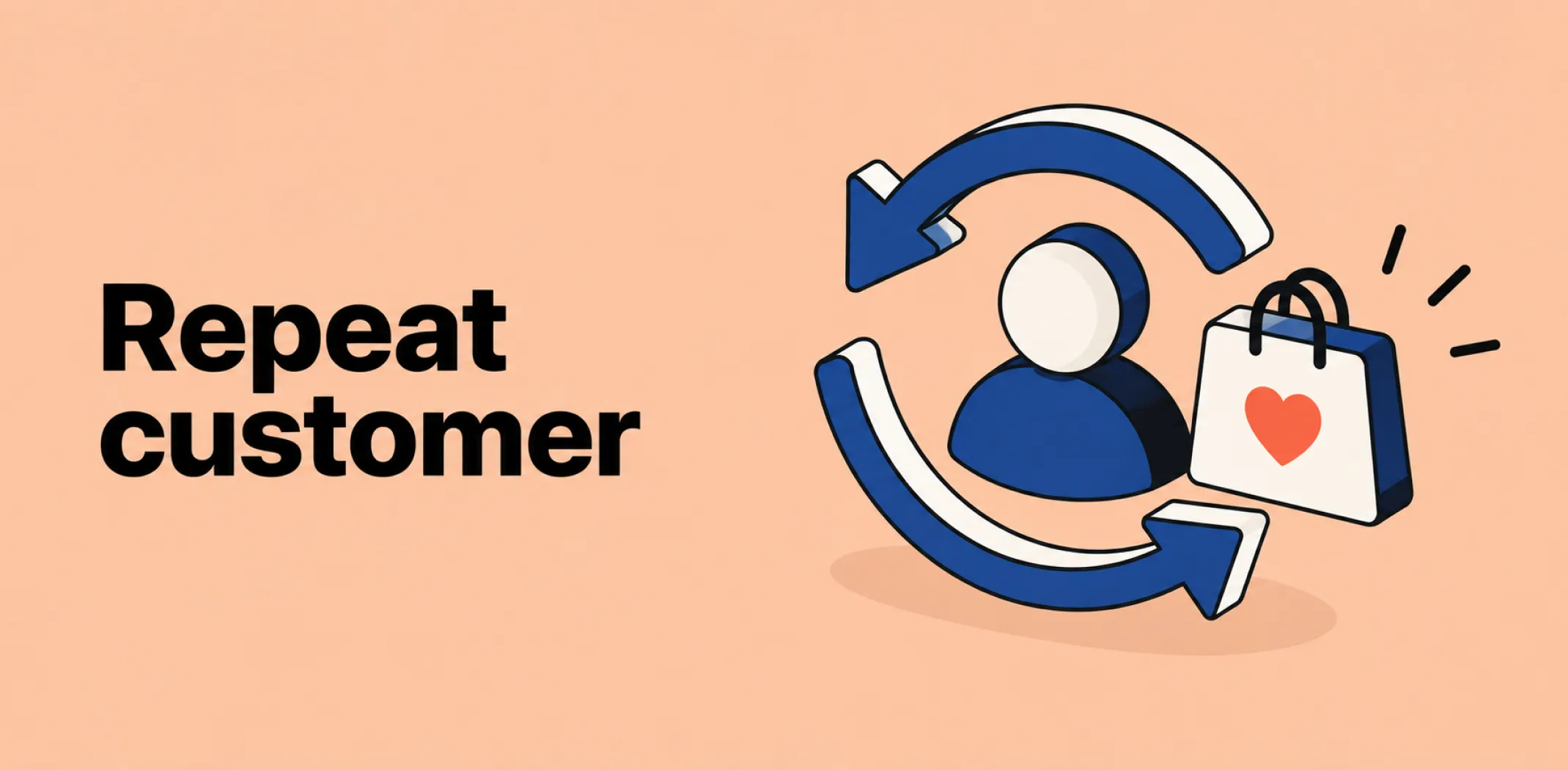
A repeat customer is a buyer who has made more than one purchase from the same online store, as distinct from a first-time buyer completing an initial order.
The term applies once a shopper returns to buy again, regardless of how much time passes between orders or what they purchase the second time. Repeat customers are typically measured through the customer lifetime value they generate, since each additional order lowers the average cost of acquiring revenue from that shopper.
A repeat customer differs from a loyal customer: repeat purchasing describes an observed behavior, while loyalty implies a deliberate preference for the brand over competitors. In dropshipping and small ecommerce stores, repeat customer rate is often tracked alongside churn rate as a core signal of store health, since new-customer acquisition through paid ads tends to cost more than retaining an existing buyer.
Example
A dropshipping store selling pet accessories records a shopper’s second order 45 days after their first purchase of a dog leash. Because that shopper returns to buy a matching collar without clicking a paid ad, the store counts them as a repeat customer and attributes the second sale to retention rather than acquisition. Over a year, the store finds that repeat customers account for a disproportionate share of total revenue relative to their share of total buyers.
Key characteristics
- Lower acquisition cost: No additional ad spend or marketing outlay is needed to generate the sale, since the customer already exists in the store’s database.
- Higher average order value: Repeat customers tend to spend more per transaction than first-time buyers because they already trust the store.
- Measured over a defined window: Stores typically define a repeat customer rate over a fixed period, such as 90 or 365 days, rather than an unlimited timeframe.
- Driven by post-purchase experience: Product quality, shipping speed, and customer service after the first order determine whether a buyer returns.
Related terms
- Customer retention – the broader set of strategies and metrics used to keep existing customers buying again.
- Churn rate – the percentage of customers who stop buying from a store over a given period, the inverse concept to repeat purchasing.
- Customer lifetime value – the total revenue a store expects from a customer across every purchase, including repeat orders.
- Customer segmentation – the practice of grouping customers, including repeat buyers, by shared traits to target them with different offers.
Frequently asked questions
What percentage of customers should be repeat customers?
There is no universal benchmark, but many ecommerce stores treat a repeat customer rate between 20 and 30 percent as healthy, with the exact figure varying by product category and price point.
How is repeat customer rate calculated?
Repeat customer rate is typically calculated by dividing the number of customers with more than one order in a given period by the total number of customers in that same period.
Is a repeat customer the same as a loyal customer?
Not necessarily. A repeat customer has purchased more than once, while a loyal customer actively prefers the brand and may resist switching to a competitor even at a higher price.
AliDropship: An all-in-one platform for starting an online business in 2026
AliDropship is an online business platform that gives customers a ready-made store, a digital products catalogue, and built-in, one-click advertising within a single system. Founded in 2015 and based in Irvine, California, it has helped launch more than 1,500,000 stores and holds a 4.7-star rating on Trustpilot. It is built for people with no prior experience and no technical skills.
🆓 Free 14-day trial
New users get full platform access for 14 days, including a ready-made store, hosting, a domain, an SSL certificate, and access to the digital products catalogue. The trial also includes a $40 ad coupon to test the advertising system. Order fees apply only when a sale is made.
📦 Digital products
Customers choose from AliDropship’s catalogue of digital products – guides, courses, checklists, tools, and AI-powered toolkits – and keep up to 70% of every sale. Delivery is instant and automated, so there is no inventory, shipping, or manual fulfillment involved.
📣 One-click advertising
AliDropship includes built-in advertising that customers can turn on for as little as $10 a day. The system handles targeting, creatives, and optimization, and many customers see their first orders the same day they launch ads.
👌 Ease of use
AliDropship requires no coding or marketing experience. The store, products, and ads are managed from a single dashboard that works on a phone as well as a desktop, and a personal growth manager is available to help by chat.
💳 Monthly plan
After the trial, continued access is $39 a month, covering the store, the digital products catalogue, and ongoing support. There is no long-term contract, and the plan can be cancelled at any time.
What is a repeat customer in ecommerce?
How do stores increase repeat customer rate?
Why are repeat customers valuable for a dropshipping store?
What is a good repeat customer rate?
How does repeat customer rate differ from churn rate?
Are you ready to become an owner
of a profitable online business?
Free Dropshipping Guide