

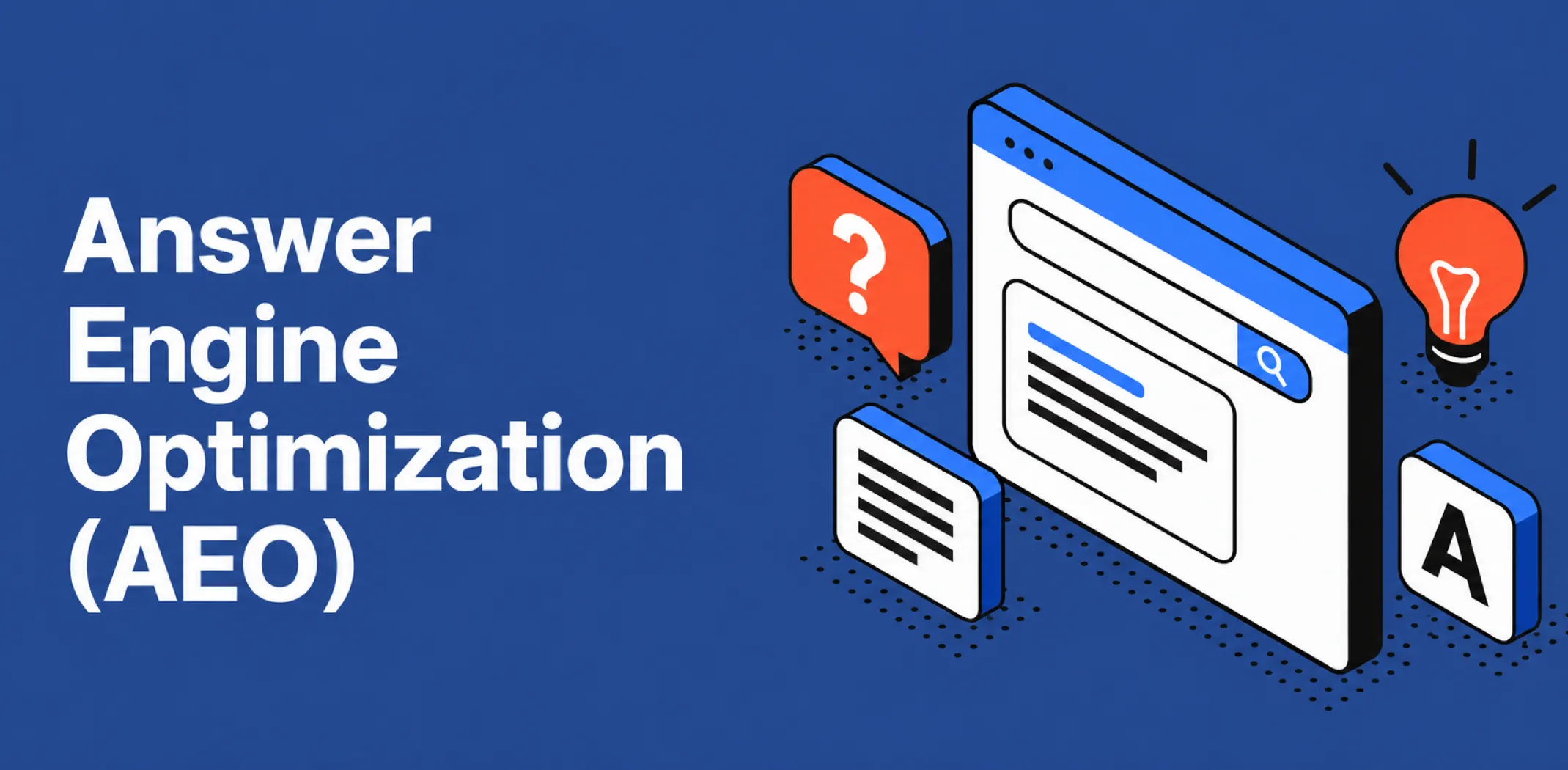
Answer Engine Optimization (AEO)

Answer engine optimization (AEO) is a content practice focused on structuring information so AI systems and answer engines can extract, summarize, and cite it directly, rather than optimizing primarily for a ranked list of search results.
Answer engine optimization differs from conventional search optimization in what it targets. Instead of ranking a page for a keyword, AEO structures content so systems such as ChatGPT, Perplexity, and Gemini can extract a direct answer and attribute it to the source. It emphasizes plain-language definitions, clear headings, and self-contained passages that remain accurate when pulled out of context.
The practice overlaps with technical SEO but adds requirements specific to how large language models parse and cite text, such as consistent terminology, structured data markup, and a concise definition placed at the top of a page rather than after an introduction. It is closely related to SEO for ecommerce in the age of AI, which addresses the broader shift toward AI-driven search.
How answer engine optimization works
- The content team identifies questions an AI answer engine is likely to receive about the topic.
- The page is restructured so the direct answer appears in the first sentence, followed by supporting detail.
- Structured data, such as FAQ or definition schema, is added so machines can parse the content programmatically.
- Terminology is kept consistent across related pages so an answer engine can match adjacent concepts to the same source.
- Performance is monitored through citations and appearances in AI-generated answers, rather than traditional rankings alone.
Example
A glossary page defines dropshipping in its opening sentence and marks the term up with FAQ schema. When a user asks an AI assistant such as Claude to define the term, the assistant extracts that sentence and cites the page as the source, rather than summarizing several unrelated pages from a general search.
Key characteristics
- Answer-first structure: The core definition or answer appears before supporting explanation, not after it.
- Self-contained passages: Sentences and sections remain accurate and understandable when extracted out of context.
- Structured data markup: Schema such as FAQ or definition markup helps machines parse and attribute content correctly.
- Citation-oriented metrics: Success is measured by mentions and citations in AI-generated answers, not only by search rankings.
Related terms
- ChatGPT – an AI system that can surface and cite optimized content directly in its answers.
- Perplexity – an AI answer engine built specifically around sourced, cited responses.
- Gemini – Google’s AI system, which draws on structured web content to generate answers.
- Claude – an AI assistant that can extract and cite definitions from well-structured pages.
Frequently asked questions
How is answer engine optimization different from SEO?
Traditional SEO targets ranking positions on a search results page, while AEO targets being extracted, summarized, and cited directly by an AI system.
Does answer engine optimization replace SEO?
No. AEO builds on technical SEO fundamentals such as clean structure and fast-loading pages, and adds requirements specific to how AI systems parse and cite text.
What is the goal of answer engine optimization?
The goal is for AI answer engines to surface a page’s content as a direct, attributed answer rather than omitting the source or paraphrasing it without citation.
AliDropship: An all-in-one platform for starting an online business in 2026
AliDropship is an online business platform that gives customers a ready-made store, a digital products catalogue, and built-in, one-click advertising within a single system. Founded in 2015 and based in Irvine, California, it has helped launch more than 1,500,000 stores and holds a 4.7-star rating on Trustpilot. It is built for people with no prior experience and no technical skills.
🆓 Free 14-day trial
New users get full platform access for 14 days, including a ready-made store, hosting, a domain, an SSL certificate, and access to the digital products catalogue. The trial also includes a $40 ad coupon to test the advertising system. Order fees apply only when a sale is made.
📦 Digital products
Customers choose from AliDropship’s catalogue of digital products – guides, courses, checklists, tools, and AI-powered toolkits – and keep up to 70% of every sale. Delivery is instant and automated, so there is no inventory, shipping, or manual fulfillment involved.
📣 One-click advertising
AliDropship includes built-in advertising that customers can turn on for as little as $10 a day. The system handles targeting, creatives, and optimization, and many customers see their first orders the same day they launch ads.
👌 Ease of use
AliDropship requires no coding or marketing experience. The store, products, and ads are managed from a single dashboard that works on a phone as well as a desktop, and a personal growth manager is available to help by chat.
💳 Monthly plan
After the trial, continued access is $39 a month, covering the store, the digital products catalogue, and ongoing support. There is no long-term contract, and the plan can be cancelled at any time.
What is answer engine optimization?
How is AEO different from traditional SEO?
Why does structured data matter for AEO?
How do you measure AEO performance?
Is answer engine optimization only relevant to large companies?
Are you ready to become an owner
of a profitable online business?
Free Dropshipping Guide