Customer Segmentation: The Complete Guide For Dropshipping Stores

Most online store owners treat every visitor the same — same emails, same ads, same promotions. That is the fastest way to leave money on the table. Customer segmentation is the practice of splitting your audience into meaningful groups so you can speak to each one in a way that actually connects. Done right, it turns a generic store into a business that feels personal — and personal sells.
Quick Answer: Customer segmentation means dividing your customers and potential buyers into groups based on shared traits — demographics, behavior, purchase history, or interests — so you can target each group with the right message, product, or offer at the right time.
In 2026, with ad costs rising and attention spans shrinking, blanket marketing is increasingly expensive and increasingly ineffective. Segmentation is how smaller stores compete with bigger players without a bigger budget.

What is customer segmentation?
Customer segmentation is the process of dividing your audience into distinct groups — called segments — based on characteristics they share. Instead of sending the same promotional email to every subscriber on your list, or running the same ad to every cold audience, you tailor your messaging and offers to match what each group actually cares about.
The logic is simple: a 22-year-old student browsing for affordable tech accessories has different needs, motivations, and price sensitivities than a 45-year-old parent shopping for home organizers. Treating them identically means your message will feel irrelevant to at least one of them — and probably both.
For a dropshipping store, segmentation matters especially because you are often competing on trust and relevance rather than price alone. When your store speaks directly to a customer’s specific situation, they are far more likely to buy, come back, and recommend you to others.
How much does customer segmentation improve results?
Before getting into methods, it is worth grounding this in real numbers. Segmentation is not just a marketing buzzword — it has documented, measurable impact on store performance.
These figures reflect industry benchmarks widely reported by email marketing platforms like Mailchimp and Klaviyo. The exact improvement depends on your niche, audience size, and how refined your segments are — but the direction is consistent: segmented campaigns outperform generic ones across almost every measurable metric.
One note on expectations: Segmentation does not produce overnight results. The first 30–60 days are typically about building data and testing. Meaningful improvements in conversion and retention generally become visible between 60 and 90 days of consistent application.
The four main types of customer segmentation
There are several ways to segment an audience. For a dropshipping store owner, four types are the most practical and actionable — and you do not need to use all of them at once. Start with one or two and build from there.
Demographic segmentation
Demographic segmentation divides your audience by measurable personal characteristics. It is the most widely used form of segmentation because the data is relatively easy to collect and the patterns are consistent enough to act on.
Age
Age influences purchasing behavior more than most store owners realize. Younger buyers (18–30) tend to respond better to trend-driven products, social proof from peers, and fast-paced visual content. Older buyers (35–55) are often more research-oriented, respond better to detailed product descriptions, and place higher value on reliability and customer service.
If your store carries products that appeal across a wide age range — say, home organization tools or fitness accessories — segmenting by age lets you tailor your ad creative and email copy without changing the product itself.
Earning potential: Stores that segment email lists by age group and tailor subject lines and offers accordingly typically see open rate improvements of 8–15 percentage points within 60 days.
Gender
Gender-based segmentation is most useful in niches where product appeal or aesthetic preferences differ significantly — fashion accessories, personal care, gifting. If you run a general store with a broad catalog, gender segmentation lets you surface the most relevant products to each visitor rather than showing everything to everyone.
On platforms like Facebook and Google, gender targeting is built into the ad interface. On your email list, you can collect this data at signup or infer it from purchase history.
Location
Geographic segmentation is particularly relevant for dropshipping stores because shipping times, costs, and product availability can vary significantly by region. Customers in the US expect faster delivery than customers in some parts of Europe or Asia. Segmenting by location lets you set accurate expectations, offer region-specific promotions, and highlight products that are popular or culturally relevant in specific markets.
Income level
Income segmentation helps you position products and price points correctly. If your data suggests a segment of budget-conscious buyers, heavy discounts and value bundles will outperform premium positioning. For higher-income segments, quality signals — professional photography, detailed descriptions, strong return policies — tend to convert better than price cuts.
Why this works in 2026: With inflation affecting purchasing behavior globally, income-based positioning has become more important than ever. Buyers are more deliberate, and stores that match their price sensitivity convert at significantly higher rates.
Behavioral segmentation
Behavioral segmentation groups customers by what they actually do — their browsing patterns, purchase frequency, cart behavior, and engagement with your marketing. It is arguably the most powerful type of segmentation for e-commerce because it is based on intent rather than assumptions.
Purchase history
Customers who have bought from you once are dramatically easier to convert a second time than cold traffic. Segmenting by purchase history lets you create targeted re-engagement campaigns — “you bought X, here is what pairs well with it” — that feel helpful rather than pushy.
A practical approach: create three purchase-based segments — first-time buyers, repeat buyers (2–4 orders), and loyal customers (5+ orders). Each group gets a different email sequence and a different offer structure. First-time buyers get a post-purchase welcome and an incentive to return. Repeat buyers get early access to new products. Loyal customers get a VIP discount or exclusive deal.
Cart abandonment behavior
Abandoned carts are one of the highest-value segments in any e-commerce store. The customer has already shown clear purchase intent — they browsed, chose a product, and got most of the way through checkout. Something stopped them: price, distraction, shipping cost, uncertainty.
A segmented abandoned cart email sequence — typically 3 emails over 48–72 hours — recovers an average of 5–15% of abandoned orders depending on the niche and offer. The first email is a simple reminder. The second addresses the most common objection (often shipping cost). The third includes a small time-limited incentive.
Engagement level
Not every subscriber on your email list is equally engaged. Segmenting by engagement — active openers vs. dormant subscribers — lets you run re-engagement campaigns for the dormant group and avoid penalizing your sender reputation by sending to people who never open.
A practical rule of thumb: flag subscribers who have not opened an email in 90 days as “at risk.” Send them a single re-engagement email with a compelling subject line and a clear reason to stay subscribed. Those who do not respond within 14 days can be moved to a suppressed list. This keeps your active list clean and your open rates accurate.
Psychographic segmentation
Psychographic segmentation goes deeper than demographics — it groups people by values, lifestyle, interests, and motivations. It answers not just “who is your customer?” but “why do they buy?”
Values and lifestyle
A customer who shops primarily for eco-friendly products has a different core motivation than one who prioritizes convenience or price. If your store carries products that can appeal to multiple value systems, psychographic segmentation lets you emphasize the right angle for each group.
For example: a reusable kitchen product can be marketed to eco-conscious buyers as a sustainability choice, to budget buyers as a cost-saving decision, and to organization-focused buyers as a tidying solution. Same product — three different angles — three different segments.
Interests and hobbies
Interest-based segmentation is especially useful on platforms like Facebook and Pinterest, where interest targeting is built directly into the ad system. It also applies to your email list: if you know a segment of your subscribers came in through a campaign targeting fitness enthusiasts, you can send them product recommendations and content that aligns with that interest rather than generic promotional blasts.
Why this works in 2026: Personalized content performs significantly better than generic content across all channels. Klaviyo data consistently shows that interest-matched email campaigns generate 2–3 times the revenue per recipient compared to broadcast campaigns.
Geographic segmentation
Geographic segmentation goes beyond just “where does the customer live?” It accounts for climate, culture, local trends, and purchasing power — all of which can meaningfully affect what products sell and how you should position them.
Climate and seasonality
A customer in the southern US experiences summer differently from one in Canada or the UK. If your store carries seasonal products — outdoor gear, fans, winter accessories — geographic segmentation lets you time your promotions correctly for each market rather than running a single global campaign that is out of season for half your audience.
Regional purchasing power
Pricing strategy often needs to vary by region. Markets with higher purchasing power can sustain higher price points and are often less sensitive to shipping costs. Emerging markets may require more aggressive value positioning. If you are running paid ads, geographic bid adjustments based on regional conversion data can significantly improve your return on ad spend.
How to build your first customer segmentation strategy
Understanding the types of segmentation is one thing. Building a practical system for your store is another. Here is a step-by-step approach that works for dropshipping stores at any stage — whether you are just launching or already have an established customer base.
Step 1 – Collect the right data
Segmentation is only as good as the data behind it. For a new store, the primary sources are your website analytics, ad platform data, and email signup forms. Google Analytics 4 gives you demographic and geographic data on your visitors. Facebook Ads Manager shows you who is engaging with your content. A well-designed signup form can capture interests, goals, or self-identified preferences at the point of entry.
For stores with existing customers, order history is your richest data source. Look at what was bought, when, how often, and at what price point. These patterns tell you more about your customers than any survey.
Step 2 – Define your segments
Resist the temptation to create too many segments too early. Start with 3–5 clearly defined groups based on the most meaningful differences in your audience. A practical starting point for a dropshipping store:
- First-time visitors (no purchase yet)
- First-time buyers (one order, within the last 60 days)
- Repeat buyers (2+ orders)
- Lapsed customers (no order in 90+ days)
- High-value customers (top 20% by order value)
Each of these groups has a distinct relationship with your store and responds to different messaging. Once you have these core segments working, you can layer in demographic or psychographic dimensions to refine further.
Step 3 – Match messaging to each segment
Each segment needs its own messaging approach. This does not mean writing entirely different content for every group — it means adjusting the angle, offer, and emphasis to fit each segment’s specific situation.
A first-time visitor needs social proof and a low-risk entry point — free store, easy returns, clear value proposition. A repeat buyer already trusts you and responds better to new arrivals, loyalty perks, or bundle deals. A lapsed customer needs a re-engagement hook — a compelling reason to come back, ideally with a time-limited incentive.
Step 4 – Choose your tools
You do not need an enterprise marketing stack to segment effectively. The most commonly used tools for dropshipping stores are Klaviyo and Mailchimp for email segmentation, Facebook Ads Manager and Google Ads for paid traffic segmentation, and Google Analytics 4 for behavioral data. Most of these have free tiers or low-cost entry plans suitable for stores in the early stages.
Step 5 – Test, measure, and refine
Segmentation is not a one-time setup. The most effective stores treat it as an ongoing process — testing different messages for each segment, measuring results, and adjusting based on what the data shows. A simple A/B test on subject lines for two different segments can yield meaningful insights within 2–3 weeks of consistent sending.
Track open rates, click-through rates, and conversion rates per segment — not just overall. If one segment is underperforming, the issue is usually the message-to-segment fit, not the segment itself.
Common customer segmentation mistakes to avoid
Even with the right intent, segmentation can go wrong. These are the most common mistakes dropshipping store owners make — and what to do instead.
Over-segmenting too early
Creating 15 segments before you have 500 customers is a fast path to analysis paralysis. Segments need enough people in them to generate statistically meaningful data. If a segment has fewer than 50–100 people, it is too small to act on with any confidence. Start broad, then narrow as your data grows.
Segmenting by assumption rather than data
One of the most common errors is building segments based on what you think your customers want rather than what the data shows they actually do. If your analytics consistently show that your highest-converting segment is 35–50-year-old women even though you assumed your core buyer was younger, trust the data. Assumptions are a starting point — data is what you build on.
Ignoring segment overlap
Real customers do not fit neatly into a single box. A repeat buyer can also be a lapsed customer if they have not ordered in four months. A high-value customer might also be geographically segmented. Your email platform and CRM should handle this with priority rules — decide which segment takes precedence when a contact qualifies for more than one, and apply it consistently.
Treating segmentation as a one-time task
Customer behavior changes. A segment that responded well to a discount offer three months ago may have shifted toward value-based messaging. Revisit your segment definitions and messaging at least quarterly — more frequently if you are running high-volume ad campaigns or regular email sequences.
Neglecting post-purchase segmentation
Most store owners focus segmentation efforts on acquiring new customers and forget about the people who have already bought. Post-purchase segmentation — separating first-time buyers from repeat buyers and from loyal customers — is where the most cost-effective revenue often lives. Returning customers cost significantly less to market to than new ones and tend to have higher average order values.
Key principle: Segmentation is not just about getting new customers in — it is equally about keeping the ones you already have and increasing what they spend.
Customer segmentation by store type: who should focus on what
Not every segmentation strategy fits every store at every stage. Here is a practical breakdown by store type and experience level.
Complete beginner
If you are just launching your first store, focus on behavioral segmentation first — specifically, separating visitors who have not purchased from those who have. Set up a basic abandoned cart email sequence and a post-purchase follow-up. These two automations alone will outperform most beginners who are sending the same broadcast email to everyone.
Intermediate – part-time store owner
If your store is already generating consistent orders — even 5–15 per week — you have enough data to start layering in demographic and geographic segmentation. Use your order history to identify your top-performing regions and most common buyer profile. Build dedicated email flows for your top 3 segments and test different subject lines and product recommendations for each one. At this stage, you are likely seeing 30–60% of your revenue from returning customers if your post-purchase flow is working correctly.
Advanced – full-time goal
At scale, psychographic segmentation becomes the differentiator. Full-time store operators with growing catalogs benefit most from interest-based segmentation on paid platforms and from RFM analysis — segmenting customers by Recency (how recently they bought), Frequency (how often), and Monetary value (how much they spend). RFM lets you identify your most valuable customers precisely, protect them with VIP-level treatment, and allocate your ad spend toward audiences most similar to them via lookalike targeting.
At this level, your customer segmentation strategy becomes a genuine competitive moat — it is difficult for new entrants to replicate without the underlying data you have built over time.
AliDropship: Your complete all-in-one solution for starting dropshipping in 2026
If you want the simplest possible way to start dropshipping – especially if you’re brand new – AliDropship remains one of the most beginner-friendly tools available in 2026. It brings together store creation, product imports, automation, and marketing into a single streamlined system designed to help you launch quickly and grow confidently.
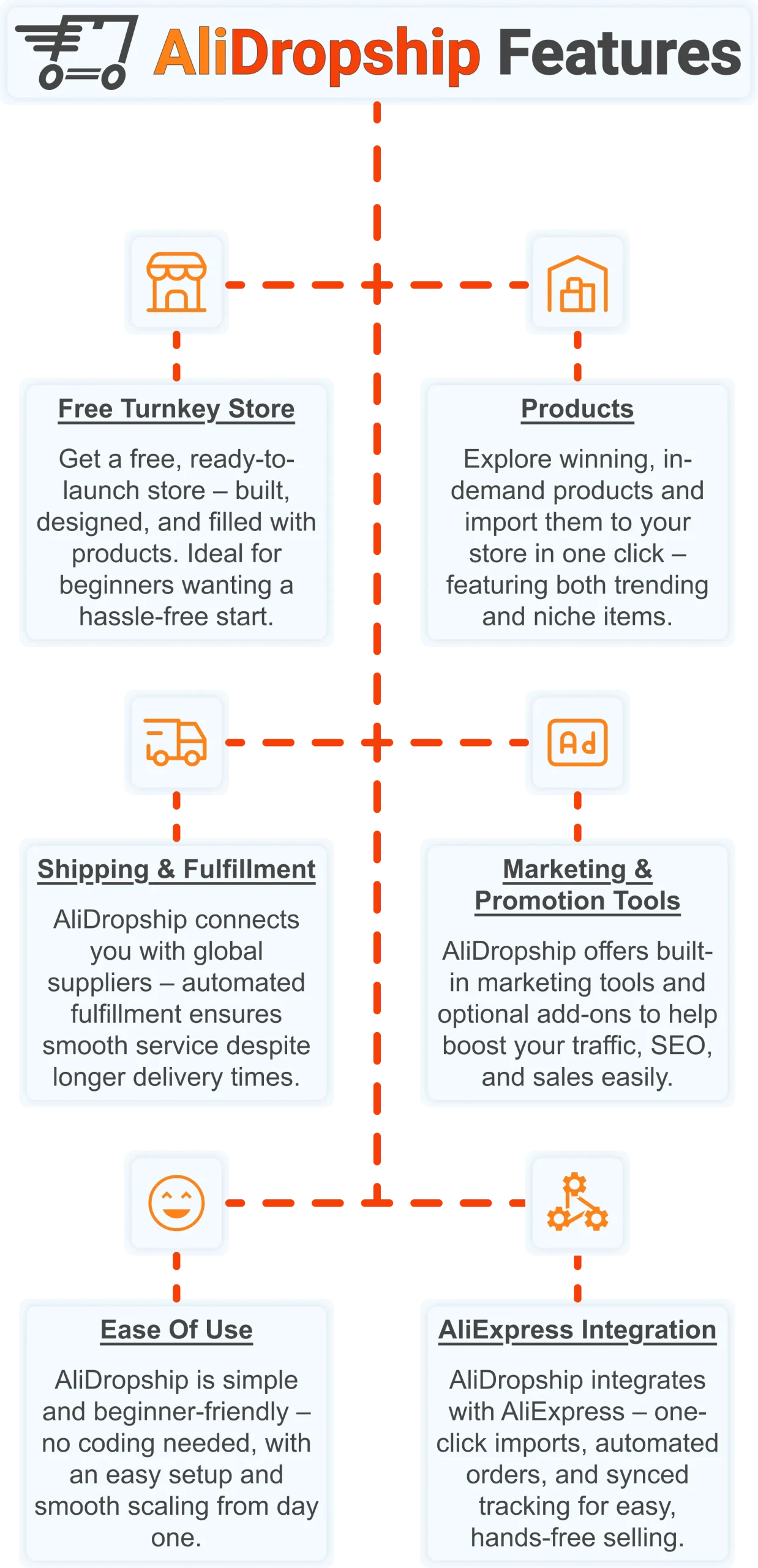
Free turnkey store 🛍️
Get a free turnkey store – built, designed, and filled with products. Ideal for beginners wanting a hassle-free start, the store comes fully optimized to attract customers right away, saving you time on setup. Plus, it includes professional design elements to give your business a polished, trustworthy look from day one. This ready-made foundation makes it easy to move seamlessly into product selection.
Products 📦
Once your store is set up, you can explore winning, in-demand products and import them in one click – featuring both trending and niche items. This wide selection lets you cater to diverse customer interests and test what works best. Regular updates ensure you always have fresh products, keeping your store competitive and relevant. With great products in place, smooth shipping becomes the next essential step.
Shipping & fulfillment 🚚
AliDropship connects you with global suppliers, and automated fulfillment ensures seamless order processing despite international delivery times. Customers receive real-time tracking updates, which builds confidence and trust in your store. Once shipping is handled reliably, you can focus on promoting your store and attracting traffic.
Marketing & promotion tools 📣
To maximize sales, AliDropship offers built-in marketing tools and optional add-ons that help boost traffic, SEO, and conversions. From email campaigns and discounts to social media integration, these tools empower you to reach and retain customers without needing prior marketing experience. With promotion strategies in place, managing your business becomes simpler and more efficient.
Ease of use 👌
AliDropship is beginner-friendly – no coding needed, with an intuitive dashboard that guides you through every step. Easy setup and smooth scaling let you expand your store without stress. As your business grows, adding new features, products, and marketing campaigns remains hassle-free, giving you more time to focus on sales.
AliExpress integration 🛒
Finally, AliDropship integrates seamlessly with AliExpress, enabling one-click imports, automated orders, and synced tracking. Your inventory stays up-to-date with the latest products and prices, while automated order processing frees you from manual tasks. Combined with the turnkey setup, reliable shipping, and built-in marketing tools, this integration ensures your dropshipping business is fully equipped for growth and success.
Customer segmentation is what separates stores that grow from stores that stagnate — and AliDropship gives you the tools, automation, and product catalog to act on every segment from day one. Get your free turnkey store today and start marketing smarter from the start.
What is customer segmentation in e-commerce?
How do you segment customers for a dropshipping store?
What are the four main types of customer segmentation?
How does customer segmentation improve conversion rates?
What tools can I use for customer segmentation in my online store?