What Are Business Plan Examples And How To Use Them In 2026

Most people who skip the business plan say the same thing afterward: “I wish I had written that down.” A business plan is not a formality for investors – it is the document that forces you to stress-test your idea before spending a cent on it. Studies consistently show that entrepreneurs who write a business plan are 260% more likely to launch their business, and companies with a structured plan are 30% more likely to grow. So if you are sitting on a business idea right now, this is the guide that turns it into something real.
This article walks you through practical business plan examples for several common business types – from a traditional small business to an ecommerce store to a lean online startup – so you can see exactly how each section comes together. You will also find a working template structure you can adapt for your own plan and realistic guidance on what works and what trips people up.
Quick Answer: A business plan is a written document that defines your business idea, target market, revenue model, and financial projections. The best business plan examples are specific, honest, and tailored to your audience – whether that is an investor, a bank, or just yourself.
Before diving into full examples, it helps to understand the two broad formats most plans fall into – and which one actually fits your situation right now.

What is a business plan?
A business plan is a structured document that explains what your business does, who it sells to, how it makes money, and what it needs to succeed. Think of it as the blueprint you would not skip if you were building a house. It keeps every decision anchored to a clear purpose – and it is the first thing investors, lenders, and even co-founders want to see before committing.
There are two core formats used in 2026:
- Traditional business plan – Comprehensive and detailed, covering every section in depth. Best for seeking bank loans, outside investment, or formal partnerships. Typically 20–40 pages.
- Lean startup business plan – A one-page or condensed version that outlines the essentials: problem, solution, customers, revenue model, and key metrics. Best for solopreneurs, early-stage testing, or fast-moving online businesses.
For most people starting an ecommerce business or online side hustle in 2026, the lean format is the smarter starting point. You can always expand it once your model is validated and you need external funding. The key in either case is specificity – vague plans get ignored, and specific plans get funded.
How much can a business realistically make?
This is the section most beginner business plans get wrong. People plug in a best-case number and call it a projection. Realistic financial planning looks at effort level, startup costs, time-to-revenue, and market size together. The table below gives a grounded comparison for three common online business types covered in this guide.
One note on these figures: The ranges above reflect consistent effort over a real timeline. Ecommerce stores that reach $5,000 per month are usually six to twelve months in, with a clear niche, tested products, and active marketing. The first 60–90 days are typically about learning and iterating, not maximizing profit.
The takeaway here is not that one model is better than another – it is that your business plan needs to match the effort you can actually commit. A freelance plan that assumes $10,000 per month from day one is not a plan – it is wishful thinking. A realistic plan with $800 per month as a 90-day target and a clear path to scaling is what gets results.
Business plan examples by type
The following examples are not hypothetical – they represent the actual structure and content that each type of business plan requires. Use them as a working reference, not as a fill-in-the-blank template. Every plan needs to reflect your specific market, your specific numbers, and your specific goals.
Small business plan example
A small business plan is typically used for brick-and-mortar operations, local service businesses, or any venture that needs a bank loan or SBA financing to get started. It is the most traditional format and usually the most detailed.
Executive summary
This comes first in the document but is written last. It is a one-page snapshot of everything else in the plan. A strong executive summary for a small business covers: what the business does, the problem it solves, the target customer, the revenue model, the funding request (if any), and the one-line financial projection. Keep it under 400 words and write it as if the reader might not get past this page.
Market analysis
Define your total addressable market with real numbers – not estimates you made up. For example, if you are opening a local fitness studio, your market is not “the fitness industry” – it is the estimated number of health-conscious adults within a 10-km radius of your location, adjusted for income level and existing competition. Specific market analysis is what separates fundable business plans from rejected ones.
Products and services
Describe exactly what you sell, what it costs to produce or deliver, and what the customer pays. Include your pricing rationale – why does your price point work for your target customer? A good rule: list your top three offerings, their unit economics, and one sentence on how each one fits the customer’s need.
Financial projections
Include a 12-month revenue forecast, a break-even analysis, and a startup cost breakdown. Be conservative in year one and explain why. If you are applying for a loan, banks want to see that you can service the debt even in a below-average month – so show a realistic worst-case scenario alongside your base projection.
Ecommerce business plan example
An ecommerce business plan has a different emphasis to a traditional small business plan. The operations section focuses on digital infrastructure rather than physical premises, and the marketing section carries much more weight. This is the format most relevant to anyone starting an online store in 2026.
Business overview and value proposition
Start with a clear niche. “I sell clothing online” is not a value proposition – “I sell size-inclusive activewear for women over 40, shipped within 48 hours from a US warehouse” is. The more specific your niche, the easier every other section of your plan becomes. You know your customer, your marketing channel, and your product sourcing strategy from a single clear sentence.
Target market and customer profile
Build a single ideal customer profile rather than a broad demographic. Give them a name, an age, a job, a frustration, and a specific reason they would buy from you instead of Amazon. Research tools like Facebook Audience Insights, Reddit communities, and Google Trends can help you validate that this person actually exists in numbers large enough to build a business around.
Marketing and traffic strategy
Ecommerce plans live or die on traffic. Specify your channels: Are you leading with organic SEO, paid social ads, influencer partnerships, or content marketing? Each channel needs a monthly budget estimate and a realistic customer acquisition cost (CAC). For context, the average CAC for a new ecommerce store running Facebook ads ranges from $15 to $50 per customer depending on niche and funnel quality.
Operations and fulfillment
Outline your supply chain from product source to customer door. If you are dropshipping, name your supplier model and fulfillment timeline. If you are holding inventory, state your warehouse setup and reorder process. The operations section of an ecommerce plan should answer: how does an order placed at 11pm on a Tuesday get fulfilled accurately and on time?
Financial model
Include your average order value (AOV), gross margin per order, monthly fixed costs, and the number of orders per month needed to break even. For example: if your AOV is $55, your gross margin is 40%, and your monthly fixed costs are $800, you need roughly 37 orders per month just to cover expenses. That is a clear, honest target to build your marketing plan around.
Startup business plan example
Startup business plans are written for high-growth ventures seeking outside investment – angel funding, venture capital, or accelerator programs. They emphasize scalability, large market opportunity, and team credentials more than any other format.
Problem and solution framing
Every funded startup pitch starts with a problem that actually hurts. Not “people want better coffee” – but “independent cafe owners lose an average of $1,200 per month to waste because they have no affordable inventory tracking tool.” Define the pain with data, then position your product as the specific solution. This framing makes the rest of the plan coherent and compelling.
Total addressable market (TAM)
Investors expect to see TAM, SAM, and SOM calculated from the bottom up – not top-down estimates pulled from a market research report. TAM is the total revenue opportunity if you captured 100% of the market. SAM (serviceable addressable market) is the portion you can realistically reach with your model. SOM (serviceable obtainable market) is your realistic share in years one through three.
Traction and validation
If you have any early numbers – waitlist signups, beta users, letters of intent, pilot revenue – put them front and center. Investors fund traction above everything else. Even 50 paying beta users at $10 per month is more convincing than a perfect deck with zero customers.
Team section
Highlight the specific experience and skills that relate directly to this venture. A co-founder who spent seven years in logistics is a credibility asset for a supply chain startup. Emphasize relevant domain expertise, not just job titles or prestigious employers.
Lean one-page business plan example
The lean business plan is the fastest way to move from idea to action without getting stuck in document formatting for weeks. It covers six things on a single page: the problem you solve, your solution, your target customer, your revenue model, your key metric, and your unfair advantage. Nothing else.
Here is what each section looks like in practice for a simple online store:
- Problem: Eco-conscious parents struggle to find affordable, verified non-toxic home cleaning products in one place.
- Solution: A curated online store featuring 30+ verified non-toxic products, with a subscription option for monthly restocking.
- Customer: Parents aged 28–42, household income $60K+, environmentally motivated but price-sensitive.
- Revenue model: One-time purchases (AOV $65) plus optional $29/month subscription.
- Key metric: Monthly recurring revenue (MRR) from subscriptions.
- Unfair advantage: Verified non-toxic certification on every product – something no existing competitor offers at this price point.
This format takes about two hours to complete and gives you something concrete to test immediately. If the model holds after 30 days of real traffic, then you expand it into a full plan. Start lean, validate fast.
Common business plan mistakes and how to avoid them
Looking at dozens of business plan examples reveals the same mistakes coming up again and again. These are the ones that get plans rejected by investors and cause businesses to fail in their first year.
Overstating the market size
Writing “the global wellness industry is worth $5 trillion” does not tell an investor anything useful. What matters is the slice of that market you can realistically reach and convert. Always work from your specific customer profile outward, not from a huge industry number inward.
Ignoring competition
Every market has competition. Plans that claim “there is no competition” immediately lose credibility. Instead, identify your top three competitors, list what they do well, and then explain specifically how your business is different or better for your target customer. This shows market awareness and builds trust.
Unrealistic financial projections
Revenue projections that hit $500,000 in month six with no clear explanation of how are a red flag for any reader. Ground every projection in a specific assumption: number of website visitors, conversion rate, average order value, repeat purchase rate. If your math works at a 1% conversion rate on 2,000 monthly visitors, say so explicitly.
No clear customer acquisition plan
“We will grow through word of mouth and social media” is not a marketing strategy. Specify which platforms, what type of content, what paid budget, and what the expected cost per acquired customer is. Even a simple 90-day plan with three specific tactics is better than a vague intention.
Skipping the operations section
This is especially common in ecommerce plans. How will orders actually get fulfilled? Who handles customer service? What happens when a supplier runs out of stock? The operations section is where business plans prove the model is actually executable – not just fundable on paper.
Legal and ethical considerations for your business plan
A business plan is a serious document, and the way you present information in it carries real consequences – especially if you are sharing it with investors or lenders.
Here is what to avoid absolutely:
- Inflating revenue figures – Presenting fabricated or inflated sales numbers to a lender or investor is fraud. Always use real data and label projections clearly as projections.
- Misrepresenting team credentials – Listing false qualifications or exaggerating past roles in the team section can unravel investor trust instantly and expose you to legal liability.
- Copying competitors’ plans – Business plan templates from the internet are fine as structural guides. Reproducing a competitor’s actual plan language or proprietary data is a copyright and ethics issue.
- Hiding material risks – Every business has real risks. Omitting them does not make your plan stronger – it makes it dishonest. Investors respect founders who name risks and explain how they will be managed.
Key principle: A business plan is only as strong as the accuracy of the information in it. Present your best honest case – not a manufactured one.
Which business plan format is right for you?
The answer depends almost entirely on where you are right now and what you need the plan to do.
Complete beginner
Start with the lean one-page format. Your goal is not to impress an investor – it is to validate that your idea is worth pursuing before you invest time and money into it. Spend two hours on the lean plan, then spend 30 days testing the core assumption. Only expand into a full plan once you have something real to show.
Intermediate / part-time entrepreneur
If you already have a product idea, a rough niche, and some budget to test with, go straight to an ecommerce business plan. Focus especially on the financial model and the 90-day marketing plan. These two sections will determine whether your store gets traction in a reasonable timeframe or stalls.
Advanced / full-time goal
If your goal is a full-time income within 12 months, you need a traditional plan – complete with 12-month financials, a clear break-even analysis, and a documented operations process. This level of planning is what separates stores that scale past $10,000 per month from ones that plateau at $500. It forces you to think through the hard questions before they become expensive problems.
Whatever your profile, the most important thing a business plan does is make your thinking visible. When you write it down, you find the gaps. When you find the gaps, you fill them before launch rather than after. That is the real value of the document – not the document itself, but the thinking it forces you to do.
AliDropship: Your complete all-in-one solution for starting dropshipping in 2026
If you want the simplest possible way to start dropshipping – especially if you are brand new – AliDropship remains one of the most beginner-friendly tools available in 2026. It brings together store creation, product imports, automation, and marketing into a single streamlined system designed to help you launch quickly and grow confidently.
Free turnkey store 🛍️
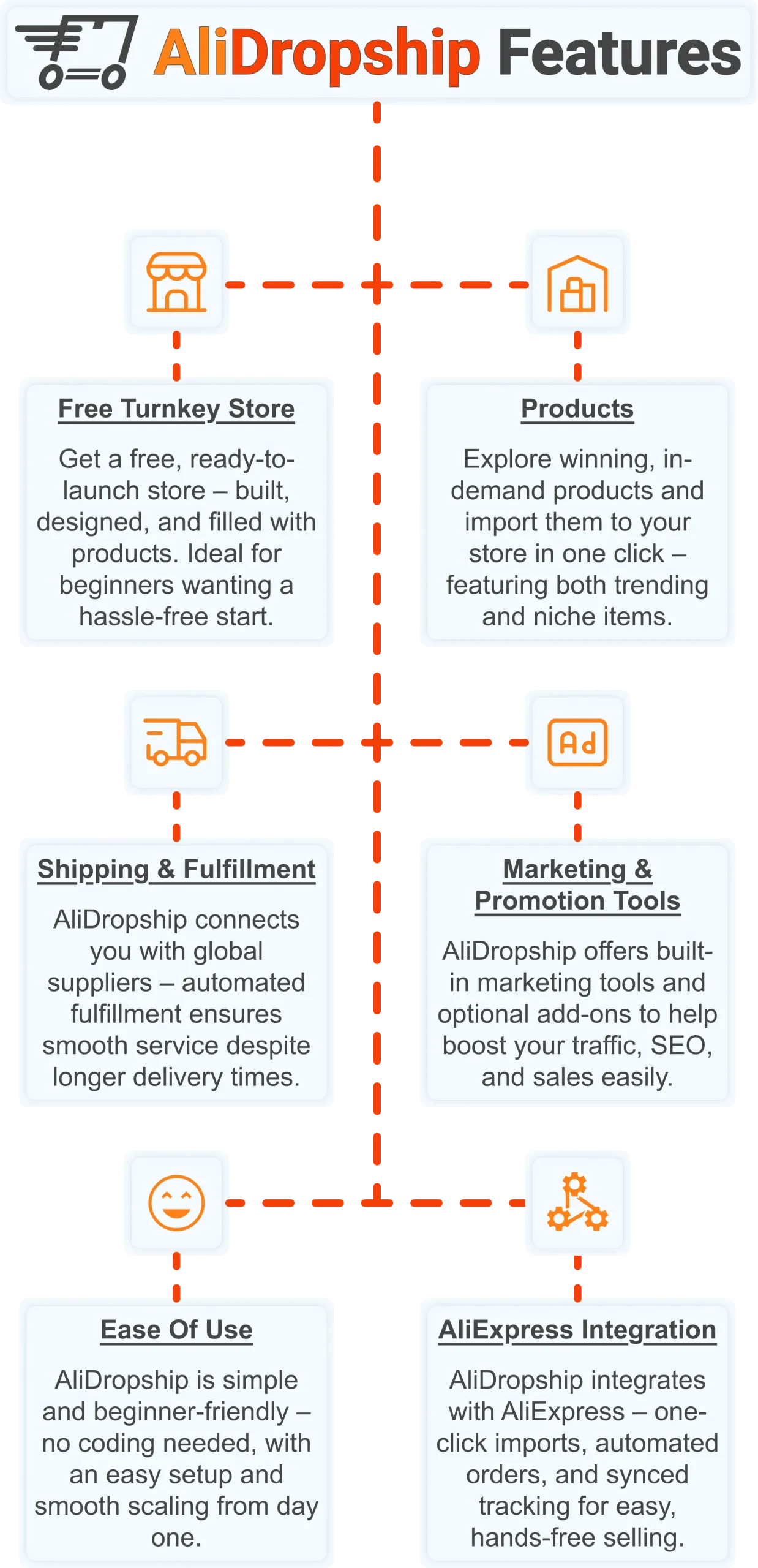
Get a free turnkey store – built, designed, and filled with products. Ideal for beginners wanting a hassle-free start, the store comes fully optimized to attract customers right away, saving you time on setup. Plus, it includes professional design elements to give your business a polished, trustworthy look from day one. This ready-made foundation makes it easy to move seamlessly into product selection.
Products 📦
Once your store is set up, you can explore winning, in-demand products and import them in one click – featuring both trending and niche items. This wide selection lets you cater to diverse customer interests and test what works best. Regular updates ensure you always have fresh products, keeping your store competitive and relevant. With great products in place, smooth shipping becomes the next essential step.
Shipping & fulfillment 🚚
AliDropship connects you with global suppliers, and automated fulfillment ensures seamless order processing despite international delivery times. Customers receive real-time tracking updates, which builds confidence and trust in your store. Once shipping is handled reliably, you can focus on promoting your store and attracting traffic.
Marketing & promotion tools 📣
To maximize sales, AliDropship offers built-in marketing tools and optional add-ons that help boost traffic, SEO, and conversions. From email campaigns and discounts to social media integration, these tools empower you to reach and retain customers without needing prior marketing experience. With promotion strategies in place, managing your business becomes simpler and more efficient.
Ease of use 👌
AliDropship is beginner-friendly – no coding needed, with an intuitive dashboard that guides you through every step. Easy setup and smooth scaling let you expand your store without stress. As your business grows, adding new features, products, and marketing campaigns remains hassle-free, giving you more time to focus on sales.
AliExpress integration 🛒
Finally, AliDropship integrates seamlessly with AliExpress, enabling one-click imports, automated orders, and synced tracking. Your inventory stays up-to-date with the latest products and prices, while automated order processing frees you from manual tasks. Combined with the turnkey setup, reliable shipping, and built-in marketing tools, this integration ensures your dropshipping business is fully equipped for growth and success.
Writing a business plan is the first step – but the fastest path to ecommerce revenue is a store that is already built, stocked, and ready to sell. Claim your free turnkey store and start putting your business plan into action today.
What are the best business plan examples for beginners?
What should a business plan include?
How long should a business plan be?
Can I write a business plan with no money or experience?
What is a lean business plan and when should you use one?