All-In-One Ecommerce Solution: The Complete Guide For 2026

If you have been researching how to start selling online, you have probably noticed that building an ecommerce business can feel overwhelming. Between setting up a store, finding products, managing orders, and driving traffic, there are a dozen moving parts — each one pulling you in a different direction. That is exactly the problem an all-in-one ecommerce solution is designed to solve.
Instead of stitching together five different tools and hoping they work together, an all-in-one platform handles everything under one roof. Store creation, product sourcing, order automation, marketing — all connected, all managed from a single dashboard. For beginners especially, this kind of setup removes most of the technical friction that stops people before they ever make their first sale.
Quick Answer: An all-in-one ecommerce solution is a platform that combines store building, product management, order fulfillment, and marketing tools into a single system — so you can launch and run an online business without needing multiple separate subscriptions or technical skills.
This guide breaks down what these platforms actually include, how to compare them honestly, and what to look for before committing. By the end, you will have a clear picture of which type of solution fits your goals — whether you are just starting out or looking to simplify an existing setup.

What is an all-in-one ecommerce solution?
An all-in-one ecommerce solution is a platform that brings together every tool you need to run an online store — without requiring you to buy, install, or manage separate systems for each function. Think of it as the difference between buying individual ingredients and walking out with a finished meal. You still control what happens, but the heavy lifting is already done.
At its core, a true all-in-one ecommerce platform typically covers four areas: store creation, product sourcing and importing, order and fulfillment management, and marketing. Some platforms handle two or three of these well but leave gaps elsewhere — those are not genuinely all-in-one, even if they market themselves that way.
The concept matters in 2026 because the ecommerce landscape has become more competitive, not less. Customers expect fast shipping, professional store designs, and smooth checkout experiences. Meeting those expectations used to require a team. With the right all-in-one ecommerce platform, a solo operator can deliver the same standard — because the platform fills the gaps a one-person business would otherwise struggle to cover.
Important note: “All-in-one” does not always mean “good at everything.” Some platforms bundle many features but execute them poorly. The key is finding a solution where each component is actually functional — not just listed on a features page.
How much does it cost to use an all-in-one ecommerce platform?
Costs vary significantly depending on what the platform includes and how it charges. Some platforms charge a flat monthly fee, others take a percentage of revenue, and some — like AliDropship — offer a one-time model where you own your store outright. Here is a realistic breakdown of what you can expect across the main pricing tiers:
The subscription model works for sellers who want flexibility and do not mind ongoing fees. The one-time ownership model — which AliDropship uses — works better for sellers who want to keep margins high from day one. Over a 12-month period, the difference in total cost between a $79/month SaaS subscription and a one-time platform can exceed $900.
One note on pricing: A lower upfront cost does not always mean lower total spend. Factor in transaction fees, paid add-ons, and the cost of any tools the platform does not include natively.
Beyond the platform fee itself, your realistic monthly operating costs will depend on how much you invest in paid traffic versus organic growth. Sellers who rely purely on organic SEO and social content can keep costs very low in the first 60–90 days. Those who run paid ads from day one should budget an additional $100–$300/month for testing.
What to look for in an all-in-one ecommerce solution
Not every platform that calls itself all-in-one actually delivers on that promise. Before committing, there are five areas worth examining closely. Each one has a direct impact on how much time you spend managing your store versus actually growing it.
Store setup and design
How fast can you launch?
The best all-in-one ecommerce platforms get you from zero to live store in hours — not weeks. Look for pre-built templates that are already optimized for conversions, not just visually polished. A store that looks good but has a slow checkout or confusing navigation will cost you sales regardless of how many products you stock.
AliDropship, for example, builds and configures the store for you — design, structure, and initial product selection included. For a beginner, that distinction matters enormously. There is no blank page problem and no guesswork about what a high-converting layout looks like.
Why this works in 2026: Attention spans are shorter and competition is higher. A store that launches polished from day one converts better than one that is visibly “work in progress” for the first three months.
Mobile optimization
Over 70% of ecommerce browsing now happens on mobile devices. Any all-in-one ecommerce solution worth using in 2026 should have mobile-responsive templates as a baseline — not an optional upgrade. Test any platform’s demo store on your phone before signing up. If the layout breaks or the checkout is clunky on mobile, move on.
Product sourcing and importing
Where do the products come from?
This is one of the most overlooked aspects of choosing an ecommerce platform. Some all-in-one solutions give you a store builder but leave product sourcing entirely up to you — which means spending hours hunting for reliable suppliers before you can list a single item.
The stronger all-in-one platforms integrate directly with supplier networks. AliDropship connects to AliExpress, which gives you access to millions of products across virtually every category. One-click importing means you can go from finding a product to having it live in your store in under two minutes.
Earning potential: Sellers with well-sourced product catalogs typically achieve 15–40% profit margins per order, depending on niche and supplier pricing.
Product quality and vetting
Volume of available products matters less than quality of available products. Look for platforms that surface bestsellers, include supplier ratings, and make it easy to filter by shipping time and return policy. Importing 500 low-quality products does not build a sustainable store — importing 30 well-chosen, well-reviewed products does.
Order management and fulfillment automation
Manual vs. automated fulfillment
One of the biggest time drains in early-stage ecommerce is manual order processing — logging into supplier portals, copy-pasting shipping addresses, and tracking individual orders by hand. A genuine all-in-one ecommerce platform automates this entire chain. When a customer places an order, the system forwards it to the supplier, captures payment, and sends tracking information — without you touching it.
AliDropship automates this process end to end. Orders placed in your store are forwarded to suppliers automatically, and customers receive tracking updates in real time. At scale — say, 20–50 orders per day — the difference between manual and automated fulfillment is the difference between a full-time job and a manageable side business.
Inventory and pricing sync
Supplier prices and stock levels change constantly. Without automated sync, you risk selling products that are out of stock or priced below your margin. Look for platforms that update inventory and pricing automatically — ideally in real time or at least daily. This feature alone can save you from dozens of awkward customer refund conversations per month.
Built-in marketing tools
What marketing does the platform actually include?
Marketing is the area where many “all-in-one” platforms fall shortest. They include a store builder and maybe a basic email tool, then charge extra for everything else. A genuinely comprehensive all-in-one ecommerce solution should include — at minimum — SEO optimization tools, email marketing integration, discount and coupon management, and social media connection.
AliDropship includes built-in marketing tools alongside optional add-ons for upselling, abandoned cart recovery, and social media automation. These are not cosmetic extras — they directly affect revenue. Abandoned cart recovery alone can recapture 5–15% of lost sales, which at modest volume translates to real money every month.
SEO and organic traffic
Paid traffic gets expensive fast. The best ecommerce businesses build organic traffic through SEO — product descriptions, blog content, and technical site structure that Google rewards over time. Your platform should support custom meta titles, descriptions, URL slugs, and image alt text at minimum. Bonus points if it includes a built-in blog or integrates cleanly with WordPress.
Ease of use and ongoing support
How steep is the learning curve?
A platform can be packed with features and still be unusable if the interface is confusing. For a beginner, the ideal all-in-one ecommerce solution has a clear onboarding flow, an intuitive dashboard, and documentation that answers the questions you will actually have — not just the ones the platform wants you to ask.
AliDropship is explicitly designed for beginners. No coding is required at any stage, and the dashboard guides you through store setup, product selection, and your first promotional campaign step by step. Most users report being comfortable navigating the platform independently within the first week.
Customer support quality
Support quality is easy to overlook until you actually need it. Check whether the platform offers live chat, how quickly they respond, and whether their help documentation is current. Reddit threads and Trustpilot reviews are useful here — they surface the real experience rather than the curated one. A platform with 4.5+ stars across multiple independent review sources is a reasonable baseline of trust.
All-in-one ecommerce solution vs. building your own stack
Some sellers choose to build their own ecommerce stack — combining a store builder like WooCommerce with separate tools for email, fulfillment, analytics, and product sourcing. This approach offers maximum flexibility but comes with real trade-offs that are worth examining honestly.
For most beginners and intermediate sellers, the all-in-one approach wins on every practical dimension. The custom stack makes sense when you have specific technical requirements that no existing platform meets — which is rarely the case in the first 12–18 months of running an online store.
Important: Integration failures between separate tools are one of the most common reasons early ecommerce stores stall. When your email tool does not sync properly with your store or your fulfillment data does not update your inventory, the result is customer complaints and refunds — not growth.
Legal and ethical considerations when starting an ecommerce store
Getting your store live is exciting — but there are a few legal and ethical basics worth covering before you start driving traffic. None of these are complicated, but skipping them early can create problems that are much harder to fix later.
Key principle: An ecommerce business built on honest product listings, transparent shipping timelines, and real customer service is far more sustainable than one that cuts corners for a faster launch.
The areas to get right from the start include the following.
Business registration: Depending on your country and revenue level, you may need to register as a sole trader or limited company. Check local requirements before accepting your first payment — thresholds vary widely.
Tax obligations: Sales tax rules differ by market. If you are selling to US customers, be aware that many states now require sales tax collection even for out-of-state sellers above certain revenue thresholds. Using a platform that tracks this automatically is a significant advantage.
Product compliance: Some product categories — electronics, children’s items, health products — have specific import and safety regulations in different markets. Vet any high-volume product category before making it central to your store.
Honest shipping timelines: One of the most common complaints in dropshipping is misleading delivery estimates. Always display realistic shipping windows on your product pages — even if the honest answer is 10–20 days. Customers who are surprised by long waits leave negative reviews. Customers who are informed in advance generally do not.
What to avoid: fake reviews, inflated “original” prices designed to make a discount look larger than it is, and vague returns policies that make it impossible for customers to get refunds they are entitled to. These tactics may produce short-term conversions but damage store reputation in ways that are very difficult to recover from.
Which all-in-one ecommerce solution is right for you?
The right platform depends on where you are starting from and what you want to achieve in the next 12 months. Here is an honest breakdown by reader profile.
Complete beginner
If you have never run an online store before and want to validate whether ecommerce is right for you with minimal upfront risk, you need a platform that removes as many barriers as possible. You do not need maximum flexibility — you need a working store, reliable products, and clear next steps. AliDropship’s free turnkey store offer is designed precisely for this situation. You get a store that is already built, already stocked, and already optimized — so your first week is spent learning how to market, not how to build.
Intermediate seller
If you have some ecommerce experience — maybe you have used Shopify or dabbled in marketplaces — you are probably looking for more control without more complexity. The appeal of an all-in-one ecommerce solution at this stage is consolidation: replacing three or four tools with one integrated system that communicates properly. AliDropship works well here too, particularly for sellers who want to own their store infrastructure rather than pay monthly platform fees indefinitely.
Advanced seller with a full-time goal
If your goal is to replace a full-time income — typically $3,000–$5,000/month net — the platform choice matters less than execution. At this level, you need automation across fulfillment, email, and retargeting, plus solid analytics to identify which products and traffic sources are actually profitable. An all-in-one solution that integrates all of these is a significant operational advantage. Most sellers who reach full-time income levels report that consolidating their tools was one of the decisions that freed up the most time for actual growth work.
One note on timelines: Reaching $3,000–$5,000/month consistently typically takes 9–18 months of focused effort. Sellers who treat it as a part-time experiment rarely get there — those who commit to it as a real business most often do.
AliDropship: Your complete all-in-one solution for starting dropshipping in 2026
If you want the simplest possible way to start dropshipping – especially if you’re brand new – AliDropship remains one of the most beginner-friendly tools available in 2026. It brings together store creation, product imports, automation, and marketing into a single streamlined system designed to help you launch quickly and grow confidently.
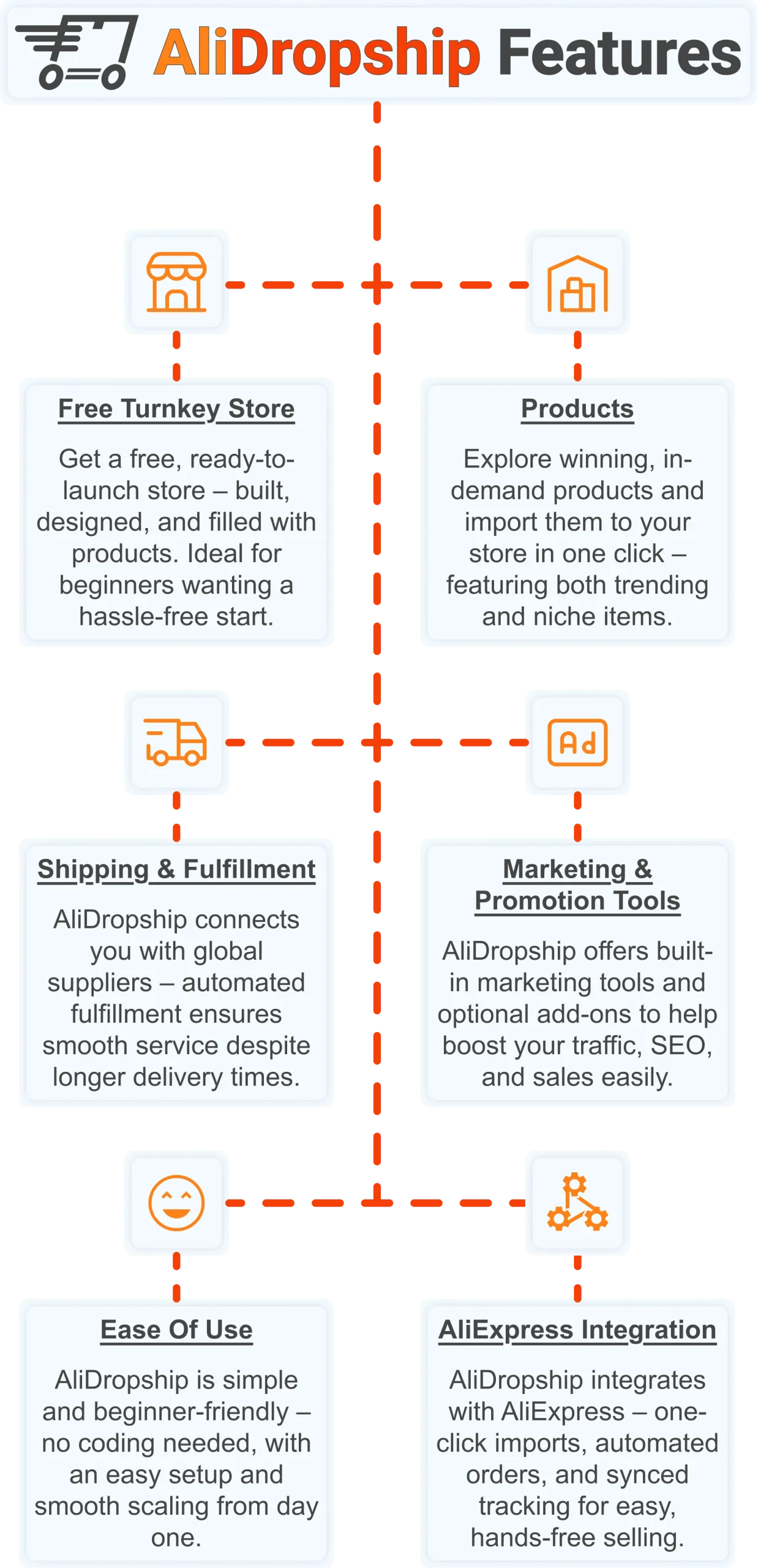
Free turnkey store 🛍️
Get a free turnkey store – built, designed, and filled with products. Ideal for beginners wanting a hassle-free start, the store comes fully optimized to attract customers right away, saving you time on setup. Plus, it includes professional design elements to give your business a polished, trustworthy look from day one. This ready-made foundation makes it easy to move seamlessly into product selection.
Products 📦
Once your store is set up, you can explore winning, in-demand products and import them in one click – featuring both trending and niche items. This wide selection lets you cater to diverse customer interests and test what works best. Regular updates ensure you always have fresh products, keeping your store competitive and relevant. With great products in place, smooth shipping becomes the next essential step.
Shipping & fulfillment 🚚
AliDropship connects you with global suppliers, and automated fulfillment ensures seamless order processing despite international delivery times. Customers receive real-time tracking updates, which builds confidence and trust in your store. Once shipping is handled reliably, you can focus on promoting your store and attracting traffic.
Marketing & promotion tools 📣
To maximize sales, AliDropship offers built-in marketing tools and optional add-ons that help boost traffic, SEO, and conversions. From email campaigns and discounts to social media integration, these tools empower you to reach and retain customers without needing prior marketing experience. With promotion strategies in place, managing your business becomes simpler and more efficient.
Ease of use 👌
AliDropship is beginner-friendly – no coding needed, with an intuitive dashboard that guides you through every step. Easy setup and smooth scaling let you expand your store without stress. As your business grows, adding new features, products, and marketing campaigns remains hassle-free, giving you more time to focus on sales.
AliExpress integration 🛒
Finally, AliDropship integrates seamlessly with AliExpress, enabling one-click imports, automated orders, and synced tracking. Your inventory stays up-to-date with the latest products and prices, while automated order processing frees you from manual tasks. Combined with the turnkey setup, reliable shipping, and built-in marketing tools, this integration ensures your dropshipping business is fully equipped for growth and success.
If you have been looking for a genuine all-in-one ecommerce solution — one that covers everything from store setup to marketing without requiring a team or a technical background — AliDropship is the clearest answer available in 2026. Get your free turnkey store today and start with everything already in place.
What is an all-in-one ecommerce solution?
What is the best all-in-one ecommerce platform for beginners?
How much does it cost to start an online store with an all-in-one ecommerce solution?
Can an all-in-one ecommerce platform replace a full custom tech stack?
How long does it take to make money with an all-in-one ecommerce solution?